

Many marketers believe adding more channels automatically improves customer engagement. This misconception leads to fragmented campaigns that confuse customers rather than guide them. The reality is that multichannel presence without integration creates operational chaos and wasted budgets. Cross channel marketing solves this by orchestrating channels into unified customer journeys. This article explains what cross channel marketing truly means, why it matters for marketing professionals in 2026, and how to leverage it for measurable campaign impact and efficiency gains.
Table of Contents
- Understanding Cross Channel Marketing And Why It Matters
- Common Pitfalls In Channel Management And How To Avoid Them
- How Cross Channel Marketing Drives ROI: Evidence From Recent Success Stories
- Steps To Implement An Effective Cross Channel Marketing Strategy In 2026
- Take Your Cross Channel Marketing To The Next Level With AI-Powered Automation
- What Is The Difference Between Multichannel And Cross Channel Marketing?
- How Do I Measure The Success Of A Cross Channel Marketing Campaign?
- What Are Common Challenges When Implementing Cross Channel Marketing?
- Which Technologies Support Effective Cross Channel Marketing?
Key takeaways
| Point | Details |
|---|---|
| Integration differentiates cross channel from multichannel | Cross channel marketing coordinates channels for seamless customer journeys, while multichannel simply operates multiple independent channels. |
| Fragmentation undermines campaign effectiveness | Adding channels without integration causes redundant steps, inconsistent messaging, and poor customer experiences that damage ROI. |
| Cross channel strategies deliver measurable ROI gains | Real-world implementations show 200% marketing impact increases through unified data and coordinated messaging. |
| Maturity models guide strategic progression | The Multichannel vs Omnichannel CX Maturity Model provides frameworks for assessing and improving channel integration. |
| Technology requires organizational readiness | Successful implementation balances platform adoption with operating model alignment and unified measurement systems. |
Understanding cross channel marketing and why it matters
Cross channel marketing represents coordinated use of multiple marketing channels designed around customer journey touchpoints. Unlike multichannel approaches that operate channels independently, cross channel strategies integrate data, messaging, and timing to create cohesive experiences. This distinction matters because customers expect brands to recognize them regardless of which channel they use.
The difference between multichannel, cross channel, and omnichannel approaches often confuses marketing teams. Multichannel means having presence across email, social media, paid ads, and other platforms without connecting them. Cross channel adds integration layer, sharing customer data and coordinating messages across these platforms. Omnichannel represents the ultimate goal, delivering fully unified, seamless experiences where channel boundaries disappear entirely.
The Multichannel vs Omnichannel CX Maturity Model helps organizations assess how well they deliver seamless customer experiences across channels. This framework evaluates three critical dimensions:
- Technology infrastructure supporting data sharing and channel orchestration
- Operating model including team structures, processes, and governance
- Measurement systems tracking unified customer journeys rather than isolated channel metrics
For medium to large businesses managing complex marketing ecosystems, cross channel marketing improves both customer engagement and operational efficiency. Siloed approaches force customers to repeat information, encounter contradictory offers, and experience disjointed brand interactions. Integrated strategies eliminate these friction points while reducing internal redundancy.
The business case for cross channel marketing strengthens in 2026 as customers interact with brands across more touchpoints than ever. Marketing professionals who unify marketing channels report faster campaign execution, better data insights, and improved conversion rates. The challenge lies not in understanding the concept but in executing the organizational and technical changes required.
"The progression from fragmented multichannel to integrated cross channel marketing requires simultaneous advances in technology, operating model, and measurement. Organizations that focus solely on technology without addressing organizational readiness typically fail to capture the full value."
This reality explains why many marketing teams struggle despite investing in sophisticated platforms. Technology enables integration, but people and processes determine whether that integration actually happens. Marketing leaders must address all three dimensions to achieve sustainable cross channel effectiveness.
Common pitfalls in channel management and how to avoid them
Marketing teams frequently add channels faster than they integrate them, creating operational nightmares that undermine campaign performance. Organizations added channels faster than they integrated them, leading to redundant steps, inconsistent offers, and fragmented service for customers. This pattern repeats across industries as businesses chase the latest platform without addressing underlying integration challenges.
The most common symptoms of poor channel integration include:
- Duplicated marketing steps where teams recreate similar content for each channel independently
- Contradictory messages caused by lack of coordination between channel owners
- Lost customer data when information captured in one channel fails to reach others
- Inconsistent brand voice as different teams manage channels with separate guidelines
- Wasted budget from redundant tools and overlapping campaigns
These problems stem from organizational structures that assign channel ownership to separate teams without requiring collaboration. Email specialists optimize for email metrics, social media managers focus on engagement rates, and paid advertising teams chase click-through rates. Nobody owns the customer journey.

Channel addition without integration causes operational inefficiency that compounds over time. Each new platform requires dedicated resources, separate reporting, and independent optimization. Marketing teams find themselves managing more tools, attending more meetings, and producing more reports while struggling to demonstrate unified impact. Customer experience suffers as people receive duplicate messages, encounter inconsistent offers, and must repeat information across touchpoints.
The solution requires prioritizing operating model and measurement changes alongside technology adoption. Centralized marketing platforms provide technical foundation, but organizational alignment determines whether integration actually happens. Marketing leaders must establish clear governance, shared KPIs, and collaborative workflows that incentivize channel coordination.
Pro Tip: Prioritize a channel integration roadmap using maturity model insights before adding more channels. Assess current integration capabilities across technology, operating model, and measurement dimensions. Identify specific gaps preventing coordination. Address these foundational issues before expanding channel presence. This approach prevents accumulating technical debt and organizational complexity that becomes increasingly difficult to untangle.
The most successful marketing organizations treat marketing channel integration as strategic priority rather than technical project. They invest in change management, redesign incentive structures, and establish executive sponsorship for integration initiatives. These soft factors matter more than platform selection for achieving sustainable cross channel effectiveness.
How cross channel marketing drives ROI: evidence from recent success stories
The business impact of effective cross channel marketing extends beyond theoretical benefits to measurable financial outcomes. A UK retailer increased their marketing impact by 200% and achieved significant ROI optimization using cross channel marketing. This dramatic improvement resulted from consolidating customer data, coordinating messaging across channels, and optimizing campaigns based on unified analytics.
Unified data and coordinated messaging improve customer conversion by eliminating friction points in the buying journey. When customers receive consistent information regardless of channel, they move through consideration stages faster. When marketing systems recognize customers across touchpoints, personalization becomes more accurate and relevant. These improvements compound to drive measurable revenue growth.
Key steps to drive ROI via cross channel marketing:
- Data consolidation across channels creates single customer view enabling accurate personalization and journey tracking
- Personalized and consistent messaging leverages unified data to deliver relevant content at optimal moments
- Measurement and optimization leveraging analytics identifies high-performing patterns and reallocates budget dynamically
- Predictive modeling using machine learning anticipates customer needs and automates personalization at scale
- Continuous testing across channels reveals interaction effects and optimal channel combinations
The financial impact becomes clear when comparing multichannel and cross channel approaches across key metrics:
| Metric | Multichannel Approach | Cross Channel Approach | Improvement |
|---|---|---|---|
| Campaign Launch Time | 4-6 weeks | 1-2 weeks | 60-75% faster |
| Customer Acquisition Cost | Baseline | 25-40% lower | Significant savings |
| Conversion Rate | Baseline | 30-50% higher | Major uplift |
| Marketing ROI | Baseline | 150-200% higher | Dramatic gains |
| Operational Efficiency | Baseline | 35-45% improvement | Substantial boost |
These improvements stem from eliminating redundancy, improving targeting accuracy, and optimizing budget allocation based on unified performance data. Marketing ROI analytics become more sophisticated when tracking customer journeys rather than isolated channel metrics.
Pro Tip: Integrate machine learning to boost ROI by predictive personalization. Modern AI systems analyze customer behavior patterns across channels to predict next best actions, optimal messaging, and ideal timing. This automation scales personalization beyond what manual segmentation achieves while continuously improving through feedback loops.
The UK retailer case demonstrates how prioritizing marketing ROI through integration delivers competitive advantage. Their success required simultaneous investment in technology, process redesign, and team training. The payback period proved short, with measurable improvements appearing within first quarter of implementation.
Marketing leaders seeking scalable marketing growth find cross channel strategies essential for managing increasing complexity without proportional budget increases. Integration enables doing more with existing resources by eliminating waste and improving targeting precision.
Steps to implement an effective cross channel marketing strategy in 2026
Building unified, integrated campaigns requires systematic approach addressing technology, organization, and measurement simultaneously. Marketing professionals can follow this framework to develop effective cross channel capabilities:
- Assess current channel maturity using CX Maturity Model to establish baseline and identify specific integration gaps across technology, operating model, and measurement dimensions
- Align operating model and assign clear roles for channel integration, establishing governance structures that incentivize collaboration over channel-specific optimization
- Consolidate customer data for unified view by implementing customer data platform or integrating existing systems to enable cross-channel recognition and journey tracking
- Implement technology that supports channel orchestration, selecting platforms enabling coordinated campaign execution and unified analytics rather than point solutions
- Design coordinated campaigns with consistent messaging by establishing creative guidelines, approval workflows, and collaboration processes ensuring brand coherence across touchpoints
- Measure outcomes with integrated KPIs across channels, tracking customer journey metrics rather than isolated channel performance to reveal true campaign impact
- Continuously optimize campaigns using analytics and machine learning, establishing feedback loops that improve targeting, messaging, and channel mix based on unified performance data
The Multichannel vs Omnichannel CX Maturity Model evaluates technology, operating model, and measurement to avoid tech-first failures. Organizations that skip operating model and measurement changes find expensive platforms underutilized because teams lack processes and incentives to leverage integration capabilities.
The differences between multichannel, cross channel, and omnichannel approaches become clear when examining implementation requirements:
| Dimension | Multichannel | Cross Channel | Omnichannel |
|---|---|---|---|
| Technology | Separate platforms per channel | Integrated platforms with data sharing | Unified platform with real-time sync |
| Operating Model | Channel-specific teams and KPIs | Coordinated teams with shared goals | Fully unified teams and processes |
| Customer Experience | Fragmented, channel-dependent | Coordinated with some consistency | Seamless, channel-agnostic |
| Data Integration | Minimal or manual | Automated with some latency | Real-time across all touchpoints |
| Implementation Complexity | Low | Moderate | High |
| Time to Value | Fast per channel | Moderate | Longer but highest impact |
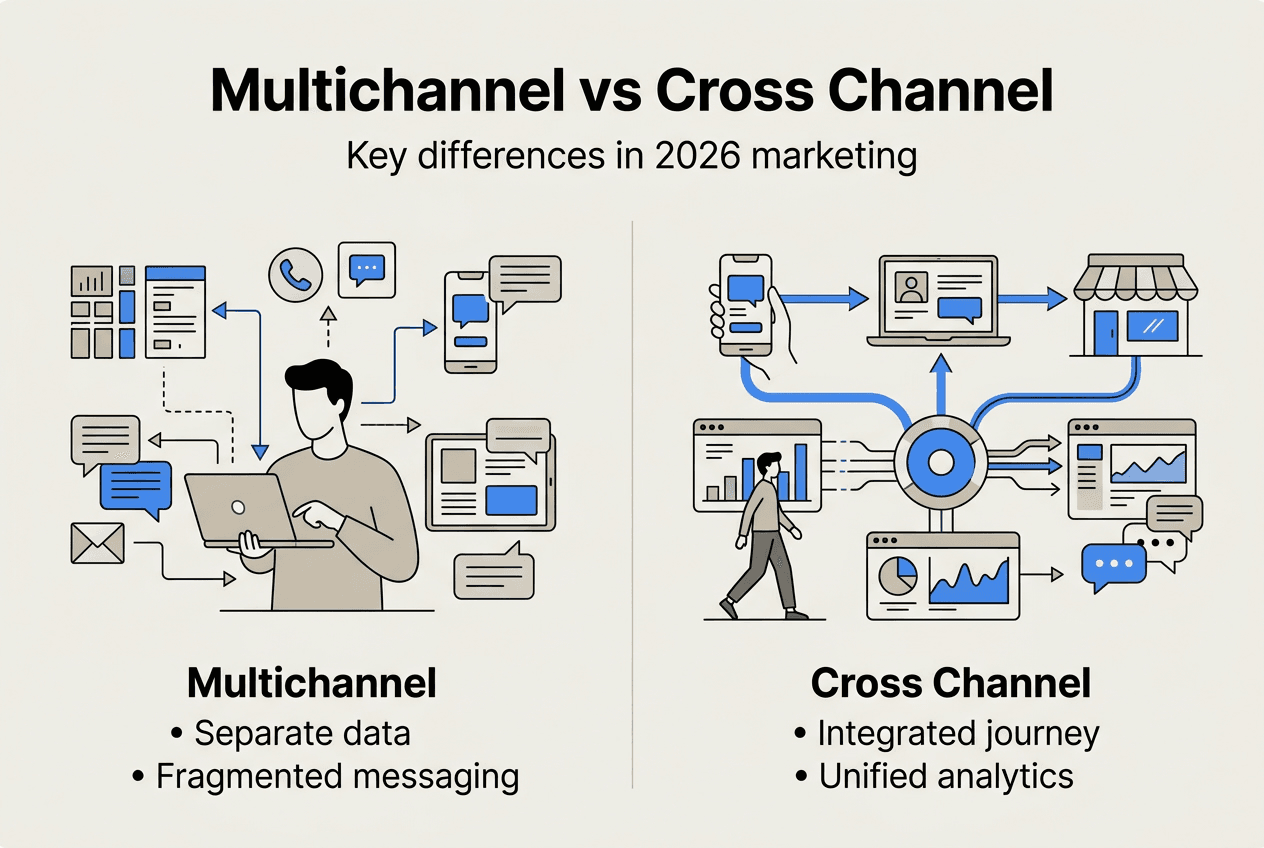
This comparison reveals why cross channel represents practical middle ground for most organizations. Omnichannel perfection requires massive investment in technology and organizational transformation. Cross channel delivers substantial benefits with more manageable implementation requirements.
Balancing technology adoption with organizational readiness prevents failed projects that deliver platforms without usage. Marketing leaders must invest in change management, training, and process redesign alongside platform implementation. The most successful initiatives establish executive sponsorship, dedicate integration resources, and celebrate early wins to build momentum.
Multi-platform marketing becomes manageable when supported by proper infrastructure and processes. Marketing strategies for brand managers increasingly emphasize integration capabilities as competitive differentiator. Organizations that master cross channel coordination gain efficiency advantages that compound over time.
The role of machine learning in marketing ROI grows as data volumes and channel complexity increase. AI systems excel at identifying patterns across channels, optimizing budget allocation, and personalizing at scale. These capabilities become accessible only after establishing unified data foundation through cross channel integration.
Take your cross channel marketing to the next level with AI-powered automation
Implementing the strategic frameworks discussed requires robust technology foundation that simplifies rather than complicates campaign execution. Hukt AI streamlines and unifies cross channel marketing efforts through intelligent automation that handles complexity behind the scenes. The platform enables simultaneous campaign launches across Meta, Google, LinkedIn, and X without platform switching, dramatically reducing the 4-6 week timelines typical of manual multichannel coordination.

Benefits include faster campaign launches through AI-powered content generation, data-driven personalization leveraging unified customer insights, and measurable ROI improvements via real-time analytics dashboards. Marketing professionals gain efficiency advantages that free resources for strategic work rather than operational coordination.
Pro Tip: Combining strategic framework with AI automation maximizes campaign effectiveness and efficiency. Use maturity model assessment to identify integration priorities, then leverage automation platforms to execute coordination at scale. This approach delivers quick wins while building toward comprehensive cross channel capabilities.
Explore Hukt AI to modernize your marketing approach in 2026 and transform cross channel complexity into competitive advantage.
What is the difference between multichannel and cross channel marketing?
Multichannel marketing operates multiple independent channels without coordination, while cross channel marketing integrates these channels around customer journeys. The critical difference lies in data sharing and message coordination. Multichannel teams manage email, social media, and paid advertising separately with channel-specific goals. Cross channel teams coordinate these touchpoints using unified customer data and consistent messaging strategies.
Integration enables recognizing customers across touchpoints, eliminating redundant steps, and delivering coherent brand experiences. Unifying marketing channels transforms disconnected activities into orchestrated journeys that guide customers efficiently through consideration and purchase stages.
How do I measure the success of a cross channel marketing campaign?
Track unified KPIs across channels such as customer lifetime value, conversion rates, and engagement consistency rather than isolated channel metrics. Use analytics platforms that consolidate data for holistic view of customer journeys. Measure how channels work together by tracking assisted conversions, cross-channel attribution, and journey completion rates.
Focus on business outcomes like revenue growth, customer acquisition cost, and marketing ROI rather than vanity metrics like impressions or clicks. Establish baseline performance before integration, then track improvements in efficiency and effectiveness as coordination improves.
What are common challenges when implementing cross channel marketing?
Organizational silos slow integration by creating competing priorities and communication barriers between channel teams. Inconsistent data and technology fragmentation prevent unified customer view necessary for coordination. Insufficient measurement alignment leaves teams optimizing for channel-specific metrics rather than customer journey outcomes.
Channels are often added faster than integrated, causing fragmented customer experiences and redundant steps. Overcoming these challenges requires executive sponsorship, change management investment, and patience as organizational culture adapts. Centralized marketing platforms provide technical foundation, but success depends on addressing people and process dimensions simultaneously.
Which technologies support effective cross channel marketing?
Customer data platforms consolidate information from multiple sources to create unified customer profiles. Marketing automation suites enable coordinated campaign execution across email, social media, and advertising channels. AI-powered orchestration tools optimize messaging, timing, and budget allocation based on performance patterns.
Emphasis should fall on platforms enabling unified data and coordinated messaging rather than best-of-breed point solutions that create integration challenges. AI marketing automation software that combines content generation, campaign orchestration, and analytics in single platform simplifies implementation while accelerating time to value. The right technology reduces rather than increases operational complexity.