

Brand managers at small to medium-sized businesses face a tough decision: which AI marketing strategies truly deliver results within tight budgets and timelines? With limited resources and pressure to prove ROI, choosing the right AI-driven approach can mean the difference between campaign success and wasted spend. This guide helps you evaluate essential criteria, compare proven AI marketing strategies, and select the methods that will accelerate your campaigns, reduce costs, and maximize impact across multiple digital channels.
Table of Contents
- Criteria For Selecting AI-Driven Marketing Strategies
- AI-Driven Content Creation
- Multi-Channel Campaign Automation
- Real-Time Campaign Performance Optimization
- Cost Efficiency Through Marketing Automation
- Use Cases And Practical Recommendations
- Comparative Feature Analysis Of AI Marketing Platforms
- Summary Decision Framework And Situational Picks
- Discover AI Marketing Automation With Hukt.ai
Key takeaways
| Point | Details |
|---|---|
| Selection criteria guide strategy choice | Speed, automation depth, cost efficiency, and analytics capabilities determine the best AI marketing fit for your business needs. |
| AI content creation cuts campaign time in half | Automated content generation reduces creation time by 50% and slashes brand messaging errors by 90%. |
| Multi-platform automation expands reach dramatically | Simultaneous campaign deployment across channels increases reach by 30% and cuts manual workload by 60%. |
| Real-time optimization boosts conversions | Dynamic campaign adjustments using live analytics increase conversion rates by 25% during active campaigns. |
| Cost reductions transform SMB marketing ROI | AI automation reduces marketing costs by 40% and improves return on ad spend by 15%. |
Criteria for selecting AI-driven marketing strategies
Choosing the right AI marketing strategy starts with understanding which factors matter most for your brand. Speed in campaign creation and launch determines how quickly you can respond to market opportunities. If your competitors can launch campaigns in days while you need weeks, you lose momentum.
Multi-platform automation capabilities reduce the manual grind of setting up separate campaigns across Meta, Google, LinkedIn, and X. Quality and consistency of AI-generated content protect your brand integrity while scaling output. Real-time analytics enable you to optimize campaigns dynamically rather than waiting for post-campaign reports.
Cost efficiency and scalability ensure the strategy fits within SMB budgets and grows with your business. Ease of integration with existing marketing tools prevents workflow disruption. Platforms like Hukt.ai consolidate these capabilities, allowing you to manage campaigns from one dashboard rather than juggling multiple tools.
Pro Tip: Prioritize platforms that offer free trials or pilot programs so you can test multi-platform automation and content quality before committing to annual contracts.
When evaluating AI marketing strategies, create a scorecard rating each option on these criteria. Weight the factors based on your current pain points. If manual workload crushes your team, automation depth matters more than advanced analytics. If campaign consistency suffers, prioritize AI content generation quality. Balancing these criteria ensures you select a strategy that solves your specific challenges rather than chasing features you won't use.
AI-driven content creation
AI-powered content generation transforms how brand managers produce campaign assets at scale. Instead of spending hours drafting ad copy variations, social posts, and email campaigns, AI content generation tools create multiple versions in minutes. This automation enables you to test more creative angles and personalize messaging for different audience segments without expanding your team.
The speed gains are substantial. AI reduces campaign creation time by 50%, letting you launch campaigns faster than competitors still relying on manual processes. Quality improves too: brand message errors drop by 90% when AI maintains consistent tone, terminology, and positioning across all assets.
Automated social media scheduling maintains continuous brand presence without daily manual posting. AI tools analyze optimal posting times, suggest content themes, and generate platform-specific formats. Campaign mistakes overall decrease around 30% because AI catches inconsistencies, broken links, and formatting errors before publication.
Pro Tip: Start by using AI for high-volume, lower-risk content like social media posts and ad variations. As you build confidence in output quality, expand to more strategic assets like campaign concepts and landing page copy.
The content creation workflow changes fundamentally. You shift from creator to editor, reviewing and refining AI-generated drafts rather than starting from scratch. This multiplies your output without sacrificing quality. For SMB brand managers wearing multiple hats, this efficiency gain frees time for strategic work like audience research and performance analysis.
Multi-channel campaign automation
Launching campaigns across multiple platforms traditionally requires logging into each advertising system separately, recreating assets in different formats, and manually tracking performance across dashboards. AI-powered multi-platform campaign automation eliminates this friction by enabling simultaneous deployment across Meta, Google, LinkedIn, and X from a single interface.
Multi-platform automation improves campaign reach by 30% by ensuring your message hits all relevant channels at launch rather than rolling out sequentially. Your audience encounters consistent messaging whether they scroll Facebook, search Google, or browse LinkedIn. This unified presence strengthens brand recall and accelerates campaign impact.
The workload reduction is equally impressive. Manual campaign setup time drops by 60% when you configure settings once instead of four times. For SMB brand managers without dedicated teams for each platform, this automation turns complex multi-channel campaigns from overwhelming to manageable.

| Platform | Manual Setup Time | Automated Setup Time | Reach Increase |
|---|---|---|---|
| Meta | 120 min | 45 min | 30% |
| 90 min | 35 min | 25% | |
| 75 min | 30 min | 28% | |
| X | 60 min | 25 min | 22% |
Automation simplifies budget allocation across platforms too. Instead of manually splitting budgets and adjusting bids in each system, AI tools optimize spend based on real-time performance. Underperforming channels automatically receive less budget while top performers scale up. This dynamic allocation maximizes return without constant manual intervention.
Real-time campaign performance optimization
Static campaigns that launch and run unchanged until completion leave money on the table. AI-powered real-time analytics transform campaigns into living systems that adjust messaging, targeting, and bids based on live performance data. This dynamic optimization delivers measurably better results than set-and-forget approaches.
Platforms with real-time analytics increase conversion rates by 25% by identifying winning variations early and shifting budget toward them. If one ad headline outperforms others by 3x in the first 24 hours, the system automatically increases its visibility while testing new alternatives. You maximize results from your best performers while continuously seeking improvements.
User satisfaction runs high for real-time campaign analytics platforms, with ratings averaging 4.7 out of 5. Brand managers appreciate seeing performance updates without waiting for end-of-week reports. Live dashboards show which channels drive conversions, which audiences engage most, and where budget adjustments will have the greatest impact.
This visibility supports smarter data-driven decisions during active campaigns. If LinkedIn generates qualified leads at half the cost of Google, you can reallocate budget immediately rather than discovering the opportunity post-campaign. When seasonal trends shift audience behavior, real-time data lets you adjust messaging before competitors notice the change.
Quick identification of underperforming channels prevents wasted spend. If X engagement drops below thresholds, the system alerts you to investigate or pause activity. For SMB brand managers with limited budgets, this fail-safe protection ensures every dollar works hard. Real-time optimization turns campaign management from periodic check-ins to continuous improvement.
Cost efficiency through marketing automation
Budget constraints define SMB marketing reality. Every dollar must justify itself through measurable returns. AI-driven marketing automation addresses this challenge directly by cutting operational costs while improving campaign performance. The economics shift dramatically when technology handles repetitive tasks formerly requiring human hours.
AI marketing automation reduces marketing costs by 40% by eliminating manual campaign setup, content creation, and performance tracking labor. A brand manager who previously spent 20 hours weekly on routine tasks reclaims that time for strategy and optimization. For small businesses unable to hire full marketing teams, this efficiency multiplier makes sophisticated campaigns feasible.
Performance improvements compound the value. Return on ad spend improves by 15% when integrated tools optimize targeting, messaging, and budget allocation based on data rather than guesswork. Better ROAS means each budget dollar generates more revenue, creating room to scale campaigns or test new channels.
Pricing for cost-efficient AI marketing platforms accommodates SMB budgets, with plans starting around $49 monthly. This entry point provides access to automation capabilities previously available only to enterprises with six-figure marketing technology stacks. Scalable credit systems let you increase usage as campaigns grow without renegotiating contracts or facing surprise bills.
Reduced team size requirements deliver ongoing savings. Instead of hiring specialists for content creation, paid advertising, and analytics, one brand manager using AI tools can handle all three functions. This consolidation cuts salary and benefit costs while maintaining or improving output quality. Automation becomes the force multiplier that lets small teams compete with larger competitors.
Use cases and practical recommendations
Real-world scenarios demonstrate how different AI marketing strategies solve specific brand manager challenges. New product launches benefit enormously from multi-platform campaign automation. By simultaneously announcing across Meta, Google, LinkedIn, and X, you create launch momentum that sequential rollouts cannot match. One SMB saw 35% higher engagement using coordinated AI-powered launches versus their previous staggered approach.
Continuous social media automation suits brands prioritizing consistent audience engagement. AI-scheduled posts maintain daily presence without manual effort, achieving up to 20% higher engagement rates through optimized timing and content variety. This strategy works especially well for B2C brands where regular touchpoints build community and drive repeat purchases.
Tradeoffs exist. Initial setup requires 1 to 3 weeks as you train AI on brand voice, upload assets, and configure platform integrations. During this onboarding period, output may need heavier editing than after the system learns your preferences. However, this upfront investment pays back quickly through sustained efficiency gains.
Select strategies based on your primary needs. If campaign speed matters most, prioritize platforms offering AI marketing use cases with rapid content generation and one-click multi-channel deployment. If budget constraints dominate, focus on automation depth to minimize manual workload. If optimization drives your goals, emphasize real-time analytics and dynamic adjustment capabilities.
Combining AI content creation with real-time analytics delivers the greatest impact for most SMB brand managers. Fast content production gets campaigns live quickly while performance optimization ensures they deliver results. This pairing addresses both efficiency and effectiveness, the dual imperatives of resource-constrained marketing.
Comparative feature analysis of AI marketing platforms
Direct platform comparison clarifies which solutions best match your requirements and constraints. The table below contrasts leading options across critical dimensions brand managers evaluate during selection.
| Platform | Multi-Platform Launch | AI Content Creation | Real-Time Analytics | Starting Price | Best For |
|---|---|---|---|---|---|
| Hukt.ai | Simultaneous across Meta, Google, LinkedIn, X | Advanced with brand voice learning | Live dashboards with dynamic optimization | $49/month | SMBs needing full-stack automation |
| Competitor A | Sequential deployment, manual coordination | Template-based, limited customization | Daily reports, no live updates | $79/month | Brands prioritizing content templates |
| Competitor B | Single platform focus | Basic AI assistance | Weekly summaries | $29/month | Budget-conscious single-channel marketers |
Hukt.ai excels at simultaneous cross-channel campaign launches, eliminating the platform-switching hassle that consumes hours weekly. Its content creation adapts to your brand voice over time, producing increasingly on-target copy as it learns. Real-time dashboards provide the performance visibility needed for mid-campaign optimization.
Competitor A offers solid template libraries but lacks true multi-platform coordination, forcing you to deploy campaigns separately. Its delayed reporting limits optimization opportunities during active campaigns. Competitor B serves budget-conscious marketers well but cannot support complex multi-channel strategies or provide the real-time insights that drive conversion improvements.
User ratings favor platforms with integrated real-time analytics, reflecting the value brand managers place on actionable insights. Platforms averaging 4.5+ stars typically combine automation depth with performance transparency. Compare AI marketing platforms side by side to evaluate which features justify pricing differences for your situation.
Decision factors include required features, budget, and growth plans. If you currently run single-platform campaigns but plan to expand, choose a platform supporting future channels even if you don't use them immediately. If your team lacks technical skills, prioritize intuitive interfaces over feature breadth. Match platform capabilities to your actual needs rather than aspirational ones.
Summary decision framework and situational picks
Synthesizing all insights into actionable steps helps you confidently select AI marketing strategies and platforms. Follow this framework to match solutions to your priorities.
- Define your primary goal: campaign speed, cost reduction, or conversion optimization. This focus narrows viable options.
- Assess current pain points. If manual workload crushes your team, automation depth matters most. If inconsistent messaging hurts your brand, prioritize AI content quality.
- Evaluate budget constraints. Calculate total cost including platform fees and implementation time. Ensure projected savings or revenue gains justify the investment.
- Test before committing. Use free trials to validate content quality, interface usability, and integration ease with your existing tools.
- Plan for onboarding. Allocate 1 to 3 weeks for setup, training, and workflow adjustment. Rushed implementations undermine adoption and results.
- Maintain human oversight. AI handles execution but you provide strategy, brand judgment, and creative direction. Review outputs regularly and refine prompts to improve quality.
- Track performance metrics. Monitor campaign speed, cost per acquisition, and conversion rates to quantify AI impact. Adjust strategy based on data rather than assumptions.
Pro Tip: Start with one AI marketing capability, master it, then expand. Trying to automate everything simultaneously often leads to poor results and team frustration. Build confidence incrementally.
For brand managers prioritizing speed, choose platforms enabling simultaneous multi-platform deployment. If cost efficiency drives decisions, select tools with strong automation reducing manual hours. When optimization matters most, AI marketing decision framework platforms with real-time analytics deliver measurable conversion improvements. Regularly review performance and recalibrate AI usage as your business grows and marketing needs evolve.
Discover AI marketing automation with Hukt.ai
Transform your marketing operations with a platform built specifically for brand managers who need results without enterprise budgets or teams. Hukt.ai AI marketing automation delivers seamless multi-platform campaign launching, advanced AI content creation, and real-time analytics that empower dynamic optimization to increase ROI.
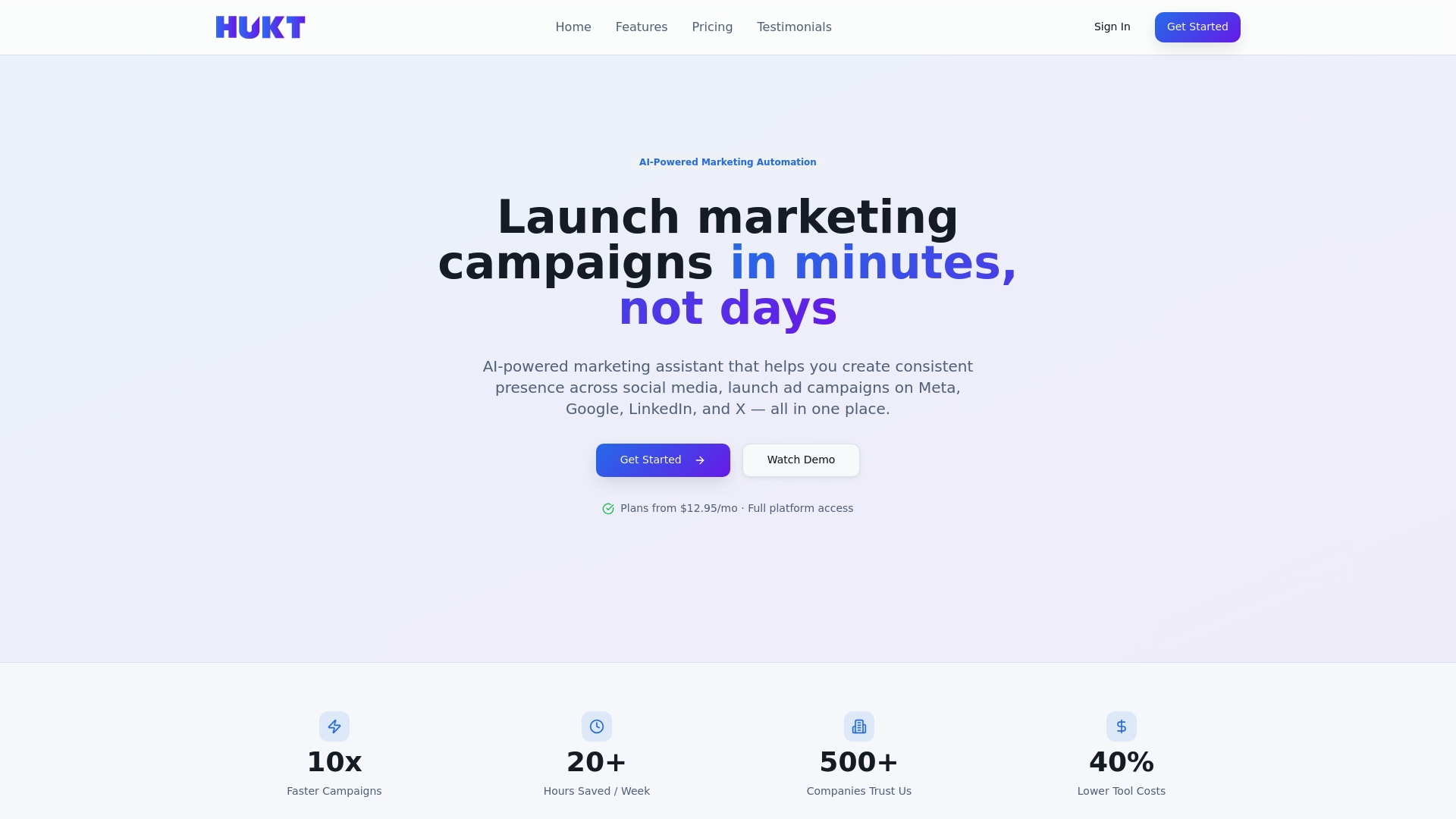
Launch coordinated campaigns across Meta, Google, LinkedIn, and X simultaneously from one intuitive dashboard. AI-generated content maintains your brand voice while cutting creation time in half. Live performance dashboards show exactly which channels and messages drive conversions, enabling mid-campaign adjustments that maximize results.
Affordable pricing starts at $49 monthly with scalable plans that grow with your business. No long-term contracts lock you in. Trusted by brand managers at hundreds of SMBs to reduce workload while boosting campaign impact. Visit Hukt.ai today to streamline your AI-powered marketing and see measurable results within weeks.
FAQ
What are the main benefits of AI-driven marketing for SMB brand managers?
AI marketing speeds up campaign creation by 50%, reduces operational costs by 40%, and improves conversion rates by 25% through real-time optimization. It helps SMBs maximize limited resources with automation that handles repetitive tasks while analytics guide strategic decisions. Brand managers reclaim time for high-value work while campaigns deliver better results.
How do AI marketing platforms improve campaign consistency?
AI-generated content minimizes brand message errors by 90% by maintaining consistent tone, terminology, and positioning across all assets. Automated scheduling ensures continuous, uniform social presence without gaps or off-brand posts. This consistency strengthens brand recognition and trust while reducing the quality control burden on small teams.
Is AI marketing automation affordable for small businesses?
Many affordable AI marketing tools offer plans starting at $49 monthly, making sophisticated automation accessible to SMBs. Automated workflows can reduce marketing costs by up to 40% by eliminating manual labor and improving campaign performance. The return on investment typically appears within the first quarter as efficiency gains and better results compound.
What initial steps should brand managers take when adopting AI marketing?
Start by defining campaign goals and resource limits to identify which AI capabilities will deliver the greatest impact. Pilot AI content generation and multi-channel automation on a single campaign before full implementation. Plan for 1 to 3 weeks of onboarding and maintain human oversight to guide strategy while AI handles execution. Getting started with AI marketing requires patience during setup but delivers sustained efficiency gains afterward.