

Marketing teams waste an average of 26% of their advertising budget due to misinterpreted analytics data, according to recent industry research. The problem isn't a lack of information but rather how organizations interpret and apply their marketing data. Many professionals believe more data automatically translates to better campaign performance, yet this assumption leads to analysis paralysis and strategic missteps. Understanding how to leverage analytics correctly transforms marketing from guesswork into a science, enabling precise optimization that drives measurable ROI improvements. This guide reveals how marketing professionals and agency owners can harness analytics effectively in 2026 to eliminate waste, improve attribution accuracy, and make data informed decisions that directly impact bottom line results.
Table of Contents
- Why Analytics Is The Cornerstone Of Marketing Success In 2026
- Attribution Modeling: Understanding The Customer Journey Beyond Last-Touch
- Common Analytics Pitfalls That Hinder Marketing ROI And How To Avoid Them
- Leveraging AI-Driven Analytics For Smarter Campaign Optimization
- Explore AI Marketing Automation Software To Maximize Your Analytics ROI
- Frequently Asked Questions
Key takeaways
| Point | Details |
|---|---|
| ROI improvement potential | Clear data and analytics usage can lift campaign ROI by up to 30% through precise optimization. |
| Attribution accuracy | Multi-touch attribution provides a fuller understanding of customer journeys than last-touch models by crediting all touchpoints. |
| Tracking integrity | Fixing tracking errors prevents budget misallocation and improves campaign accuracy by ensuring data reliability. |
| Metric prioritization | Prioritizing meaningful metrics over vanity metrics drives better business decisions tied to revenue and customer lifetime value. |
| AI-powered insights | AI-driven analytics help uncover the 'why' behind customer behavior for smarter marketing strategies and faster optimizations. |
Why analytics is the cornerstone of marketing success in 2026
Analytics fundamentally reshapes how marketing teams allocate budgets, measure campaign effectiveness, and optimize for revenue growth. Marketing teams with high data clarity outperform others by 20-30% in campaign ROI through precise optimization, demonstrating that quality interpretation matters more than raw data volume. The misconception that collecting more data automatically improves marketing performance creates a dangerous trap for organizations.
Successful marketing analytics requires interpretation frameworks that transform raw numbers into actionable strategies. Without proper context and analysis methodology, even comprehensive datasets fail to deliver meaningful insights. The role of data in marketing 2026 extends beyond simple collection to encompass strategic application that drives business outcomes.
Prioritizing actionable metrics tied directly to business outcomes separates high-performing marketing teams from those drowning in vanity metrics. Consider these essential focus areas:
- Revenue attribution and customer acquisition cost
- Customer lifetime value and retention rates
- Conversion funnel efficiency and drop-off points
- Channel-specific ROI and budget allocation effectiveness
Common pitfalls include drowning in data overload without clear prioritization frameworks and misusing metrics by tracking impressions instead of conversions. Marketing professionals must develop disciplined approaches to metric selection, focusing exclusively on measurements that inform strategic decisions and budget allocation.
Expert insight: The future of marketing is using analytics to understand the 'why' behind customer behavior, not just the 'what' happened.
This perspective shift from descriptive to diagnostic analytics enables marketing teams to anticipate customer needs, personalize experiences effectively, and allocate resources to high-impact channels. Smart data usage uncovers behavioral patterns that inform creative strategy, messaging refinement, and channel optimization in ways that surface-level metrics never reveal.
Attribution modeling: understanding the customer journey beyond last-touch
Attribution modeling determines how marketing teams assign credit for conversions across multiple customer touchpoints, directly impacting budget allocation decisions and campaign optimization strategies. The choice between attribution models fundamentally alters your understanding of which channels drive results and deserve increased investment.

Last-touch attribution assigns 100% credit to the final touchpoint, ignoring earlier interactions that influenced the customer journey. This oversimplified approach creates blind spots in marketing strategy by undervaluing awareness and consideration-stage channels that initiate customer relationships. A prospect might discover your brand through social media, research via organic search, engage with email nurture campaigns, and finally convert through a paid search ad, yet last-touch attribution credits only that final click.
Multi-touch attribution provides proportional credit across the customer journey, recognizing that conversions result from cumulative touchpoint exposure rather than single interactions. This methodology reveals the true value of each marketing channel and enables sophisticated budget optimization. Companies using multi-touch attribution saw a 15% improvement in marketing efficiency by reallocating budgets based on comprehensive journey analysis rather than final-click data alone.
Despite clear advantages, 73% of organizations still rely on last-click attribution, risking distorted strategy and misallocated budgets. This persistence stems from implementation complexity and organizational resistance to changing established measurement frameworks. However, the competitive disadvantage of ignoring mid-funnel touchpoints grows as customer journeys become increasingly complex across digital channels.
| Attribution Model | Credit Distribution | Best Use Case | Limitation |
|---|---|---|---|
| Last-touch | 100% to final touchpoint | Simple, short sales cycles | Ignores journey complexity |
| First-touch | 100% to initial touchpoint | Brand awareness focus | Overlooks conversion drivers |
| Linear | Equal credit to all touchpoints | Balanced journey view | Oversimplifies touchpoint impact |
| Time-decay | More credit to recent touchpoints | Considers recency effect | May undervalue early awareness |
| Position-based | 40% first, 40% last, 20% middle | Highlights journey endpoints | Arbitrary credit assignment |
Multi-touch attribution helps allocate budget effectively by revealing which channels contribute most significantly at different journey stages. Marketing teams can then invest appropriately in awareness channels that initiate relationships, consideration channels that nurture prospects, and conversion channels that close deals. This nuanced understanding supports pipeline growth by optimizing the entire funnel rather than just the final step.
Implementing effective attribution requires integrating data across platforms, establishing consistent tracking parameters, and selecting models that align with your specific sales cycle and customer behavior patterns. The marketing efficiency in 2026 depends heavily on attribution accuracy that informs strategic decisions.
Pro Tip: Combine attribution insights with contextual campaign data like creative messaging, audience segments, and seasonal factors to understand not just which channels work but why they perform differently across contexts.
Common analytics pitfalls that hinder marketing ROI and how to avoid them
Flawed analytics implementations sabotage marketing performance even when teams invest heavily in measurement infrastructure and analysis resources. The most damaging issues stem from technical tracking problems that corrupt data integrity, rendering subsequent analysis unreliable regardless of analytical sophistication.
Data overwriting and broken tracking workflows cause inaccurate ROI measurement by corrupting the attribution data marketing teams rely on for optimization decisions. In one documented case, 19 separate workflows were overwriting UTM parameters, making it impossible to accurately assess ROI across different campaigns and channels. When tracking parameters get overwritten, marketing teams attribute conversions to incorrect sources, leading to budget misallocation and strategic errors.
Such errors lead to budget misallocation and misguided optimizations that compound over time. A team might dramatically increase spend on a channel that appears highly effective due to corrupted attribution data, while simultaneously cutting budget from truly high-performing channels that tracking errors make invisible. This creates a vicious cycle where bad data drives bad decisions that worsen overall marketing performance.
Preventing and correcting analytics pitfalls requires systematic approaches:
- Conduct comprehensive tracking audits quarterly to identify parameter overwriting, broken pixels, and inconsistent naming conventions across campaigns.
- Implement automated monitoring systems that alert teams immediately when tracking anomalies occur, enabling rapid correction before significant data corruption.
- Establish clear data governance protocols defining UTM parameter structures, naming conventions, and approval workflows for campaign setup.
- Validate data accuracy by comparing analytics platform reports against actual business outcomes like revenue, leads, and customer acquisition.
- Document all tracking implementations and changes in centralized repositories accessible to marketing, analytics, and technical teams.
- Test tracking implementations in staging environments before launching campaigns to catch errors proactively.
Clear data governance and continuous monitoring form the foundation of reliable analytics. Organizations must treat data quality as a critical operational priority rather than an occasional audit activity. The investment in robust tracking infrastructure and governance pays dividends through improved decision quality and eliminated waste from misallocated budgets.
Marketing teams should also reduce marketing costs with AI by automating error detection and correction workflows that traditionally require manual monitoring. Automated systems can flag anomalies like sudden traffic source shifts, conversion rate changes, or parameter inconsistencies that indicate tracking problems requiring immediate attention.
Pro Tip: Automate checks for data integrity within analytics workflows by setting up alerts for unusual patterns like zero values in critical fields, dramatic traffic source shifts, or conversion tracking gaps that signal implementation problems.
Leveraging AI-driven analytics for smarter campaign optimization
AI-powered analytics transform marketing by processing vast datasets at speeds impossible for human analysts, revealing patterns and insights that inform strategic decisions and tactical optimizations. Traditional analytics tools require manual hypothesis formation and testing, while AI systems automatically identify correlations, predict outcomes, and recommend actions based on comprehensive data analysis.
AI analyzes vast datasets quickly to reveal actionable insights by processing millions of data points across channels, campaigns, customer segments, and time periods simultaneously. This computational power enables marketers to understand complex interactions between variables like creative elements, audience characteristics, timing factors, and competitive dynamics that influence campaign performance. Machine learning algorithms detect subtle patterns that human analysts might miss, such as micro-segments with disproportionately high conversion rates or specific creative combinations that resonate with particular audience subsets.
AI-powered segmentation creates hyper-targeted audience groups based on behavioral patterns, purchase history, engagement signals, and predictive lifetime value scores. Rather than relying on broad demographic categories, AI identifies behavioral cohorts that share similar conversion propensities and respond to specific messaging approaches. This granular segmentation enables personalization at scale, delivering tailored experiences that dramatically improve engagement and conversion rates.
Predictive analytics forecast future customer behavior, campaign performance, and market trends based on historical patterns and current signals. Marketing teams can anticipate which prospects are most likely to convert, which customers face churn risk, and which channels will deliver optimal ROI under different budget scenarios. These predictions inform proactive strategy adjustments rather than reactive responses to performance declines.
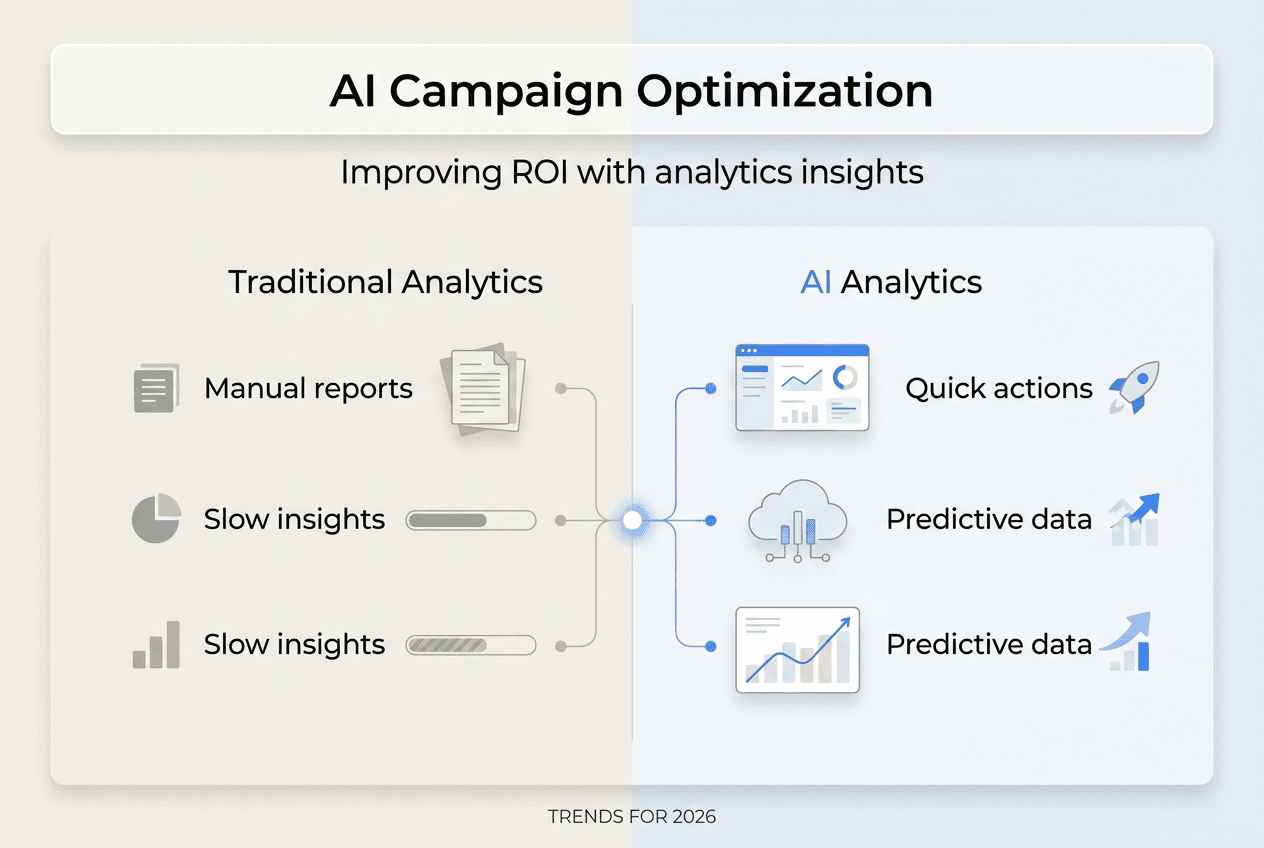
| Optimization Approach | Traditional Analytics | AI-Driven Analytics |
|---|---|---|
| Data processing speed | Hours to days for complex analysis | Real-time insights from millions of data points |
| Pattern recognition | Manual hypothesis testing | Automatic anomaly and opportunity detection |
| Personalization scale | Broad segments (demographics) | Individual-level behavioral predictions |
| Optimization frequency | Weekly or monthly reviews | Continuous automated adjustments |
| ROI improvement potential | 10-15% through manual optimization | Up to 30% through intelligent automation |
Benefits include better forecasting that enables proactive budget allocation, faster adjustments that capitalize on emerging opportunities before competitors, and improved ROI reaching up to 30% through intelligent optimization. AI systems continuously learn from new data, refining their models and recommendations as market conditions evolve and customer behaviors shift.
Marketing professionals can implement AI analytics strategies through:
- Deploying machine learning marketing roi boost 2026 platforms that automate bid optimization, budget allocation, and creative testing across channels.
- Integrating predictive lead scoring models that prioritize sales follow-up based on conversion probability rather than arbitrary qualification criteria.
- Implementing AI-powered content recommendation engines that personalize website experiences, email campaigns, and ad creative based on individual behavioral signals.
- Utilizing natural language processing to analyze customer feedback, reviews, and support interactions for sentiment insights that inform messaging strategy.
- Adopting automated reporting dashboards that surface anomalies, opportunities, and performance trends without manual analysis effort.
The AI ad campaign strategy 2026 landscape emphasizes integration between creative development, audience targeting, and performance optimization through unified AI platforms. Rather than treating these functions separately, leading marketers leverage AI systems that optimize holistically across the entire campaign lifecycle from concept through conversion.
Explore AI marketing automation software to maximize your analytics ROI
Transforming analytics insights into optimized campaigns requires platforms that integrate data intelligence with execution capabilities across channels. Marketing teams struggle to manually implement optimization recommendations across Meta, Google, LinkedIn, and X while maintaining creative consistency and tracking accuracy.
AI marketing automation software consolidates campaign management, creative generation, and performance analytics into unified workflows that eliminate platform switching and reduce implementation complexity. These solutions help avoid analytics pitfalls through automated tracking validation and improve attribution accuracy with consistent parameter implementation across all campaigns and channels.
The role of data in marketing 2026 extends beyond measurement to encompass intelligent automation that applies insights instantly. Rather than analyzing performance reports and manually adjusting campaigns, AI-powered platforms continuously optimize based on real-time data signals. This approach dramatically reduces the time between insight and action, capturing opportunities that disappear when optimization cycles take days or weeks.
Implementing AI ad campaign strategy 2026 frameworks through automation platforms enables marketing teams to scale personalization, maintain consistent brand messaging, and optimize performance without proportional increases in team size or operational complexity.
Pro Tip: Integrate AI automation tools early in your marketing technology stack to realize full ROI potential, as delayed adoption creates data silos and workflow inefficiencies that compound over time.
Frequently asked questions
What is the role of analytics in marketing?
Analytics enables marketing teams to measure campaign effectiveness, understand customer behavior patterns, and optimize budget allocation based on performance data rather than assumptions. It transforms marketing from intuition-based to evidence-based decision making, revealing which channels, messages, and tactics drive measurable business outcomes like revenue growth and customer acquisition.
What is the difference between last-touch and multi-touch attribution?
Last-touch attribution assigns 100% conversion credit to the final customer touchpoint before purchase, while multi-touch attribution distributes credit across all interactions throughout the customer journey. Multi-touch models provide more accurate insights into how awareness and consideration channels contribute to conversions, enabling better budget allocation across the entire marketing funnel rather than over-investing in final-click channels.
How do tracking errors impact marketing ROI measurement?
Tracking errors like overwritten UTM parameters and broken pixels corrupt attribution data, causing marketing teams to misidentify which campaigns and channels drive conversions. This leads to budget misallocation where teams increase spend on channels that appear effective due to corrupted data while cutting investment from truly high-performing sources, creating a cycle of declining overall marketing effectiveness.
Why is AI important for marketing analytics in 2026?
AI processes vast datasets at speeds impossible for human analysts, automatically identifying patterns, predicting customer behavior, and recommending optimizations that improve campaign performance. It enables real-time personalization at scale, predictive forecasting that informs proactive strategy, and continuous optimization that adapts to changing market conditions faster than manual analysis cycles allow.
How can marketing teams improve their analytics accuracy?
Teams should conduct quarterly tracking audits to identify implementation errors, establish clear data governance protocols for consistent parameter usage, and implement automated monitoring systems that alert when anomalies occur. Validating analytics reports against actual business outcomes like revenue and comparing data across multiple sources helps identify discrepancies that indicate tracking problems requiring correction.
What metrics should marketing professionals prioritize for ROI optimization?
Focus on revenue attribution, customer acquisition cost, lifetime value, conversion funnel efficiency, and channel-specific ROI rather than vanity metrics like impressions or page views. These business-outcome metrics directly inform budget allocation decisions and strategic priorities, enabling optimization that improves bottom-line results rather than superficial engagement numbers that lack clear business value.