

Most marketing professionals believe scaling campaigns means spending more money. This assumption leads agencies to balloon budgets without improving efficiency, only to watch ROI stagnate or decline. The reality is that scalable marketing powered by AI transforms growth by reducing operational costs while expanding reach. This guide explains why scalable marketing matters and how to leverage AI automation to achieve measurable, cost-effective growth in 2026.
Table of Contents
- What Is Scalable Marketing And Why It Matters
- How AI Drives Scalable Marketing Success
- Measuring And Maximizing ROI In Scalable Marketing
- Implementing Scalable Marketing Strategies In Your Agency
- Elevate Your Marketing With AI Automation Software
- Frequently Asked Questions About Scalable Marketing
Key takeaways
| Point | Details |
|---|---|
| AI enables efficient scaling | Scalable marketing uses AI to increase campaign reach while lowering operational costs and manual workload. |
| Strategy comes first | Clear objectives, clean data infrastructure, and upskilled teams are essential foundations for successful implementation. |
| Agentic AI accelerates ROI | Autonomous AI workflows execute tasks independently, delivering faster results and freeing teams for strategic work. |
| SEO and email lead returns | Among scalable channels, SEO offers 748% ROI and email marketing delivers 261% returns on investment. |
| Partnership accelerates growth | Working with AI-powered platforms and agencies speeds up adoption and maximizes efficiency gains. |
What is scalable marketing and why it matters
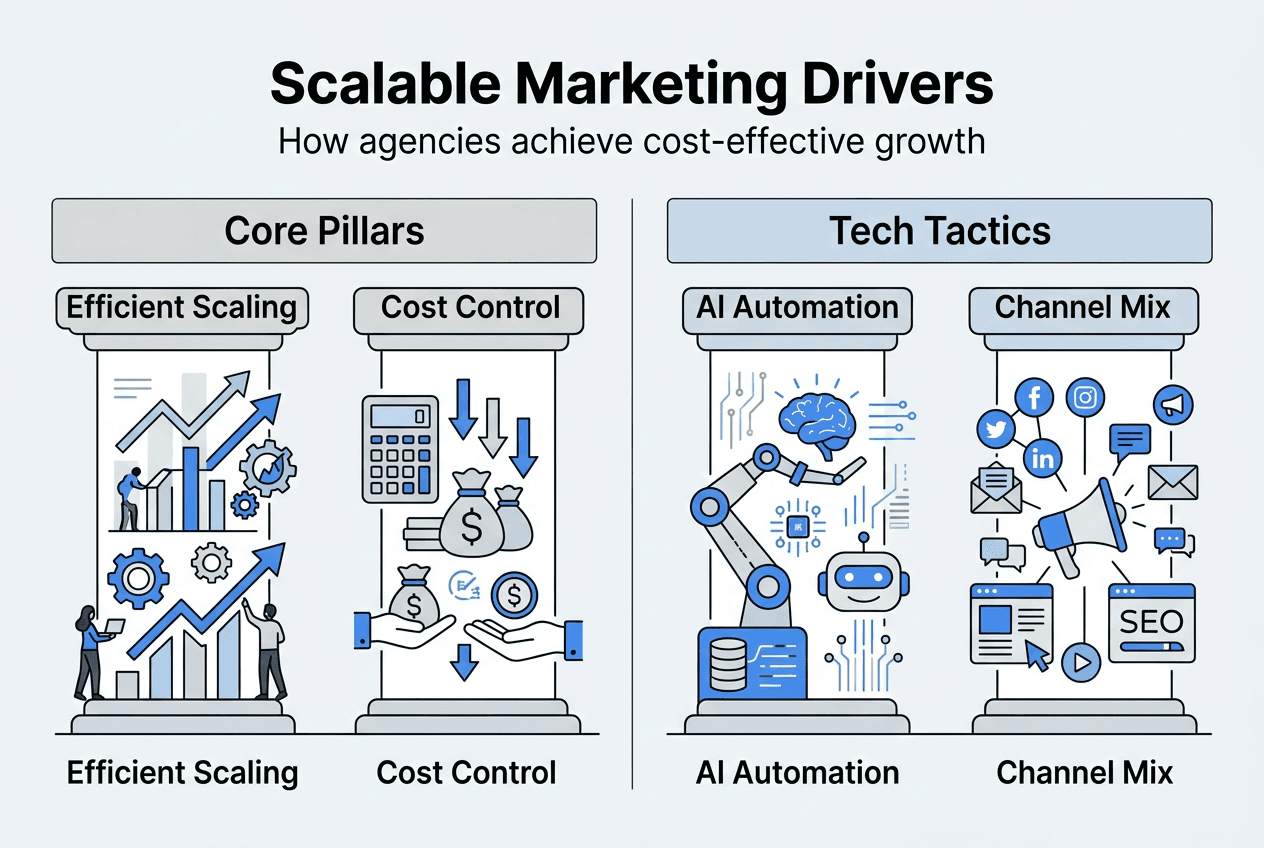
Scalable marketing involves expanding campaigns efficiently without proportionally increasing resources, time, or budget. Traditional scaling approaches create a linear relationship between growth and costs. You double your ad spend, you double your team size, you double your operational expenses. This model quickly becomes unsustainable for agencies and marketing professionals seeking profitable growth.
AI-powered automation fundamentally changes this equation by reducing manual tasks and enabling real-time insights across multiple channels simultaneously. Instead of hiring three specialists to manage campaigns on Meta, Google, and LinkedIn separately, AI systems coordinate these efforts through unified workflows. The technology handles repetitive execution while marketers focus on strategy and creative direction.
The benefits of scalable marketing extend beyond simple cost reduction:
- Cost savings: Automation eliminates redundant manual processes, reducing labor expenses by up to 40% while maintaining or improving output quality.
- Faster deployment: Campaigns launch across multiple platforms simultaneously instead of sequentially, cutting time to market from weeks to days.
- Precision targeting: AI analyzes customer data patterns humans miss, improving audience segmentation and personalization at scale.
- Agile optimization: Real-time performance monitoring enables immediate adjustments, preventing wasted spend on underperforming creative or targeting.
For marketing professionals aiming to boost effectiveness while controlling budgets, scalable marketing supports three critical business goals: profitability through efficient resource allocation, agility in responding to market changes, and data-driven decision making that replaces guesswork with measurable insights. Understanding what AI marketing truly means helps agencies position themselves for sustainable growth rather than unsustainable expansion.
How AI drives scalable marketing success
Agentic AI represents the next evolution beyond simple automation tools. These systems actively execute tasks, decompose complex goals into actionable steps, and use APIs to interact with marketing platforms autonomously. Unlike basic automation that follows rigid if-then rules, agentic AI adapts its approach based on performance data and changing conditions.
The most significant ROI from AI comes from areas many marketers overlook:
- Predictive analytics: AI models forecast customer behavior, campaign performance, and market trends with accuracy that improves continuously as data accumulates.
- Attribution modeling: Multi-touch attribution across channels becomes feasible at scale, revealing which touchpoints genuinely drive conversions versus those receiving undeserved credit.
- Campaign reporting: Automated dashboards aggregate data from disparate sources, eliminating hours of manual spreadsheet work and reducing reporting errors.
- Real-time optimization: AI systems adjust bids, budgets, and creative rotation based on performance signals faster than human teams can process information.
Research confirms that analytics, reporting, attribution, and predictive modeling deliver greater returns than content generation alone. While AI-written ad copy attracts attention, the backend intelligence optimizing spend allocation and audience targeting produces measurable revenue impact.
AI reduces human error and accelerates campaign deployment, but complete automation without oversight creates new risks. Smart agencies maintain quality control by having team members review approximately 20% of AI output, focusing verification efforts on high-stakes deliverables and customer-facing content. This balanced approach captures efficiency gains while preserving brand integrity.
"Agentic-first agencies design every service around autonomous AI agent workflows, fundamentally rethinking how marketing services are delivered and priced."
The shift toward agentic AI workflows enables new business models. Unit-based pricing replaces traditional hourly billing because AI systems complete tasks in minutes that previously required hours. Clients pay for outcomes and deliverables rather than time spent, aligning incentives and making costs more predictable.
Pro Tip: Start with one high-volume, repetitive process like social media scheduling or reporting. Automate this completely before expanding to more complex workflows. Early wins build team confidence and demonstrate ROI to stakeholders.
Understanding automation's role in ad campaigns helps marketing professionals identify which processes offer the greatest efficiency gains. Focus automation efforts where volume is high, decisions are data-driven, and speed matters most.

Measuring and maximizing ROI in scalable marketing
Understanding ROI benchmarks helps agencies set realistic goals and allocate budgets effectively across channels. Marketing professionals need concrete data to justify investments and optimize strategies based on performance rather than assumptions.
Recent industry analysis reveals stark differences in channel performance:
| Channel | Average ROI | Key Success Factor |
|---|---|---|
| SEO | 748% | Long-term compound growth |
| Email Marketing | 261% | Segmentation and personalization |
| Webinars | 213% | High-intent audience engagement |
| Content Marketing | 189% | Consistent publishing and distribution |
| Paid Search | 156% | Precise targeting and bid management |
These B2B marketing ROI benchmarks demonstrate why scalable marketing strategies prioritize channels with compounding returns. SEO and email marketing scale efficiently because incremental effort produces disproportionate results over time. A well-optimized article continues attracting qualified traffic for years. A segmented email list enables personalized campaigns at minimal marginal cost per recipient.
AI and machine learning improve ROI across all channels by 20-30% through several mechanisms:
- Predictive lead scoring: AI identifies prospects most likely to convert, allowing sales teams to prioritize high-value opportunities.
- Dynamic content personalization: Systems automatically customize messaging based on user behavior, industry, company size, and engagement history.
- Budget optimization: Machine learning algorithms shift spend toward high-performing campaigns and away from underperformers faster than manual analysis allows.
- Churn prediction: AI flags at-risk customers before they leave, enabling proactive retention efforts.
Data-driven decision making prevents blind spending and accelerates revenue pipeline development. Instead of allocating budgets based on last year's plan or executive intuition, scalable marketing relies on performance data to guide resource allocation. This approach requires robust analytics infrastructure and team members who understand how to interpret insights correctly.
Pro Tip: Establish clear attribution windows for each channel before measuring ROI. SEO typically requires 6-12 months to show full impact, while paid search delivers immediate but potentially less durable results. Comparing channels without accounting for these timing differences leads to flawed conclusions.
Continual measurement and adjustment are critical for scalable growth. Set monthly review cycles to analyze performance trends, identify optimization opportunities, and reallocate resources toward highest-ROI activities. Marketing professionals who understand how to prioritize efficiency outperform those who simply increase spending. The relationship between machine learning and ROI becomes clearer when you track specific metrics over time rather than relying on vanity numbers.
Implementing scalable marketing strategies in your agency
Adopting scalable marketing requires strategic planning and operational changes beyond simply purchasing new software. Agencies that rush implementation without proper foundation work often struggle with data quality issues, team resistance, and disappointing results.
Start with clear objectives and data infrastructure. Before implementing AI tools, answer these questions:
- What specific outcomes do we want to improve? (lead volume, conversion rates, customer acquisition cost, campaign velocity)
- Do we have clean, accessible data across all marketing channels?
- Can our current systems integrate with AI platforms through APIs?
- Which team members will champion adoption and train others?
Research shows that lack of clear strategy before implementing AI ranks among the most common pitfalls. Define goals explicitly, ensure data readiness, and invest in upskilling team members who will work with new systems daily. Technical capabilities matter less than strategic clarity and organizational readiness.
Invest in team training to handle AI tools effectively. Marketing professionals need to understand what AI can and cannot do, how to evaluate output quality, and when human judgment should override automated recommendations. Training should cover:
- Prompt engineering for content generation tools
- Interpreting AI-generated analytics and recommendations
- Quality assurance processes for automated output
- Ethical considerations and bias detection
Transition gradually to agentic AI models over 6-12 months. Existing agencies can evolve their operations incrementally rather than attempting overnight transformation. Begin with one service line or client segment, prove the model works, then expand systematically. This phased approach reduces risk and allows teams to build competence progressively.
Maintain human verification to ensure quality and relevance. Even sophisticated AI systems occasionally produce outputs that miss context, violate brand guidelines, or contain factual errors. Establish review protocols that balance efficiency with quality control. High-stakes content like client presentations and major campaign launches warrant more scrutiny than routine social posts.
Leverage multi-channel automation for faster campaign launches and improved coordination. Multi-platform marketing automation eliminates the inefficiency of managing each channel separately. Unified systems ensure consistent messaging, coordinated timing, and comprehensive performance tracking across Meta, Google, LinkedIn, and other platforms simultaneously. Marketing professionals exploring effective strategies for brand managers find that integrated automation delivers better results than siloed channel management.
Elevate your marketing with AI automation software
Implementing the strategies outlined above requires the right technology foundation. AI automation software helps you launch campaigns faster, reduce operational costs, and achieve the scalable growth this guide describes. Platforms like Hukt AI support agentic workflows and data-driven optimization, consolidating creative generation, multi-platform campaign management, and real-time analytics into a single unified system.
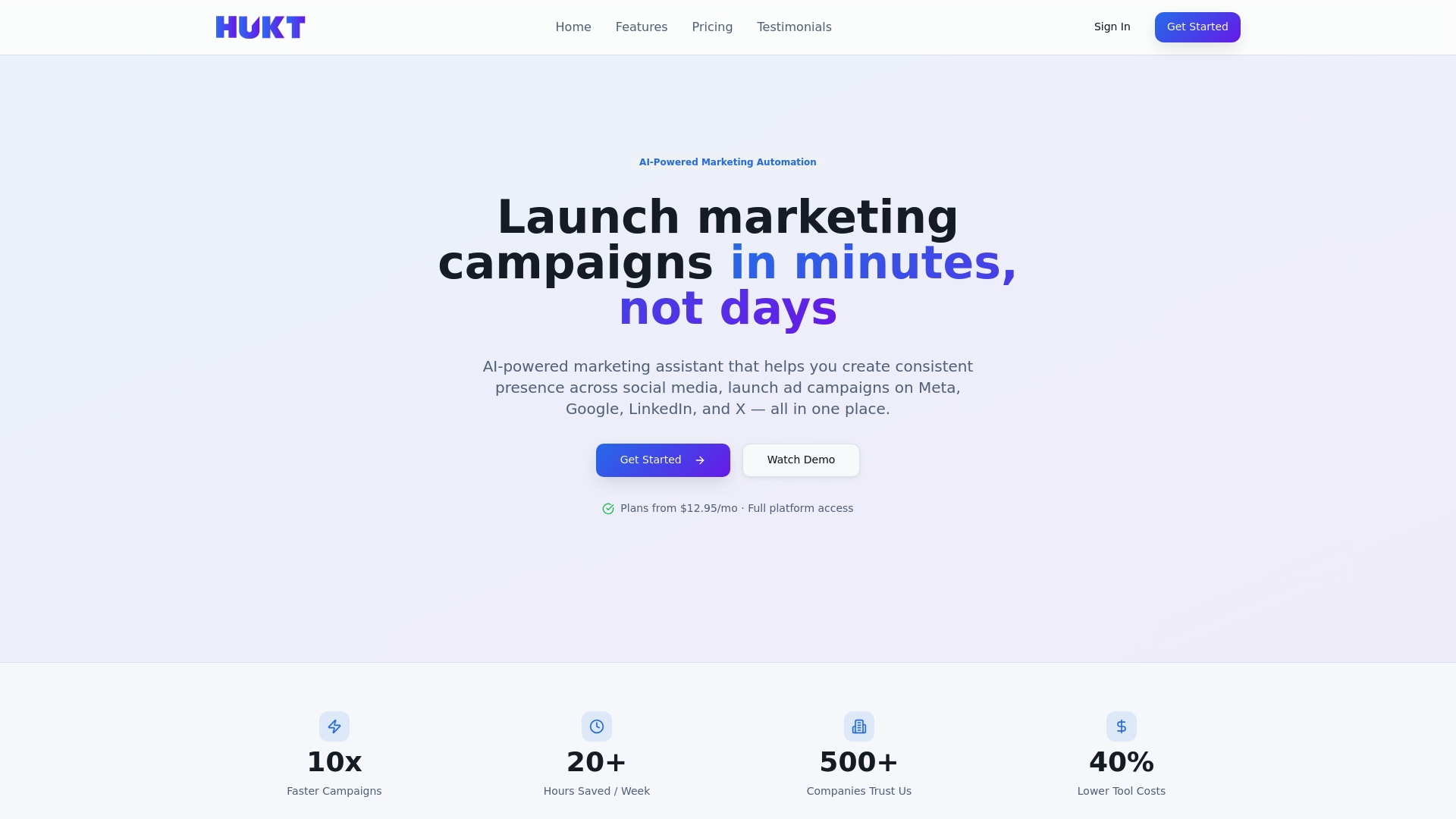
Partnering with the right platform accelerates your scalable marketing journey by eliminating the need to integrate multiple point solutions. Explore features designed for marketing professionals wanting to maximize ROI efficiently while maintaining the quality and brand consistency your clients expect.
Frequently asked questions about scalable marketing
What distinguishes scalable marketing from traditional marketing?
Scalable marketing expands reach and impact without proportionally increasing costs, time, or team size through AI automation and intelligent workflows. Traditional marketing scales linearly, requiring more resources for more output, while scalable approaches leverage technology to create exponential efficiency gains.
How long does it typically take to implement AI-driven scalable marketing in an agency?
Most agencies transition to agentic AI operations over 6-12 months, starting with one service line or client segment before expanding. Initial setup including data integration and team training takes 4-8 weeks, with measurable efficiency improvements appearing within the first quarter.
Which marketing channels yield the best ROI for scalable marketing approaches?
SEO delivers 748% ROI leading all channels, followed by email marketing at 261% and webinars at 213%. These channels scale efficiently because they produce compounding returns where incremental effort generates disproportionate long-term results.
What are common pitfalls when adopting AI automation in marketing?
Lack of clear strategy before implementation, poor data quality, insufficient team training, and unrealistic expectations about automation capabilities represent the most frequent obstacles. Success requires defining specific goals, ensuring data readiness, and investing in upskilling before deploying new systems.
How does human oversight fit into AI-powered scalable marketing workflows?
Smart agencies review approximately 20% of AI output, focusing verification on high-stakes deliverables and customer-facing content. This balanced approach captures efficiency gains while preserving brand integrity, quality standards, and the strategic judgment that AI cannot replicate.