

In 2026, 45% of marketing leaders prioritize AI tools specifically to enhance marketing efficiency and accelerate campaign execution. Marketing efficiency means optimizing time, budget, and effort to achieve maximum campaign impact. As digital channels multiply and consumer behavior evolves rapidly, the ability to do more with less has become a competitive necessity. This guide shows you how to prioritize efficiency, measure what matters, avoid common pitfalls, and leverage AI automation to transform your marketing ROI and speed.
Table of Contents
- The Critical Importance Of Marketing Efficiency In 2026
- How AI And Automation Propel Marketing Efficiency
- Measuring Marketing Efficiency: KPIs And Frameworks For 2026
- Common Misconceptions And Pitfalls About Marketing Efficiency
- Strategic Frameworks And Decision Criteria To Prioritize Marketing Efficiency
- Practical Implementation: How To Enhance Marketing Efficiency Today
- Turning Efficiency Into Competitive Advantage
- Explore AI Marketing Automation With Hukt AI
Key takeaways
| Point | Details |
|---|---|
| Marketing efficiency optimizes resources for maximum campaign impact | Focus on doing more with less by streamlining workflows, cutting waste, and aligning efforts to revenue goals. |
| AI automation accelerates workflows and enables scalable campaigns | Artificial intelligence reduces manual tasks, speeds content creation, and manages multi-platform campaigns seamlessly. |
| KPIs have shifted from vanity metrics to revenue indicators | Measure ROI, cost per acquisition, and conversion rates instead of impressions or clicks for true efficiency insights. |
| Common misconceptions include overreliance on AI without strategy | AI amplifies strategy but doesn't replace it; balance automation with human oversight and clear goals. |
| Agile planning and data-driven frameworks prioritize efficiency | Quarterly agile cycles and accurate data enable rapid adaptation and smarter resource allocation for better results. |
The critical importance of marketing efficiency in 2026
Marketing efficiency means optimizing resources like time, budget, and effort to achieve maximum campaign impact. It's about getting better results without burning through your budget or exhausting your team. In 2026, this concept has moved from nice-to-have to mission-critical as digital marketing landscapes grow increasingly complex.
Several factors drive the urgency. Fragmented channels force marketers to juggle Meta, Google, LinkedIn, X, and emerging platforms simultaneously. Evolving consumer behavior demands rapid adaptation to new preferences and engagement patterns. The rapid evolution of AI technologies offers unprecedented opportunities but also raises the stakes for those who fail to adopt smarter workflows. Marketers who ignore efficiency risk falling behind competitors who leverage automation and data-driven agility.
Common resource challenges plague marketing teams daily. Budget limits squeeze campaign reach and experimentation. Slow campaign execution delays time-to-market and reduces competitive responsiveness. Scattered tools create operational overhead as teams switch between platforms, duplicate efforts, and struggle with fragmented data. Agencies and in-house teams alike face mounting pressure to deliver more campaigns faster while proving measurable ROI to stakeholders.
Top 2026 trends pushing efficiency focus include:
- AI-driven automation that eliminates repetitive tasks and accelerates content creation
- Multi-platform campaign management tools that consolidate workflows and reduce platform switching
- Real-time analytics dashboards enabling dynamic optimization and faster decision cycles
- Agile marketing frameworks replacing rigid annual plans with quarterly adaptive strategies
- Data quality initiatives ensuring AI tools produce accurate, actionable insights rather than amplifying errors
Marketing professionals must recognize that efficiency isn't about cutting corners. It's about strategic resource allocation, intelligent automation, and continuous optimization. The marketing strategies for brand managers who succeed in 2026 will be those who master these efficiency principles early and apply them consistently across campaigns.
How AI and automation propel marketing efficiency
Artificial intelligence fundamentally transforms how marketing teams operate by accelerating workflows, reducing errors, enabling scale, and cutting costs. In 2026, 45% of marketing leaders prioritize AI tools and automation investments specifically to enhance marketing efficiency and speed of campaign execution. This isn't hype. It's a strategic response to the demands of modern digital marketing.
AI adoption delivers measurable efficiency gains across multiple dimensions. Content creation that once took hours now happens in minutes as AI generates ad copy, social posts, and campaign concepts quickly and consistently. Scheduling automation maintains continuous social media presence without manual intervention. Multi-platform management tools launch campaigns simultaneously across Meta, Google, LinkedIn, and X, eliminating the operational burden of platform switching and duplicated workflows.

Yet AI's effectiveness depends entirely on data quality. High-quality, accurate, and fresh data is critical for AI-driven marketing efficiency because poor data leads to automation of ineffective decisions rather than improvements. Garbage in, garbage out remains true even with sophisticated algorithms. Marketers must validate data sources continuously, clean datasets regularly, and ensure integration accuracy across systems.
Practical AI applications boosting efficiency include:
- Creative content generation producing multiple ad variations for A/B testing in seconds
- Predictive analytics identifying high-value audience segments before campaign launch
- Automated bid management optimizing ad spend across platforms in real time
- Smart scheduling tools posting content at optimal engagement times across time zones
- Performance dashboards surfacing actionable insights without manual report building
Automation reduces manual errors that plague traditional workflows. Human fatigue leads to inconsistent campaign setups, missed deadlines, and costly mistakes. AI tools execute repetitive tasks flawlessly at scale, freeing marketing teams to focus on strategy, creative direction, and relationship building. This shift lowers operational costs while improving output quality and campaign velocity.
Pro Tip: Start with high-quality data validation before deploying AI automation. Audit your current data sources, clean historical records, and establish governance processes to maintain accuracy. This foundation ensures your AI investments deliver genuine efficiency gains rather than amplifying existing problems.
The marketing strategies for brand managers who embrace AI thoughtfully will outpace competitors still trapped in manual workflows. Explore automated marketing guide resources to deepen your understanding and accelerate implementation. The multi-platform marketing automation guide provides additional frameworks for consolidating workflows and reducing operational friction.
Measuring marketing efficiency: KPIs and frameworks for 2026
You can't improve what you don't measure. Yet many marketing teams still track vanity metrics that obscure true efficiency and business impact. Impressions, clicks, and followers feel good but rarely connect to revenue outcomes. They create the illusion of progress while budgets drain and stakeholders question marketing's value contribution.
Marketing teams are shifting KPIs from vanity metrics to revenue impact and efficiency metrics, which better reflect marketing ROI and efficiency in 2026. This shift acknowledges that marketing exists to drive business growth, not accumulate superficial engagement statistics. Revenue-aligned KPIs focus on outcomes that matter: customer acquisition cost, return on ad spend, conversion rates, customer lifetime value, and campaign efficiency ratios.
A practical framework for measuring efficiency links campaigns directly to business outcomes through measurable metrics. Start by defining clear revenue goals for each campaign. Identify the customer journey stages your campaign targets. Select KPIs that measure progress through those stages toward revenue conversion. Track cost efficiency by comparing spend to outcome value. Review performance continuously and adjust tactics based on real data, not assumptions.
| Metric Type | Vanity Metrics | Revenue Impact Metrics | Efficiency Focus |
|---|---|---|---|
| Awareness | Impressions, Reach | Cost per quality lead, Brand lift | Spend efficiency per engaged prospect |
| Engagement | Clicks, Likes, Shares | Engagement rate among target audience, Content conversion rate | Time invested vs qualified engagement |
| Conversion | Form fills, Downloads | Cost per acquisition, Conversion rate, Revenue per campaign | Marketing spend to revenue ratio |
| Retention | Email open rate, Follower growth | Customer lifetime value, Repeat purchase rate, Churn reduction | Retention cost vs customer value |
Top 5 KPIs driving efficient marketing in 2026:
- Return on ad spend (ROAS) measuring revenue generated per dollar spent on advertising
- Customer acquisition cost (CAC) tracking total marketing spend required to acquire one new customer
- Conversion rate across funnel stages from awareness to purchase
- Marketing qualified lead (MQL) to sales qualified lead (SQL) conversion rate showing lead quality
- Campaign velocity measuring time from concept to launch and results
These metrics empower teams to identify what works, cut what doesn't, and allocate budgets strategically. They enable conversations with executives and stakeholders grounded in business impact rather than marketing jargon. The machine learning marketing ROI boost frameworks demonstrate how advanced analytics further refine measurement precision.
Implement real-time dashboards that surface these KPIs continuously. Weekly reviews catch underperforming campaigns early enough to pivot. Monthly analysis identifies patterns and informs strategic adjustments. Quarterly planning cycles use accumulated insights to optimize resource allocation and campaign priorities. Visit marketing performance metrics 2026 for additional measurement strategies and benchmarks.
Common misconceptions and pitfalls about marketing efficiency
Efficiency sounds straightforward until marketers stumble into avoidable traps that waste resources and undermine results. Recognizing these misconceptions early prevents costly mistakes and keeps your efficiency initiatives on track.
The biggest myth is that AI alone solves efficiency issues without strategic input. Marketers deploy automation tools expecting magic, then feel disappointed when results underwhelm. AI amplifies strategy, good or bad. Feed it poor targeting and weak messaging, and it efficiently scales failure. Over 30% of marketing leaders report buyer's remorse when using AI tools due to overreliance and unrealistic ROI expectations, indicating common misconceptions about AI's role in marketing efficiency. Success requires clear goals, quality data, and human oversight guiding AI execution.
Another mistake is equating higher campaign volume with better efficiency. Launching more campaigns doesn't improve efficiency if they dilute focus, confuse audiences, or cannibalize each other. Quality beats quantity. Three well-targeted campaigns often outperform ten scattered efforts. Efficiency means maximizing impact per campaign, not maximizing campaign count.
Marketers also misunderstand the balance between agility and planning. Some abandon planning entirely, chasing every trend reactively. Others cling to rigid annual plans that ignore market shifts. True efficiency lives in the middle: agile quarterly planning with clear strategic direction but tactical flexibility. This approach enables rapid adaptation without chaos.
Top 4 pitfalls and their corrections:
- Automating before optimizing: Fix broken processes first, then automate them for efficiency gains
- Ignoring data quality: Clean and validate data continuously to ensure AI produces accurate insights
- Chasing trends without strategy: Evaluate new tools and tactics against your specific goals before adopting
- Measuring activity instead of outcomes: Track revenue-aligned KPIs, not task completion rates
Pro Tip: Maintain human oversight and strategic reviews even with heavy automation. Schedule weekly check-ins to review AI-generated content, campaign performance, and strategic alignment. This balance captures AI's speed benefits while ensuring quality and brand consistency.
The machine learning ROI insights reveal that successful AI adoption pairs technology with thoughtful strategy and continuous refinement. Avoid the 2026 marketing AI misconceptions by setting realistic expectations, investing in training, and treating AI as a powerful tool requiring skilled direction rather than a self-operating solution.
Strategic frameworks and decision criteria to prioritize marketing efficiency
Prioritizing efficiency requires structured frameworks that guide resource allocation and campaign decisions. Without clear criteria, teams chase opportunities reactively, spreading resources thin and achieving mediocre results across multiple fronts.
Agile planning drives efficiency far better than traditional rigid annual plans. Annual planning locks teams into tactics that may become irrelevant as markets shift. Agile quarterly cycles enable rapid adaptation while maintaining strategic coherence. Teams set quarterly goals, test tactics quickly, measure results, and adjust based on real performance data. This iterative approach optimizes resource use continuously rather than waiting until year-end to assess what worked.
| Planning Approach | Traditional Annual | Agile Quarterly |
|---|---|---|
| Planning Cycle | 12 months, rigid | 3 months, flexible |
| Adaptation Speed | Slow, waits for annual review | Fast, adjusts every quarter |
| Resource Allocation | Fixed budgets per tactic | Dynamic budgets based on performance |
| Risk Level | High (locked into potentially outdated tactics) | Lower (quick pivots limit exposure) |
| Team Focus | Executing predetermined plans | Testing, learning, optimizing continuously |
Effective decision criteria for selecting marketing initiatives include data accuracy, revenue alignment, and integration ability. Efficient multi-platform campaign management powered by AI reduces the operational burden and costs of platform switching and duplicated workflows. Prioritize initiatives that consolidate tools, automate repetitive tasks, and surface actionable insights quickly.
5 decision criteria for prioritizing efficiency investment:
- Revenue impact potential: Does this initiative directly influence customer acquisition or retention at scale?
- Data quality requirement: Do we have accurate, fresh data to support effective execution and measurement?
- Integration capability: Does this tool or tactic connect seamlessly with our existing marketing stack?
- Scalability factor: Can we expand this initiative efficiently as we grow without proportional cost increases?
- Speed to results: How quickly will we see measurable outcomes to inform continued investment decisions?
Multi-platform AI automation exemplifies efficiency prioritization done right. Instead of managing campaigns separately across Meta, Google, LinkedIn, and X, consolidated platforms enable simultaneous launches, unified reporting, and centralized optimization. This approach slashes operational overhead, accelerates time-to-market, and improves campaign consistency. The Hukt AI marketing automation software demonstrates how integrated platforms transform scattered workflows into streamlined operations.
Apply these frameworks systematically. Score potential initiatives against your criteria. Focus resources on high-impact, high-feasibility opportunities. Cut or delay low-scoring initiatives regardless of how appealing they seem in isolation. This disciplined approach prevents resource fragmentation and ensures your team delivers measurable efficiency gains rather than spreading effort across too many fronts.
Practical implementation: how to enhance marketing efficiency today
Knowledge means nothing without action. Here's your step-by-step roadmap to start improving marketing efficiency immediately, building momentum through quick wins while laying foundations for long-term transformation.
- Audit current marketing activities to identify inefficiencies, redundancies, and manual bottlenecks consuming disproportionate time or budget.
- Implement agile planning by shifting from annual to quarterly cycles with clear goals, rapid testing, and performance-based adjustments.
- Integrate AI automation platforms that consolidate multi-channel campaign management, content creation, and performance analytics in one place.
- Shift KPI focus from vanity metrics to revenue-aligned measures like ROI, customer acquisition cost, and conversion rates.
- Deploy real-time dashboards surfacing actionable insights continuously, enabling dynamic optimization without waiting for manual reports.
- Establish iterative review cycles with weekly tactical check-ins and monthly strategic assessments to catch issues early and scale successes.
- Invest in data quality initiatives including source validation, regular cleaning, and governance processes ensuring AI tools operate on accurate information.
Start with high-impact, low-complexity AI automations to build momentum and demonstrate value quickly. Content scheduling, basic performance reporting, and email workflow automation deliver immediate time savings without requiring extensive technical integration. These quick wins build organizational confidence and support for larger efficiency initiatives.
Pro Tip: Begin by automating your most repetitive, time-consuming tasks first. Identify the three manual processes draining the most team hours weekly. Implement automation for those specific tasks before expanding to other areas. This focused approach delivers fast ROI and proves the efficiency case for broader adoption.
Multi-platform tools demonstrate efficiency gains dramatically. Traditional workflows require logging into each platform separately, duplicating campaign setups, and manually compiling performance data. AI marketing automation software eliminates this friction by enabling simultaneous campaign launches across channels, unified reporting, and centralized optimization. Teams report 40 to 60 percent reductions in campaign setup time and 30 percent improvements in cost efficiency through consolidated platforms.
The precision improvements from AI also drive efficiency. AI boosts precision 30 percent in complex decision environments by processing vast data sets and identifying patterns humans miss. Applied to marketing, this means better targeting, more accurate bid optimization, and smarter budget allocation across channels. Small precision gains compound into substantial efficiency improvements over time.
Don't wait for perfect conditions. Start now with what you have. Audit, prioritize, automate, measure, and iterate. Each cycle builds efficiency and proves value, creating momentum for continued investment and organizational support.
Turning efficiency into competitive advantage
Marketing efficiency isn't just operational housekeeping. It's a strategic growth enabler separating winners from laggards in increasingly competitive 2026 markets. Teams that master efficiency launch campaigns faster, optimize smarter, and achieve superior ROI with the same or fewer resources than competitors still trapped in manual workflows.
The risks of ignoring efficiency priorities grow steeper daily. Wasted budgets on underperforming campaigns compound as competitors capture market share. Slow execution delays product launches and promotional windows, surrendering first-mover advantages. Scattered tools and fragmented data prevent the unified insights needed for strategic decisions. Teams burn out from operational overload, leading to turnover and lost institutional knowledge.
Conversely, organizations embracing AI-driven automation and agile practices position themselves for sustained competitive advantage. They test more hypotheses faster, learning what works before competitors even launch. They scale successes rapidly while cutting losses quickly. They allocate budgets dynamically based on real performance, not outdated assumptions. This agility and intelligence create compounding advantages over time.
The path forward is clear. Prioritize efficiency now through AI adoption, agile frameworks, and revenue-aligned measurement. Build the operational foundation enabling rapid execution and continuous optimization. Invest in data quality ensuring your automation amplifies strategy rather than errors. Maintain human oversight preserving brand consistency and strategic direction.
Your marketing efficiency journey begins with a single decision to change. Make that decision today. Audit your workflows, identify your biggest inefficiencies, and implement your first automation. Each step forward builds momentum, proves value, and accelerates your transformation into a high-efficiency marketing organization delivering measurable business results.
Explore AI marketing automation with Hukt AI
Ready to transform marketing efficiency from concept to reality? Hukt AI marketing automation software consolidates creative content generation, multi-platform campaign management, AI-powered scheduling, and real-time analytics into one cloud-based platform. Launch campaigns simultaneously across Meta, Google, LinkedIn, and X without platform switching. Generate ad copy, social posts, and campaign concepts instantly with AI. Monitor performance through unified dashboards enabling dynamic optimization.
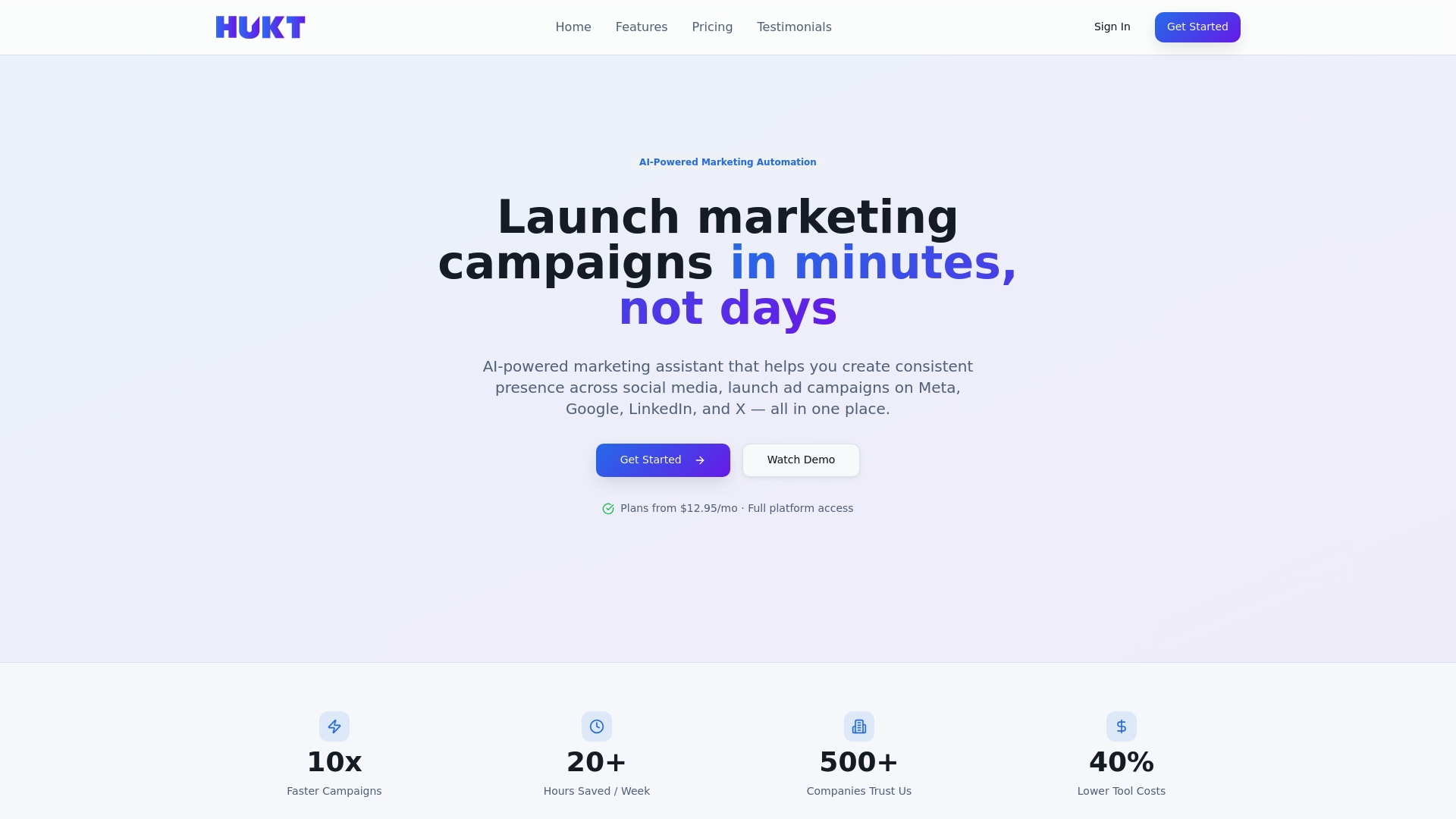
Hukt AI reduces campaign launch times by up to 60 percent while lowering operational costs through workflow consolidation and intelligent automation. Tiered subscription plans scale with your needs from individual marketers to large agency teams. Accelerate your marketing efficiency journey and maximize ROI with AI-driven automation designed specifically for marketing professionals facing the complex, fast-moving digital landscape of 2026. Explore Hukt AI today and experience how unified AI automation transforms marketing operations.
Frequently asked questions
What is marketing efficiency and why is it critical in 2026?
Marketing efficiency means optimizing time, budget, and effort to achieve maximum campaign impact with minimal resource waste. It's critical in 2026 because digital channels have multiplied, consumer behavior evolves rapidly, and AI automation creates opportunities for those who adapt while punishing those who don't. Efficiency separates competitive winners from laggards burning budgets on scattered, slow campaigns.
How does AI improve marketing efficiency?
AI automates repetitive tasks like content creation, scheduling, and performance reporting, freeing teams for strategic work. It processes vast data sets to identify patterns and opportunities humans miss, enabling smarter targeting and budget allocation. AI enables scalable multi-channel campaigns with fewer errors and faster execution than manual workflows. The key is pairing AI tools with quality data and clear strategic direction.
What KPIs should I focus on to measure marketing efficiency?
Focus on revenue-aligned KPIs like return on ad spend (ROAS), customer acquisition cost (CAC), conversion rates, and marketing qualified lead to sales qualified lead conversion rates. Avoid vanity metrics like impressions, clicks, and follower counts that feel good but don't connect to business outcomes. Track campaign velocity measuring time from concept to results. Real-time dashboards enable continuous optimization rather than waiting for monthly reports.
What are common mistakes marketers make regarding efficiency?
Assuming AI alone solves efficiency without strategic input leads to disappointment and buyer's remorse. Confusing more campaigns with better efficiency spreads resources thin and dilutes impact. Automating broken processes before fixing them amplifies inefficiency. Ignoring data quality causes AI to scale poor decisions. Measuring activity instead of outcomes creates illusions of progress while budgets drain without meaningful results.
How can I start improving marketing efficiency immediately?
Begin by auditing current workflows to identify manual bottlenecks and redundant tasks consuming disproportionate time. Implement agile quarterly planning replacing rigid annual cycles. Integrate AI automation platforms consolidating multi-channel management and content creation. Shift KPIs from vanity metrics to revenue-aligned measures. Start with high-impact, low-complexity automations like scheduling and basic reporting to build quick wins and organizational confidence for broader transformation.
Recommended
- Machine Learning in Marketing: Boost ROI by 30% in 2026
- Multi-Platform Marketing Guide 2026: Cut Launch Time 40%
- Marketing strategies for brand managers: 50% faster campaigns
- AI Marketing Automation Software | Hukt AI - Launch Campaigns with AI
- 7 Νέες Τάσεις Digital Marketing 2025 που Πρέπει να Ξέρετε - maverix.gr