

Fragmented marketing tools drain time and budgets. Multi-platform marketing automation can cut campaign launch times by up to 50%, freeing SMB marketers to focus on strategy instead of juggling scattered systems. This article explains how centralized marketing platforms unify workflows, consolidate data, and drive measurable efficiency gains. You'll discover concrete benefits, automation strategies, real case studies, and a practical roadmap for implementation tailored to small and medium businesses.
Table of Contents
- Understanding Centralized Marketing Platforms
- The Role Of Data Centralization
- Benefits Of Centralized Marketing Platforms
- Automation And Workflow Streamlining
- Common Misconceptions About Centralized Marketing
- Case Studies Of Centralized Marketing Success
- Leveraging Analytics And Optimization
- Implementing Centralized Marketing Platforms In Smbs
- Discover Centralized Marketing Solutions With Hukt Ai
- Frequently Asked Questions About Centralized Marketing Platforms
Key takeaways
| Point | Details |
|---|---|
| Centralized platforms unify multi-channel marketing and data in one place | They eliminate tool fragmentation, creating a single dashboard for campaign management across all channels. |
| They improve efficiency by reducing campaign launch times and manual work | Launch times drop by up to 50%, allowing teams to do more with fewer resources. |
| Automation embedded in platforms personalizes campaigns and cuts costs | AI-driven tools adapt messaging dynamically while reducing labor hours and operational expenses. |
| Data centralization creates a single source of truth for better decisions | Unified data improves accuracy, speeds reporting by 80%, and enables reliable ROI attribution. |
| Misconceptions about loss of local relevance are unfounded | Modern platforms support regional customization while maintaining consistent brand standards. |
Understanding centralized marketing platforms
Centralized marketing platforms are software solutions that unify campaign management and data across multiple marketing channels into a single interface. Instead of logging into separate tools for email, social media, paid ads, and analytics, you work from one dashboard. This consolidation streamlines workflows, reduces context switching, and accelerates execution.
These platforms aggregate data streams from every channel, creating a unified view of performance metrics, customer interactions, and campaign results. For SMBs, this means faster decision-making and fewer opportunities for errors caused by manual data transfers. You can launch campaigns simultaneously on Meta, Google, LinkedIn, and X without hopping between platforms.
Key features include:
- Unified campaign creation and scheduling across channels
- Consolidated performance dashboards with real-time metrics
- Automated workflows that reduce repetitive manual tasks
- Centralized content libraries for brand asset management
- Integrated analytics tools for attribution and ROI tracking
Centralized marketing platforms unify multi-channel management and consolidate data workflows. This foundation enables the speed and consistency that modern marketing demands. With fewer tools to manage, your team spends less time on administrative overhead and more time optimizing campaigns.
The role of data centralization
Data centralization transforms how SMB marketing teams operate by creating a single source of truth. When customer data, campaign metrics, and performance analytics live in one place, you eliminate inconsistencies and version control headaches. No more hunting through spreadsheets or reconciling conflicting reports from different tools.
This unified data approach improves governance and quality control. You establish clear data standards, reduce duplicate records, and ensure everyone works from the same information. Centralizing marketing data creates a single source that improves data quality, decision-making, and governance with an 80% reduction in reporting time.
Centralized data accelerates reporting processes dramatically. Instead of spending hours pulling metrics from various platforms and building custom reports, your team accesses pre-built dashboards that update automatically. This speed advantage lets you spot performance trends early and adjust campaigns before budgets are wasted.
Accurate attribution becomes possible when all touchpoints feed into one system. You can trace a customer's journey from first ad impression through final conversion, assigning credit appropriately across channels. This clarity helps you allocate budgets intelligently and prove marketing ROI to stakeholders.
Benefits of centralized data:
- Eliminates data silos and manual reconciliation work
- Reduces reporting time by up to 80%
- Improves attribution accuracy across the customer journey
- Enables predictive analytics and trend spotting
- Supports compliance with data privacy regulations
For a deeper exploration of data centralization benefits and strategy, consider how unified data powers smarter marketing decisions.
Benefits of centralized marketing platforms
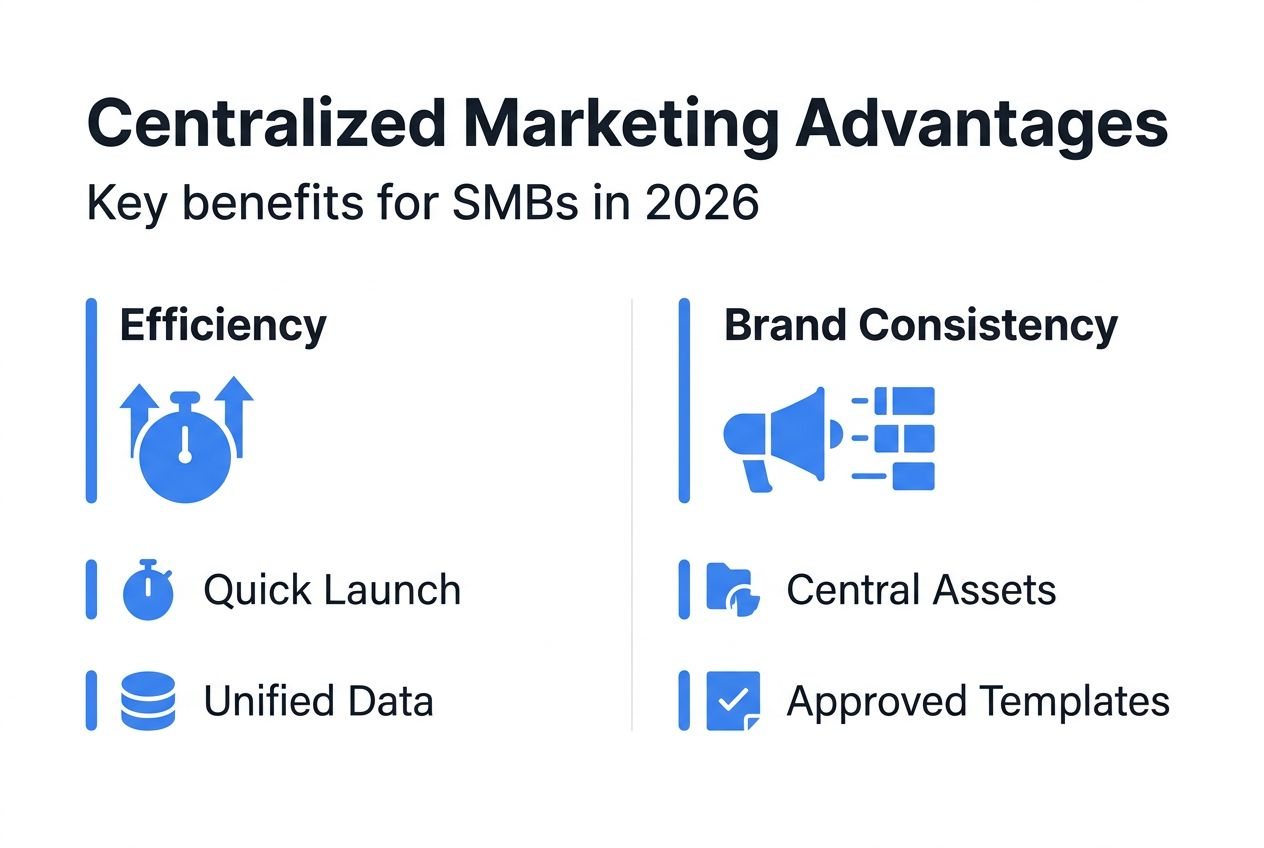
Efficiency gains rank among the most compelling reasons to adopt centralized marketing platforms. Centralized marketing operations increase efficiency and speed campaign launches by up to 50%. This time savings comes from eliminating redundant approvals, reducing tool switching, and automating repetitive tasks. Your team launches more campaigns in less time.

Brand consistency becomes easier to maintain when all marketing assets and guidelines live in a central repository. Every team member accesses the same approved logos, color palettes, messaging frameworks, and templates. This consistency strengthens brand recognition and equity across every customer touchpoint, whether someone encounters your brand on social media, search ads, or email.
Cost savings emerge from multiple sources. You pay for fewer software subscriptions, reduce the labor hours spent on manual tasks, and leverage bulk purchasing power for ad spend across platforms. A multinational beverages company reduced time to market by 50% and cut costs significantly through centralized operations.
Faster decision-making happens when approval workflows are streamlined and stakeholders work from unified data. You eliminate bottlenecks caused by unclear ownership or conflicting information. Campaigns move from concept to launch faster, letting you capitalize on timely opportunities.
| Aspect | Centralized Approach | Decentralized Approach |
|---|---|---|
| Campaign launch speed | 50% faster on average | Slower due to coordination overhead |
| Data consistency | Single source of truth | Conflicting reports common |
| Brand consistency | High, with centralized assets | Varies by team or region |
| Tool costs | Lower, fewer subscriptions | Higher, multiple overlapping tools |
| Approval workflows | Streamlined, clear ownership | Complex, prone to bottlenecks |
Pro Tip: Maintain brand consistency while allowing regional flexibility by creating tiered approval systems. Let local teams customize campaign messaging within pre-approved templates and brand guardrails.
For SMBs looking to scale, marketing strategies for brand managers often emphasize the efficiency and consistency advantages of centralized platforms. Additionally, machine learning marketing ROI boost becomes more achievable when data flows through unified systems. Explore centralized marketing strategies and the multinational beverages company case study for detailed examples.
Automation and workflow streamlining
Marketing automation has become essential for competitive advantage. At least 81% of marketing teams use automation, with 96% adopting or planning to use it in 2026. These statistics highlight how critical automation is for staying efficient in modern marketing.
AI-powered automation within centralized platforms personalizes customer experiences at scale. AI-powered marketing automation drives personalized engagement and better outcomes by adapting messaging based on user behavior, preferences, and stage in the buyer journey. This personalization happens automatically, without manual intervention for each customer segment.
Automation benefits include:
- Faster campaign launches through templates and pre-built workflows
- Reduced manual labor for repetitive tasks like scheduling and reporting
- Better targeting through AI-driven audience segmentation
- Consistent follow-up sequences that nurture leads automatically
- Dynamic content optimization based on performance data
Centralized platforms embed automation throughout the marketing workflow. You can set up triggers that launch email sequences when prospects take specific actions, schedule social posts weeks in advance, and automatically pause underperforming ads while scaling winners. These capabilities free your team to focus on strategy and creative work.
Pro Tip: Balance automation with human oversight by reviewing AI-generated content before publication and monitoring automated workflows weekly. Authenticity matters, and occasional personal touches strengthen customer relationships.
For SMBs seeking comprehensive automation capabilities, AI marketing automation software provides the tools needed to compete with larger competitors. Review marketing automation statistics 2026 for deeper insights into adoption trends and ROI metrics.
Common misconceptions about centralized marketing
Myth: Centralization reduces local relevance. Reality: Modern centralized platforms support regional customization while maintaining brand standards. Effective centralized marketing allows local customization while maintaining brand consistency. Teams can adapt messaging, imagery, and offers to local markets within approved frameworks.
Myth: Centralization is the same as basic automation. Reality: Centralized marketing platforms integrate workflows, data, and automation into a unified system. Basic automation tools handle specific tasks like email scheduling, but centralized platforms connect every marketing function. You get automation plus unified data, cross-channel orchestration, and consolidated analytics.
Myth: Platforms are too complex or costly for SMBs. Reality: Cloud-based solutions now offer scalable pricing and intuitive interfaces designed for small teams. You don't need enterprise budgets or technical expertise to benefit from centralization. Many platforms offer tiered plans that grow with your business.
Common concerns addressed:
- Fear of losing creative control: Templates and brand guidelines enhance rather than limit creativity by providing proven frameworks
- Worry about implementation complexity: Modern platforms offer guided onboarding, pre-built templates, and support resources
- Doubt about ROI for smaller budgets: Time savings and efficiency gains deliver measurable returns regardless of company size
- Concern about vendor lock-in: Most platforms support data export and integration with other tools
For SMBs evaluating options, AI marketing automation software demonstrates how accessible centralized platforms have become. Learn more about overcoming centralized marketing misconceptions through real-world examples.
Case studies of centralized marketing success
Real-world results prove the value of centralized marketing platforms. A multinational beverages company cut time to market by 50% using centralized marketing platforms. This dramatic improvement came from eliminating approval bottlenecks, standardizing workflows, and automating repetitive tasks across regional teams.
Brands like Apple maintain consistent global branding through centralized marketing models. Every Apple store, website, and campaign reflects identical brand standards, yet regional teams adapt messaging to local cultural contexts. This balance between consistency and flexibility drives brand equity worldwide.
Key metrics from successful implementations:
| Company | Time to Market | Cost Reduction | Brand Consistency Score |
|---|---|---|---|
| Multinational Beverages | 50% faster | 35% lower operational costs | 95% consistency across regions |
| Global Tech Brand | 45% faster | 28% lower agency costs | 98% consistency across markets |
| Retail Chain | 40% faster | 30% lower content production costs | 92% consistency across locations |
These companies achieved results by:
- Implementing unified content management systems
- Establishing clear approval hierarchies
- Training regional teams on platform capabilities
- Monitoring performance metrics consistently
- Iterating workflows based on user feedback
For detailed analysis, review the beverages company case study and examples of apple brand consistency. These resources show how centralization delivers measurable business outcomes.
Leveraging analytics and optimization
Real-time analytics dashboards transform how quickly you can optimize campaigns. Instead of waiting for weekly reports, you monitor performance continuously and adjust tactics immediately when data signals opportunities or problems. Centralized platforms unify metrics from all channels into single dashboards, eliminating the need to compile data manually.
Analytics capabilities reduce campaign optimization time significantly. You spot underperforming ads within hours instead of days, pause wasteful spending, and reallocate budgets to winning tactics. This speed advantage compounds over time, improving ROI across every campaign.
Dynamic adjustment capabilities include:
- Automatic bid adjustments based on conversion data
- Real-time A/B testing of ad creative and messaging
- Audience expansion when campaigns exceed performance targets
- Budget reallocation across channels based on ROI metrics
- Predictive analytics that forecast campaign outcomes
For SMBs competing in fast-moving markets, this agility matters enormously. You can test new messaging on Monday, analyze results by Tuesday, and scale winning variants by Wednesday. Traditional approaches that rely on monthly reports can't match this speed.
Centralized analytics also improve collaboration. When everyone views the same dashboards, conversations focus on strategy rather than arguing about data accuracy. Teams align quickly around shared insights and move forward with confidence.
Implementing centralized marketing platforms in SMBs
Successful implementation requires a structured approach. Follow these steps to maximize your chances of smooth adoption and quick wins:
-
Assess current marketing fragmentation and set centralization goals. Document every tool you currently use, map data flows, identify pain points, and define success metrics for the new platform.
-
Evaluate platforms focusing on AI, multi-channel support, and analytics. Prioritize solutions that integrate with your existing tech stack, offer scalable pricing, and provide strong customer support.
-
Run pilot campaigns to test and measure impact. Select a specific channel or campaign type as your pilot, migrate only that workflow initially, and measure time savings and performance improvements.
-
Train teams for smooth adoption and workflow integration. Provide hands-on training sessions, create documentation for common tasks, designate platform champions, and establish feedback loops.
-
Monitor performance and optimize continuously. Review analytics weekly, gather user feedback monthly, adjust workflows based on learnings, and expand platform usage gradually.
Pro Tip: Involve key stakeholders early in the evaluation process to ensure alignment. When team members help select the platform, adoption rates increase significantly because they feel ownership of the decision.
For SMBs seeking practical guidance, AI marketing automation software offers resources and support designed for smaller teams. Additionally, strategies for maximizing IT investments for SMBs apply directly to marketing technology decisions. Visit maximizing IT investments for SMBs for broader context on technology adoption.
Discover centralized marketing solutions with Hukt AI
Hukt AI provides a centralized marketing platform built specifically for SMBs seeking efficiency gains without enterprise complexity. Our AI-driven automation handles content generation, multi-channel campaign launches, and performance analytics from a single interface. You can create ad copy, schedule social posts, and launch campaigns across Meta, Google, LinkedIn, and X simultaneously.
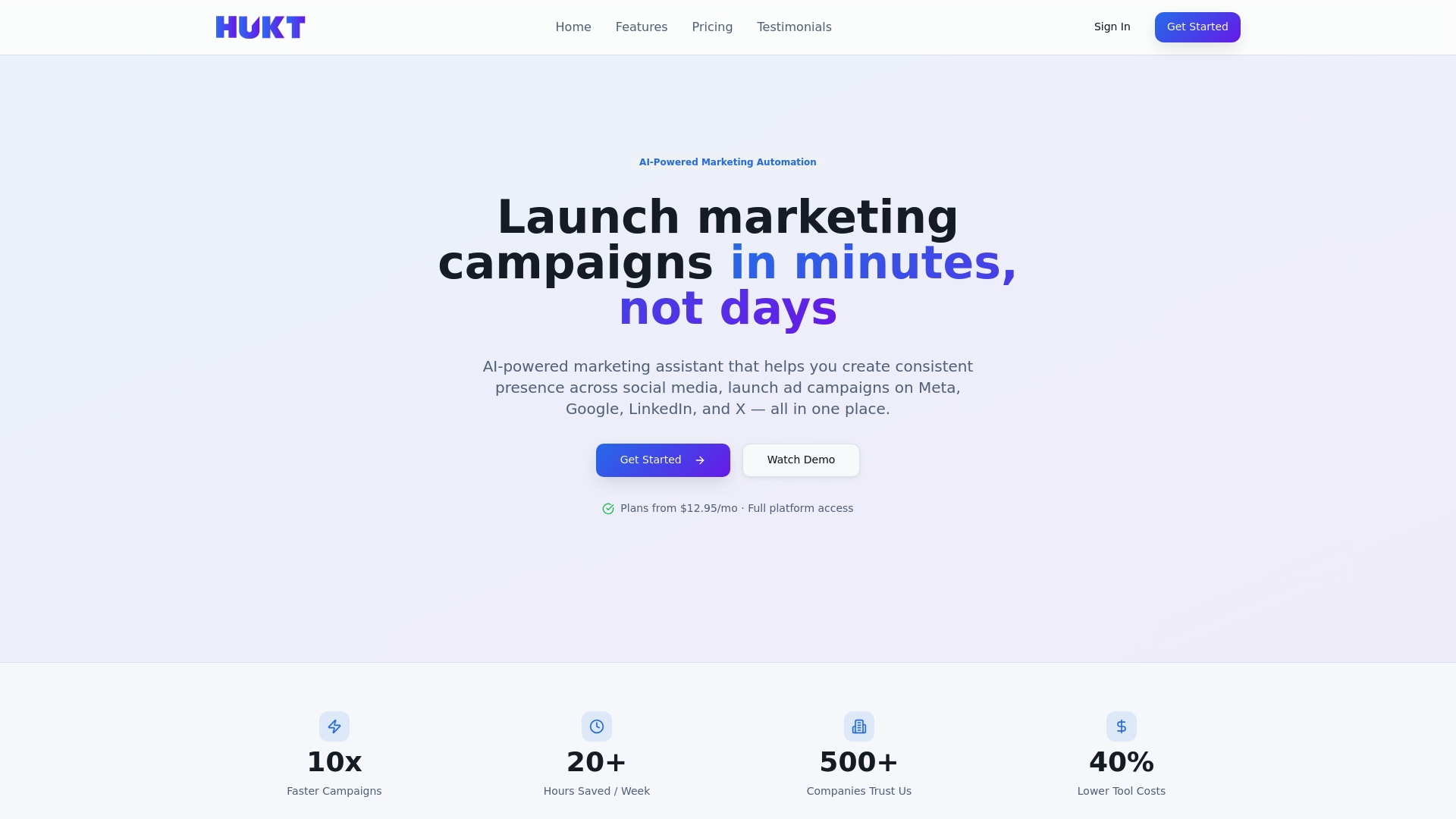
The platform scales with your business through flexible subscription tiers that match your team size and campaign volume. Whether you're a solo marketer or managing a small agency, Hukt AI delivers the automation and insights you need to compete effectively. Real-time dashboards show exactly which campaigns drive results, letting you optimize budgets dynamically.
Explore how AI marketing automation software can cut your campaign launch times and improve ROI. For strategic guidance on leveraging these tools, review our marketing strategies for brand managers to see how automation and centralization work together.
Frequently asked questions about centralized marketing platforms
What defines a centralized marketing platform?
A centralized marketing platform is software that unifies campaign management, data, and workflows across multiple marketing channels into a single interface. It consolidates tools for content creation, scheduling, analytics, and automation, eliminating the need to switch between separate applications for each channel.
How do these platforms improve marketing efficiency?
They reduce campaign launch times by up to 50% through automated workflows, unified data access, and streamlined approval processes. Teams spend less time on administrative tasks and more time on strategy and optimization, increasing output without adding headcount.
Can SMBs afford and implement these solutions effectively?
Yes, modern cloud-based platforms offer scalable pricing tiers designed for small teams and budgets. Implementation typically takes weeks rather than months, and intuitive interfaces reduce the learning curve. Many platforms provide guided onboarding and support resources specifically for SMBs.
How is local market relevance maintained with centralization?
Centralized platforms support regional customization within brand guidelines through tiered approval systems and flexible templates. Local teams can adapt messaging, imagery, and offers to their markets while maintaining consistent brand standards. This balance preserves relevance without sacrificing brand equity.
What role does AI play in centralized marketing platforms?
AI powers personalization, automation, and optimization throughout the platform. It generates content variations, segments audiences dynamically, predicts campaign performance, and adjusts tactics in real time based on data patterns. This intelligence amplifies human creativity rather than replacing it, enabling teams to scale their impact efficiently.
Recommended
- Multi-Platform Marketing Guide 2026: Cut Launch Time 40%
- Machine Learning in Marketing: Boost ROI by 30% in 2026
- Marketing strategies for brand managers: 50% faster campaigns
- AI Marketing Automation Software | Hukt AI - Launch Campaigns with AI
- LinkedIn Marketing Benefits 2026: 80% B2B Leads & 2x CVR - Kawaak