

Managing ad campaigns manually has become nearly impossible in 2026. Campaign complexity exceeds human capacity to optimize effectively, with fragmented platforms, real-time bidding, and massive data volumes overwhelming even experienced teams. AI-driven strategies now deliver 20-30% higher campaign ROI compared to traditional methods, transforming marketing from experimental to essential. This guide shows you how to leverage AI tools to launch campaigns that optimize themselves in real time, saving you hours while maximizing returns.
Table of Contents
- Understanding The Challenges Of Ad Campaign Strategy In 2026
- Preparing To Implement AI-Driven Ad Campaigns: Tools And Prerequisites
- Executing AI-Enhanced Campaign Strategies For Maximum Impact
- Verifying Success And Optimizing Post-Campaign With AI Insights
- Explore Hukt AI For Your 2026 Campaigns
Key takeaways
| Point | Details |
|---|---|
| AI delivers measurable ROI gains | Companies using AI in marketing report 20-30% higher campaign ROI than traditional approaches. |
| Real-time optimization replaces manual cycles | Modern AI systems monitor and adjust campaigns continuously, eliminating slow manual optimization loops. |
| Human strategy remains essential | AI handles data processing and pattern detection, but strategic decisions require human oversight for maximum impact. |
| Data quality determines AI success | Clean, centralized data feeds AI engines and directly impacts campaign performance and accuracy. |
Understanding the challenges of ad campaign strategy in 2026
Campaign complexity has outpaced human capacity to optimize effectively. You're managing campaigns across Meta, Google, LinkedIn, and X simultaneously while tracking hundreds of metrics per platform. The volume and velocity of marketing data now exceed what any team can process manually.
Fragmented platforms create optimization nightmares. Each channel has unique algorithms, bidding strategies, and audience behaviors. Switching between dashboards wastes time and creates gaps in your optimization cycles. By the time you analyze performance on one platform and adjust, market conditions have already shifted.
Marketers struggle to keep campaigns efficient without intelligent automation. Manual A/B testing takes days or weeks to produce insights. You're making decisions based on yesterday's data in markets that change by the hour. Traditional optimization cycles simply can't keep pace with 2026 competition.
AI has shifted from experimental to essential for campaign success. Your competitors are already using machine learning to prioritize marketing efficiency and outperform manual strategies. The marketing landscape now rewards speed and precision that only AI can deliver consistently.
Key challenges demanding AI solutions:
- Data volume overwhelming manual analysis capacity
- Multi-platform campaign coordination requiring constant attention
- Real-time bidding adjustments happening faster than human response
- Audience segmentation complexity multiplying with personalization demands
- Creative testing cycles too slow for dynamic market conditions
Pro Tip: Start tracking how much time your team spends on manual optimization tasks. This baseline helps you measure AI efficiency gains and justify technology investments to stakeholders.
Preparing to implement AI-driven ad campaigns: tools and prerequisites
Successful AI campaigns require the right foundation. You need platforms that integrate data sources, automate optimization, and provide actionable insights without requiring data science expertise. Global spending on AI-driven marketing technology is projected to reach $82 billion in 2025, reflecting widespread adoption.
Essential AI marketing platforms include campaign management tools with built-in machine learning, predictive analytics dashboards, and automated creative testing systems. Look for solutions that connect directly to your ad accounts and centralize reporting. The best platforms learn from your data and improve recommendations over time.
Clean, centralized data forms the foundation of AI success. Your AI tools are only as effective as the data feeding them. Consolidate customer information, campaign performance metrics, and conversion data into unified systems. Poor data quality produces unreliable AI recommendations that waste budget.

Integration across marketing platforms eliminates manual work and data silos. Choose tools that sync automatically with Meta Ads Manager, Google Ads, LinkedIn Campaign Manager, and other channels you use. Seamless integration means AI can optimize across platforms simultaneously, finding the best allocation of your budget.
Budgeting for AI technology requires realistic investment planning. Factor in software subscriptions, data infrastructure upgrades, and training time. However, the ROI typically justifies costs quickly through improved campaign performance and time savings. Start with pilot programs on high-value campaigns to demonstrate value.
| Tool Category | Key Features | Typical Investment |
|---|---|---|
| Campaign Automation | Multi-platform launch, bid optimization, budget allocation | $200-2000/month |
| Predictive Analytics | Audience insights, performance forecasting, trend detection | $500-3000/month |
| Creative Testing | Automated A/B testing, dynamic ad generation, copy optimization | $300-1500/month |
| Data Integration | Centralized dashboards, API connections, real-time sync | $400-2500/month |
Explore top marketing apps for 2026 to identify solutions matching your campaign complexity and budget. Prioritize platforms offering trial periods so you can validate performance before committing.
Understand the role of data in marketing to build infrastructure supporting AI capabilities. Without quality data pipelines, even the most sophisticated AI tools underperform.
Pro Tip: Begin with one AI tool addressing your biggest pain point rather than implementing a complete stack simultaneously. Master one capability, measure results, then expand your AI toolkit based on proven ROI.
Executing AI-enhanced campaign strategies for maximum impact
Launching AI-powered campaigns requires a systematic approach balancing automation with strategic oversight. Follow these steps to maximize AI benefits while maintaining control over campaign direction and brand alignment.
- Define clear campaign objectives and success metrics before activating AI tools. AI optimizes toward the goals you set, so precise targeting and KPI definition determine results.
- Segment audiences using AI-powered insights that identify high-value customer patterns. Machine learning detects behavioral signals humans miss in large datasets.
- Create multiple creative variations for AI testing systems to evaluate. Provide diverse ad copy, images, and formats so algorithms identify winning combinations.
- Set initial budgets and bid strategies, then allow AI to optimize allocations based on real-time performance data across channels.
- Monitor AI recommendations daily during the first week, then adjust oversight frequency as you build confidence in automated decisions.
- Implement continuous feedback loops where conversion data trains AI models to improve future targeting and creative selection.
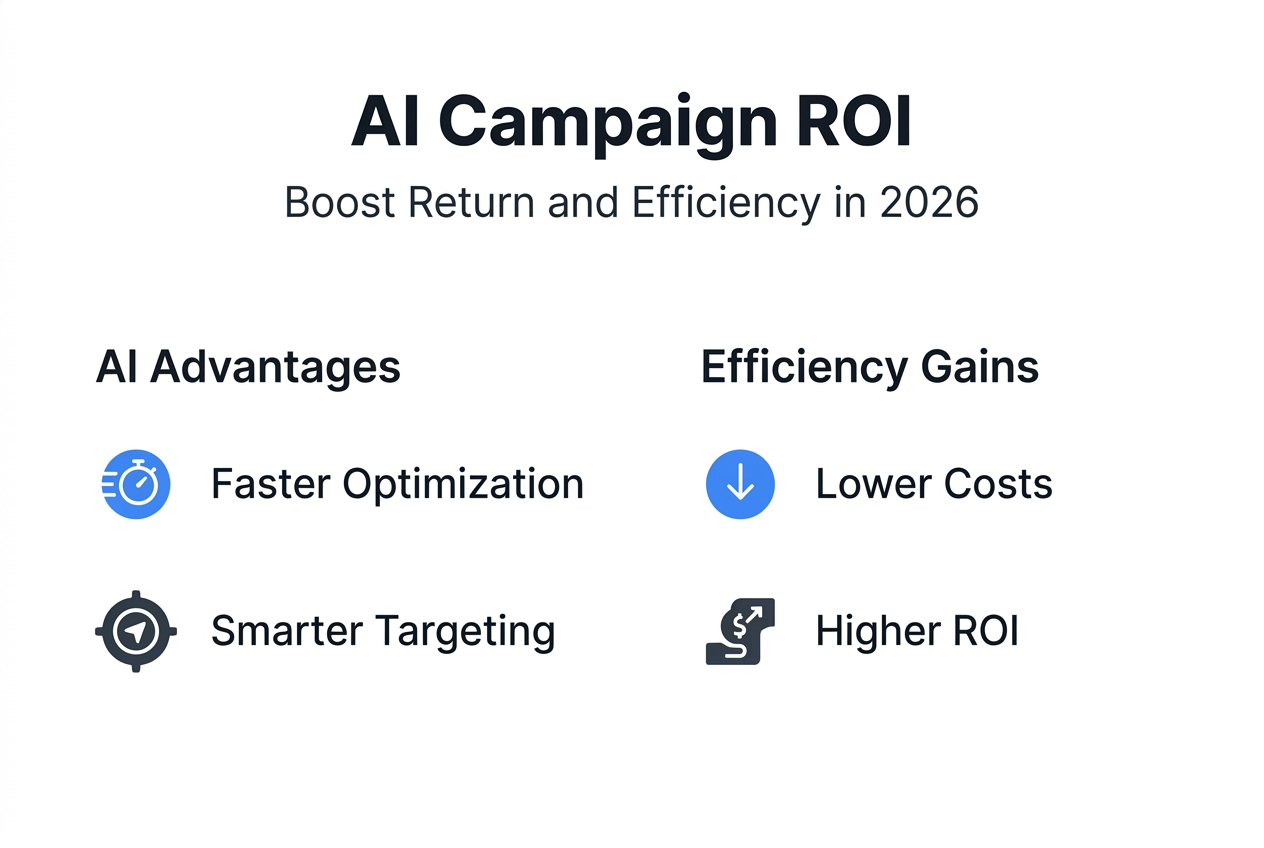
Companies leveraging AI in marketing report 20-30% higher campaign ROI compared to traditional methods. This performance gap reflects AI's ability to process signals and adjust campaigns faster than manual workflows allow.
Real-time data monitoring enables continuous AI adjustment throughout campaign lifecycles. Your AI tools analyze performance metrics every hour or even every few minutes. They shift budgets from underperforming ad sets to winners automatically, capitalizing on opportunities before they disappear.
| Traditional Campaign Management | AI-Driven Campaign Management |
|---|---|
| Weekly optimization cycles | Continuous real-time optimization |
| Manual performance analysis | Automated pattern detection |
| Single-platform focus | Simultaneous multi-platform coordination |
| Reactive budget adjustments | Predictive budget allocation |
| Limited creative testing | Extensive automated A/B testing |
Balancing AI automation with human strategic input remains crucial for campaign success. AI excels at processing data and executing tactical optimizations, but you provide the strategic vision, brand guidelines, and creative direction. Use AI for speed and scale while reserving judgment calls for human decision makers.
Learn how machine learning boosts marketing ROI through intelligent optimization that adapts faster than manual methods. Understanding these capabilities helps you set realistic expectations and identify optimization opportunities.
Explore marketing strategies for AI campaigns that brand managers use to maintain creative control while leveraging automation benefits. Strategic frameworks guide AI tools toward business objectives.
Criteo's AI advancements demonstrate how sophisticated algorithms improve ad performance through continuous learning and optimization at scale.
Pro Tip: Create a decision matrix defining which optimizations AI handles autonomously and which require human approval. Clear boundaries prevent both over-reliance on automation and micromanagement that negates efficiency gains.
Verifying success and optimizing post-campaign with AI insights
Measuring AI campaign performance requires tracking metrics that reveal both immediate results and long-term value. Focus on indicators showing whether AI optimizations actually improve business outcomes, not just vanity metrics.
Key metrics for evaluating AI campaign success:
- ROI lift compared to baseline campaigns without AI optimization
- Return on ad spend (ROAS) improvements across channels
- Cost per acquisition (CPA) reductions from automated bidding
- Conversion rate increases from AI-optimized targeting
- Time saved on manual optimization tasks
- Multi-touch attribution insights revealing customer journey patterns
Modern optimization systems monitor campaign performance continuously, replacing manual cycles with real-time adjustments that capture opportunities immediately. This shift from periodic to continuous optimization fundamentally changes how you measure and improve campaigns.
Advantage+ Sales Campaigns deliver an average 22% lift in ROAS compared to manual campaign management, demonstrating the measurable impact of AI-driven optimization on bottom-line results.
Common mistakes undermine AI campaign effectiveness when marketers over-rely on automation without maintaining strategic oversight. AI tools optimize toward the goals you set, but they can't define business strategy or evaluate brand alignment. Review AI decisions regularly to ensure automated optimizations support broader marketing objectives.
Ignoring data quality sabotages AI performance regardless of how sophisticated your tools are. Garbage in equals garbage out. Audit data feeds monthly to catch tracking errors, duplicate records, or integration failures before they corrupt AI learning models.
Failing to monitor continuously wastes AI's primary advantage of real-time optimization. Check dashboards daily during campaign launches, then adjust frequency based on campaign stability. Set up automated alerts for performance anomalies requiring immediate attention.
Actionable troubleshooting steps when campaigns underperform:
- Verify tracking pixels fire correctly and attribute conversions accurately
- Review audience targeting parameters for excessive narrowness or broadness
- Examine creative performance to identify failing ad variations dragging down results
- Check bid strategies align with campaign objectives and current market conditions
- Analyze time-of-day and day-of-week patterns for optimization opportunities
Using AI data to refine future campaigns creates compounding improvements over time. Each campaign generates insights that train your AI systems and inform your strategic decisions. Document what works and feed successful patterns back into campaign planning.
Discover how automation in ad campaigns boosts efficiency and ROI through systematic optimization that improves with every campaign you run. The learning compounds as your AI tools process more of your data.
Pro Tip: Create a campaign retrospective template documenting AI recommendations that succeeded, failed, or required human override. This knowledge base helps you calibrate the human-AI balance for your specific business context and improves decision quality over time.
Explore Hukt AI for your 2026 campaigns
Executing the strategies outlined above becomes dramatically easier with the right platform supporting your efforts. Hukt AI consolidates campaign management, creative generation, and optimization into a single AI-powered system designed for marketing teams seeking efficiency and results.
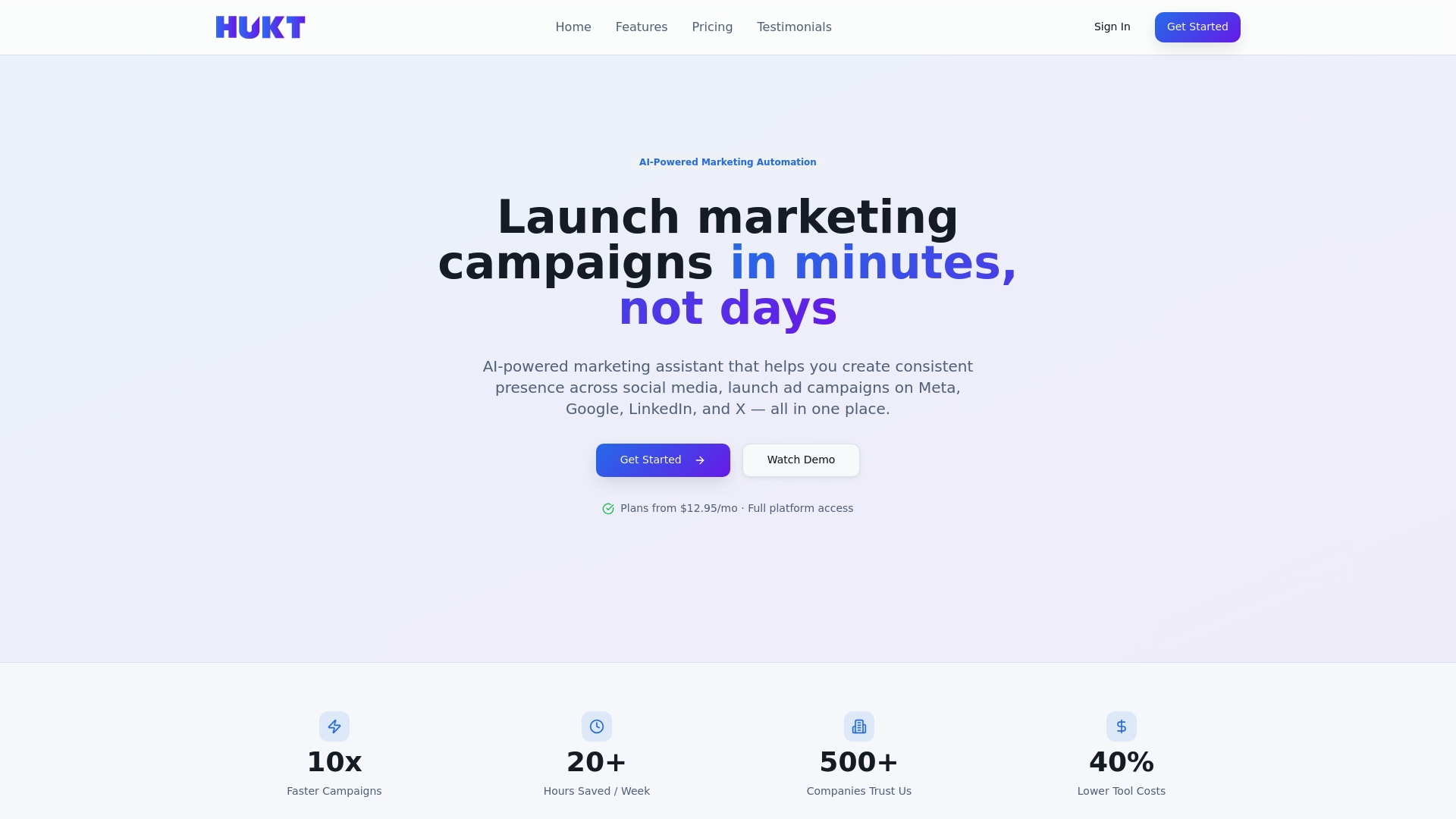
Launching campaigns across Meta, Google, LinkedIn, and X simultaneously no longer requires platform switching or manual coordination. Hukt AI's marketing automation software handles multi-channel campaign deployment while AI-powered analytics track performance in real time. You maintain strategic control while automation handles tactical execution, saving hours per campaign and improving results through continuous optimization. Whether you're managing agency clients or in-house marketing, Hukt AI scales with your needs through flexible plans supporting individual marketers to enterprise teams.
FAQ
What is the key advantage of using AI in ad campaigns?
AI enables real-time optimization that adjusts bids, budgets, and targeting continuously based on performance data. This speed and precision deliver 20-30% higher ROI compared to manual campaign management. AI processes complex data patterns humans can't detect at scale.
How can marketers balance AI automation with human strategy?
Use AI for data processing, pattern detection, and tactical optimizations while reserving strategic decisions for human judgment. AI handles speed and scale, but you provide creative direction, brand alignment, and business strategy. Create clear decision boundaries defining which actions AI handles autonomously.
Which metrics best measure AI-driven campaign success?
Monitor ROI lift compared to baseline campaigns, return on ad spend improvements, and cost per acquisition reductions. Track time saved on optimization tasks and multi-touch attribution insights revealing customer journey patterns. Focus on business outcomes, not vanity metrics.
What are common pitfalls to avoid with AI marketing?
Over-reliance on automation without strategic oversight leads campaigns astray from business objectives. Ignoring data quality corrupts AI learning and produces unreliable recommendations. Failing to monitor continuously wastes AI's real-time optimization advantage. Maintain human oversight and data hygiene.