

Marketing professionals lose an average of 30% of their time managing disconnected platforms. This fragmentation creates operational chaos, inconsistent messaging, and missed opportunities. Channel unification fixes these problems by centralizing control, automating workflows, and enabling synchronized campaigns across Meta, Google, LinkedIn, and X. This guide explains how unifying marketing channels can reduce campaign launch times by up to 30% while boosting performance and cutting costs.
Table of Contents
- Understanding Why Marketing Channels Are Fragmented
- How Channel Unification Enhances Efficiency
- The Impact Of Consistency On Campaign Performance
- The Financial And Operational Benefits Of Unification
- Common Misconceptions About Channel Unification
- Frameworks For Implementing Unified Marketing Strategies
- Quantifying The Impact Of Channel Unification
- Real-World Examples Of Unified Channel Impact
- Discover Hukt AI For Unified Marketing Success
- Frequently Asked Questions About Unifying Marketing Channels
Key takeaways
| Point | Details |
|---|---|
| Launch speed | Unified channels reduce campaign launch times by up to 30%, accelerating go-to-market execution. |
| Message consistency | Consistent messaging across platforms increases engagement and builds customer trust through coherent brand experiences. |
| Cost efficiency | Automation and AI streamline workflows, lowering operational costs by up to 25% while improving productivity. |
| Creative flexibility | Platform-specific tactics remain viable within unified systems, preserving creative customization and targeting precision. |
| Structured implementation | Step-by-step frameworks help marketers transition smoothly from fragmented operations to unified channel strategies. |
Understanding why marketing channels are fragmented
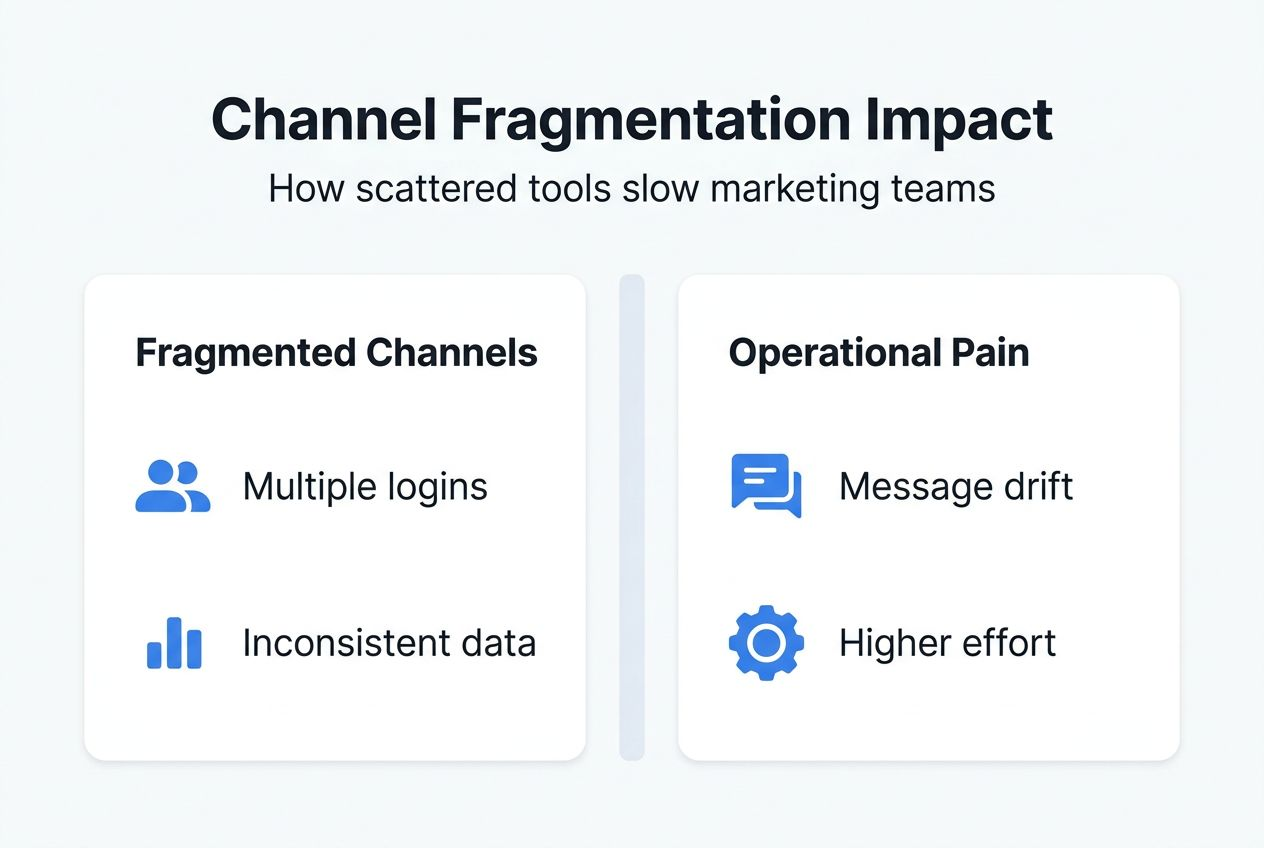
Marketing teams typically manage Facebook Ads, Google Ads, LinkedIn campaigns, and X promotions as separate entities. Each platform requires unique logins, different dashboards, and distinct creative specifications. This separation creates a patchwork system where campaigns launch at different times, messages drift off brand, and performance tracking becomes a manual nightmare.
The root causes include legacy workflows where teams added platforms incrementally without integration planning. Agencies often assign different specialists to each channel, creating silos that rarely communicate. Budget allocation happens in isolation, preventing strategic resource optimization. Technology stacks grow organically, resulting in disconnected tools that don't share data or coordinate actions.
These problems compound quickly:
- Brand messaging varies across platforms, confusing customers and weakening recognition
- Manual content scheduling introduces errors and delays, missing optimal posting windows
- Performance data sits in separate dashboards, making holistic analysis nearly impossible
- Campaign launches stagger across days or weeks instead of synchronized debuts
- Reporting requires manual aggregation from multiple sources, wasting analyst time
Fragmented channels lead to inconsistent messaging and increased operational complexity, directly harming campaign ROI through missed coordination opportunities and duplicated effort. Marketing professionals spend hours toggling between platforms, copying content manually, and reconciling performance metrics. This approach doesn't scale efficiently and creates burnout among team members managing the chaos.
The shift to multi-platform marketing automation addresses these core fragmentation issues by providing centralized orchestration. Without unification, teams remain trapped in reactive cycles, constantly fighting platform complexity instead of optimizing strategy.
How channel unification enhances efficiency
Unified workflows eliminate platform switching by centralizing campaign creation, scheduling, and monitoring. Marketers build campaigns once and deploy simultaneously across Meta, Google, LinkedIn, and X from a single interface. This synchronized approach transforms campaign launches from multi-day ordeals into coordinated events that maximize market impact through precise timing.

Automation removes repetitive manual tasks that consume marketing hours. AI-powered systems schedule content across channels based on optimal engagement windows for each platform. Creative assets adapt automatically to platform specifications while maintaining brand consistency. Reporting consolidates into unified dashboards showing cross-channel performance in real time.
Key efficiency gains include:
- Campaign creation time drops by eliminating redundant setup across separate platforms
- Scheduling automation ensures continuous presence without manual intervention
- Performance monitoring becomes instantaneous through centralized analytics dashboards
- Budget reallocation happens dynamically based on real-time channel performance data
- Team coordination improves when everyone works from shared campaign views
Statistic spotlight: Unified marketing channels can reduce campaign launch times by up to 30%, freeing marketing teams to focus on strategy rather than execution logistics.
Centralized dashboards provide the operational visibility teams need to make fast decisions. Instead of logging into four platforms to check performance, marketers see aggregated metrics showing which channels drive results and which need adjustment. This real-time visibility enables rapid optimization, shifting budgets toward top performers within hours instead of days.
The efficiency transformation extends beyond time savings. Unified systems reduce cognitive load on marketing teams who no longer juggle multiple interfaces, password systems, and platform-specific quirks. Mental energy shifts from operational firefighting to strategic thinking about audience engagement and creative innovation.
Effective marketing strategies brand managers implement rely on this operational efficiency to maintain competitive velocity. When launch cycles compress and optimization accelerates, brands respond faster to market opportunities and competitive threats.
The impact of consistency on campaign performance
Consistent brand messaging across unified channels builds recognition and trust faster than fragmented approaches. Customers encountering the same core message on Facebook, Google search results, LinkedIn feeds, and X timelines develop stronger brand recall. This repetition through coordinated exposure creates mental availability, making your brand the obvious choice when purchase decisions arrive.
Message coherence directly correlates with higher conversion rates. When prospects see aligned value propositions across touchpoints, they perceive professional credibility and strategic clarity. Inconsistent messages create doubt about brand identity and competence, causing prospects to question whether your organization understands its own offerings.
Unified platforms maintain consistency while enabling targeted creativity:
- Core brand values and positioning remain constant across all channels
- Platform-specific creative executions adapt format while preserving message integrity
- Audience targeting customizes delivery without fragmenting brand identity
- Visual brand elements stay consistent, reinforcing recognition through repeated exposure
- Campaign themes coordinate timing and emphasis across channel mix
Consistency builds compound effects over time. Each aligned exposure reinforces previous impressions, creating stronger brand associations than scattered messages ever achieve. Customers develop confidence in brands that present unified narratives, perceiving them as organized, professional, and trustworthy.
"Brands maintaining message consistency across channels experience up to 23% higher revenue growth compared to those with fragmented communications, because customers reward clarity and coherence with loyalty and purchases."
Unified platforms help marketers maintain this consistency without sacrificing creativity. Templates ensure brand guidelines apply automatically while allowing customization for platform contexts and audience segments. A campaign promoting the same offer can use different creative approaches on LinkedIn versus Instagram while maintaining aligned positioning and calls to action.
The operational discipline required for consistency becomes manageable through unified systems. Instead of coordinating message alignment across disconnected platforms manually, teams work from shared campaign structures that enforce coherence by design. This architectural approach prevents drift and ensures every channel reinforces overall strategy.
Leveraging machine learning marketing ROI boost capabilities within unified platforms adds intelligent optimization to consistent messaging, creating campaigns that maintain brand integrity while adapting delivery for maximum impact.
The financial and operational benefits of unification
Operational costs drop significantly when teams consolidate fragmented workflows into unified systems. Managing one integrated platform costs less than maintaining separate subscriptions, training, and specialists for each channel. Platform fees consolidate, training needs simplify, and operational overhead shrinks.
Quantified benefits marketers achieve through channel unification:
| Metric | Improvement Range | Business Impact |
|---|---|---|
| Operational costs | 20-25% reduction | Lower overhead through consolidated tools and streamlined workflows |
| Marketing ROI | 15-20% uplift | Better performance from coordinated campaigns and faster optimization |
| Team productivity | 35-40% increase | More campaigns launched with same resources through automation |
| Campaign launch time | 25-30% faster | Accelerated go-to-market through synchronized deployment |
| Reporting efficiency | 50-60% time savings | Automated analytics eliminate manual data aggregation |
Marketing ROI improvements stem from multiple sources. Coordinated campaigns perform better because consistent messaging reinforces impact across channels. Faster launch cycles mean brands capitalize on opportunities before competitors. Real-time optimization shifts budgets toward top performers immediately instead of waiting for weekly reviews. These factors compound into measurable revenue gains.
Productivity improvements transform team capacity. Marketing professionals launching campaigns in days instead of weeks can execute three times more initiatives annually with identical headcount. This velocity advantage enables rapid testing, faster learning cycles, and more aggressive market presence. Small teams achieve output previously requiring much larger organizations.
Pro Tip: Calculate your potential savings by tracking hours spent on manual platform switching, content copying, and report aggregation weekly, then multiply by your loaded labor cost to see the operational waste channel fragmentation creates.
Reducing operational complexity frees budget for strategic investments. Money previously consumed by platform subscriptions, integration tools, and coordination overhead becomes available for creative development, audience research, and channel expansion. Teams optimize spending mix toward revenue generation rather than operational maintenance.
Effective marketing strategies brand managers implement focus resources on strategy and creativity rather than operational logistics. Financial benefits from unification enable this strategic shift.
Agencies particularly benefit from productivity gains. Serving more clients with existing teams improves margins and competitive positioning. Faster campaign turnaround creates client satisfaction and retention. Sophisticated content marketing workflow agencies implement unified systems to scale operations profitably.
Common misconceptions about channel unification
Many marketers resist channel unification based on misunderstandings about how integrated platforms actually work. Addressing these misconceptions removes barriers preventing teams from capturing efficiency benefits.
Myth 1: Unification eliminates platform-specific tactics. Reality shows unified systems enable targeted customization within coordinated frameworks. You maintain LinkedIn's professional tone while using Instagram's visual storytelling, all from one campaign structure. Platform differences remain respected while coordination improves.
Myth 2: AI automation makes campaigns generic and impersonal. Modern AI platforms generate platform-optimized variations from strategic briefs, maintaining brand voice while adapting format and tone. Personalization increases through better data integration, not decreases.
Myth 3: Unified platforms add operational complexity. Properly designed systems reduce complexity by eliminating redundant logins, scattered data, and manual coordination. Learning one comprehensive platform proves simpler than juggling four separate interfaces.
Key clarifications about unified channel management:
- Creative flexibility increases because unified data shows what works across channels
- Platform-specific best practices get encoded into templates and automation rules
- Team specialization continues, but specialists coordinate through shared systems
- Rapid testing becomes easier when launching variations across channels simultaneously
- Budget optimization improves through centralized performance visibility
Unification complements existing marketing expertise rather than replacing it. Channel specialists maintain their knowledge while gaining tools that amplify impact through coordination. LinkedIn experts still craft professional content, but now deploy it through systems that ensure brand alignment and performance tracking.
Pro Tip: Start with a pilot campaign coordinating two channels through unified tools to experience benefits firsthand before committing to full-scale implementation, reducing perceived risk while building internal proof points.
The benefits of a unified marketing approach become clear once teams experience operational improvements directly. Misconceptions dissolve when marketers see coordination enhancing rather than constraining creativity.
Frameworks for implementing unified marketing strategies
Successful channel unification follows structured implementation frameworks that minimize disruption while maximizing benefit capture. This phased approach builds capability systematically.
Step 1: Audit existing channels and workflows. Document every platform, tool, login, specialist, and process currently managing marketing campaigns. Identify redundancies, gaps, and pain points. Quantify time spent on manual tasks, platform switching, and report aggregation. This baseline reveals improvement opportunities and justifies investment.
Step 2: Integrate platforms into unified technology stack. Select AI marketing automation software that connects your priority channels into centralized control. Implement platform integrations that enable synchronized campaign deployment. Migrate historical data for performance benchmarking. Establish shared dashboards providing team-wide visibility.
Step 3: Implement AI-driven automation for content and scheduling. Configure automation rules for:
- Content generation from strategic briefs into platform-optimized variations
- Scheduled publishing based on engagement data for each channel
- Performance monitoring with automatic alerts for significant changes
- Budget allocation adjustments based on real-time ROI data
- Reporting generation consolidating cross-channel metrics automatically
Step 4: Customize creatives per platform while maintaining brand consistency. Develop templates encoding brand guidelines that automatically apply across channels. Create variation frameworks allowing platform-specific adaptation within coordinated campaigns. Train teams on balancing consistency with contextual relevance.
Step 5: Continuously monitor performance with unified analytics. Establish regular optimization reviews using consolidated dashboards. Implement rapid testing protocols launching variations across channels simultaneously. Build learning systems capturing insights about what works across platform combinations.
Implementation timeline and resource requirements:
| Phase | Duration | Key Activities | Success Metrics |
|---|---|---|---|
| Planning | 2-3 weeks | Audit, vendor selection, integration planning | Comprehensive workflow documentation completed |
| Integration | 3-4 weeks | Platform connections, data migration, team training | All channels operational through unified system |
| Optimization | 4-6 weeks | Process refinement, automation tuning, performance baseline | Campaign launch time reduced by target percentage |
| Scale | Ongoing | Capability expansion, advanced features, team growth | Sustained efficiency gains and ROI improvements |
Successful implementations prioritize quick wins that demonstrate value early. Coordinate one major campaign through the unified system within the first month to prove concept and build team confidence. Capture metrics showing time savings, improved coordination, and performance gains to justify continued investment.
Effective multi-platform marketing automation requires commitment to new workflows and willingness to abandon legacy approaches that create fragmentation.
Quantifying the impact of channel unification
Measuring unified channel impact requires establishing baseline metrics before implementation and tracking improvements systematically. Clear quantification builds organizational confidence and justifies continued investment.
Performance improvements documented across unified channel implementations:
| Performance Category | Metric | Typical Improvement | Measurement Method |
|---|---|---|---|
| Efficiency | Campaign launch time | 25-30% reduction | Days from brief to live campaign |
| Productivity | Campaigns per quarter | 35-40% increase | Total campaigns launched per team member |
| Financial | Operational costs | 20-25% decrease | Marketing overhead as percentage of spend |
| Performance | Marketing ROI | 15-20% uplift | Revenue per marketing dollar across channels |
| Quality | Message consistency | 60-70% improvement | Brand guideline compliance across touchpoints |
ROI uplifts stem from multiple improvement sources. Coordinated messaging increases conversion rates through reinforced exposure. Faster optimization cycles capture performance gains earlier. Reduced operational waste redirects budget toward revenue-generating activities. These factors combine into measurable bottom-line impact.
Campaign productivity improvements enable aggressive testing programs previously impossible with limited resources. Teams launching 40% more campaigns annually learn faster about what resonates with audiences. This accelerated learning cycle compounds competitive advantages over time.
Operational cost reductions provide immediate budget relief. Consolidated platform fees, reduced training needs, and eliminated manual coordination overhead free resources for strategic initiatives. Marketing organizations reinvest savings into creative development, audience research, and channel expansion.
Industry benchmarks show consistent patterns. Brands maintaining unified channel operations outperform fragmented competitors across engagement rates, conversion metrics, and customer lifetime value. The coordination advantage proves durable and difficult for competitors to replicate without similar infrastructure.
Leveraging machine learning marketing ROI boost capabilities within unified platforms adds intelligent optimization that amplifies human strategic decisions with data-driven execution precision.
Real-world examples of unified channel impact
Agencies adopting unified channel platforms document dramatic productivity and performance improvements. One mid-sized agency managing campaigns for 15 clients reduced campaign launch time from 8 days to 3 days through coordinated deployment. This 40% productivity improvement enabled serving five additional clients without adding staff, directly improving agency profitability and competitive positioning.
AI automation success stories highlight operational transformation:
- Marketing team eliminated 20 hours weekly previously spent manually scheduling content across platforms
- Campaign performance improved 18% through synchronized launches creating coordinated market impact
- Creative quality increased because teams focused energy on strategy rather than execution logistics
- Client satisfaction scores rose due to faster turnaround and more sophisticated reporting
Consistent messaging through unified campaigns drives measurable engagement improvements. A B2B software company coordinating LinkedIn, Google, and X campaigns around a product launch saw 27% higher conversion rates compared to previous fragmented launches. Message reinforcement across channels created compound awareness effects that isolated platform campaigns never achieved.
"Implementing unified channel management transformed our agency operations. We're launching campaigns 40% faster, managing more clients with the same team, and delivering better results through coordinated messaging. The efficiency gains are remarkable and sustainable."
Centralized monitoring enables rapid optimization that fragmented approaches can't match. Marketing teams spotting performance patterns across channels shift budgets within hours instead of waiting for weekly reviews. This responsiveness captures opportunities and limits losses from underperforming variations quickly.
Effective marketing strategies brand managers implement demonstrate the competitive advantages unified operations create. Brands coordinating channels outperform competitors still managing platforms separately through superior timing, consistency, and optimization velocity.
Discover Hukt AI for unified marketing success
Hukt AI provides the centralized platform marketing professionals need to unify channels and capture efficiency benefits. The AI-powered system enables coordinated campaign creation, automated scheduling, and real-time performance monitoring across Meta, Google, LinkedIn, and X from one interface.
Accelerate campaign launches while maintaining message consistency through intelligent automation that adapts content for each platform while preserving brand integrity. Boost ROI through rapid optimization enabled by consolidated analytics showing exactly which channel combinations drive results. Reduce operational costs by eliminating redundant tools, manual coordination, and scattered data.
Designed specifically for agencies and marketing teams tackling multi-channel complexity, Hukt AI's marketing automation software transforms fragmented operations into coordinated campaigns that perform better while requiring less effort. Explore how unified channel management creates sustainable competitive advantages through superior efficiency and effectiveness.
Frequently asked questions about unifying marketing channels
What are the top challenges marketers face when unifying marketing channels?
The biggest obstacles include organizational resistance to changing established workflows and concerns about losing platform-specific optimization. Technical integration complexity and data migration create implementation hurdles. Teams worry about maintaining creative flexibility within coordinated systems. These challenges resolve through phased implementation, pilot programs demonstrating quick wins, and platforms designed specifically for multi-channel coordination that preserve customization while enabling unification.
How can AI improve automation without losing personal touch in campaigns?
Modern AI generates platform-optimized variations from strategic briefs while maintaining brand voice and core messaging. Systems analyze performance data to identify what resonates with specific audience segments, enabling hyper-personalization at scale. AI handles repetitive execution tasks like scheduling and format adaptation, freeing marketers to focus on strategic creativity and authentic audience connection. Personalization increases through better data integration rather than decreasing.
Is channel unification suitable for small marketing teams?
Small teams benefit most from unification because efficiency gains multiply limited resources dramatically. Automated coordination enables two-person marketing departments to maintain presence across multiple platforms that previously required much larger teams. Unified systems eliminate operational overhead that disproportionately burdens small organizations. Cost consolidation and productivity improvements make sophisticated multi-channel campaigns accessible to teams operating on constrained budgets.
How do I measure unified campaign performance effectively?
Establish baseline metrics before implementation covering campaign launch time, operational costs, marketing ROI, and team productivity. Track these metrics consistently post-implementation to document improvements. Use consolidated dashboards showing cross-channel performance to identify optimization opportunities. Measure message consistency through brand guideline compliance across touchpoints. Calculate the financial impact of time savings, cost reductions, and performance improvements to quantify total value.
Can I maintain platform-specific targeting within a unified system?
Unified platforms enhance rather than limit targeting precision by providing better data integration across channels. You maintain platform-specific audience segmentation while gaining insights about how segments respond across channel combinations. Targeting rules specific to LinkedIn, Meta, Google, or X remain fully functional within coordinated campaign structures. The advantage comes from centralized visibility showing which targeting approaches work best across your entire channel mix.
How long does implementing unified channel management typically take?
Phased implementations typically span 8 to 12 weeks from initial planning through full operational capability. Planning and platform selection require 2 to 3 weeks. Integration and team training take another 3 to 4 weeks. Optimization and process refinement continue for 4 to 6 weeks as teams develop proficiency. Organizations prioritizing quick wins can coordinate initial campaigns through unified systems within the first month, demonstrating value early while building toward comprehensive capability.