

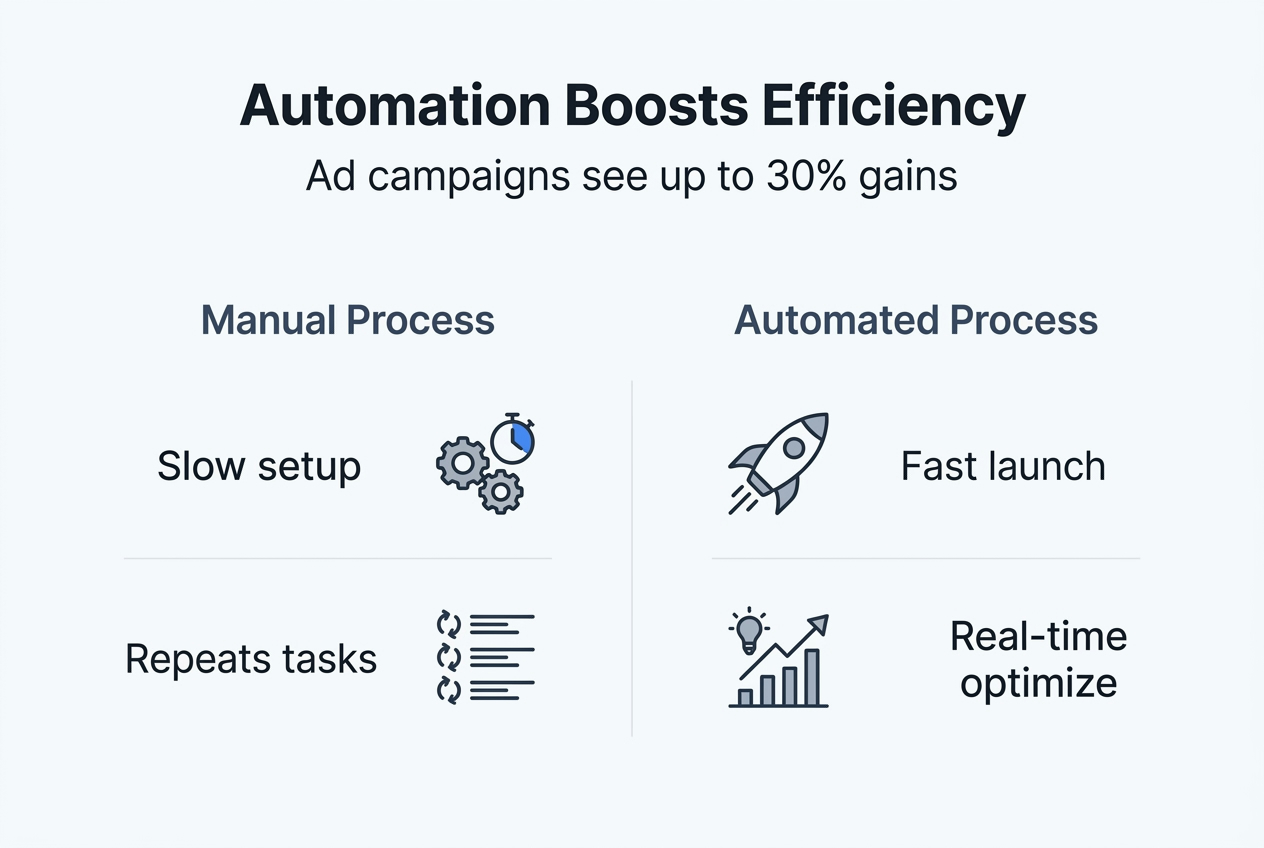
Automation cuts campaign launch times by up to 50% while increasing ROI by 20 to 30%, transforming how digital marketers plan, execute, and optimize ad campaigns. Despite these proven gains, many professionals still hesitate, unsure how automation fits into their creative workflow or worried it might replace human expertise. This guide explains what automation means for modern ad campaigns, how AI powers creative generation and real-time optimization, and provides a practical framework for choosing and implementing the right tools to accelerate your marketing results.
Table of Contents
- Understanding Automation In Digital Advertising
- How Automation Accelerates Campaign Management
- Role Of AI In Creative Content Generation
- Real-Time Optimization And Data-Driven Decisions
- Multi-Platform Campaign Management Made Simple
- Common Misconceptions About Automation
- Framework For Choosing Automation Tools
- Real-World Impact And Case Studies
- Discover Hukt AI Marketing Automation Software
- Frequently Asked Questions
Key takeaways
| Point | Details |
|---|---|
| Speed boost | Automation reduces campaign launch times by up to 50%, letting you execute faster across channels. |
| Creative acceleration | AI generates ad copy and social posts in under 60 seconds while maintaining brand consistency. |
| ROI improvement | Real-time optimization increases ROI by 20 to 30% through dynamic budget allocation. |
| Multi-platform simplicity | Integrated platforms cut operational costs by 25% and eliminate platform switching. |
| Human oversight essential | Automation complements human creativity; strategic control prevents errors and preserves brand voice. |
Understanding automation in digital advertising
Automation in digital advertising refers to software-driven processes reducing manual tasks in campaign planning, creative production, execution, and optimization. It encompasses several key types that work together to streamline your workflow. Creative generation uses AI to produce ad copy, visual concepts, and social media posts at scale. Scheduling and posting automation handles content distribution across channels without manual intervention. Bid and budget optimization continuously adjusts spending based on performance data to maximize returns.
These automated steps integrate seamlessly within your campaign workflows, handling repetitive tasks while you maintain strategic control over messaging, targeting, and overall campaign direction. The synergy between automated execution and human oversight creates a powerful combination where technology handles speed and scale while marketers focus on creative strategy and brand positioning.
Automation applies across major digital ad platforms including Meta, Google Ads, LinkedIn, and X. Each platform offers native automation features, but integrated tools can coordinate campaigns simultaneously across all channels. This cross-platform capability becomes especially valuable for marketing strategies brand managers use to launch AI campaigns efficiently.
Key automation capabilities include:
- Creative asset generation with brand consistency controls
- Automated A/B testing of ad variations
- Dynamic budget allocation based on performance
- Real-time bid adjustments for optimal ad placement
- Scheduled posting across multiple social channels
- Consolidated analytics and reporting dashboards
How automation accelerates campaign management
Automation eliminates repetitive manual tasks that traditionally consume hours of campaign setup time. Instead of manually creating individual ads for each platform, uploading creative assets separately, and configuring targeting parameters repeatedly, automation handles these steps through templated workflows and bulk operations. This shift frees marketers to focus on high-value activities like strategy development and creative conceptualization.

Campaigns that previously required days to launch now go live in hours. Research shows automation reduces launch times by 30 to 50% across channels, with the most significant gains in multi-platform campaigns where coordination complexity traditionally creates bottlenecks. Scheduling and posting automation further accelerates time to market by queueing content in advance and publishing at optimal times without manual intervention.
Streamlined multi-platform posting represents one of automation's biggest advantages. Rather than logging into separate platforms, adapting content for each channel's format requirements, and publishing individually, automation tools let you create once and distribute everywhere. This synchronization ensures consistent messaging across channels while reducing the administrative burden that often delays campaign launches.
Pro Tip: Start by automating your most time-consuming setup tasks and repetitive processes first. This approach delivers the fastest return on your automation investment while building team confidence in the technology.
The speed benefits compound as campaigns scale. Agencies managing dozens of client campaigns simultaneously see the most dramatic improvements, as automation prevents the bottlenecks that occur when human teams try to coordinate complex multi-client, multi-platform operations. For a deeper look at coordinating across channels, explore this multi-platform marketing automation guide for 2026.
Role of AI in creative content generation
AI transforms creative production from a bottleneck into a competitive advantage by generating ad copy, visual concepts, and social posts in seconds rather than hours or days. Modern AI tools analyze your brand guidelines, past campaign performance, and target audience data to produce variations that maintain consistency while personalizing messages for different segments. This capability solves one of the biggest challenges agencies face, where creative teams struggle to produce enough content variations to keep campaigns fresh.
AI-driven creative automation generates ad copies and social posts in under 60 seconds while preserving your brand voice and visual identity. The technology uses natural language processing to understand your brand tone and machine learning models trained on high-performing ad content to suggest compelling messages. For visual content, AI generates layout variations, suggests imagery, and even creates simple graphics based on text prompts.
Typical creative delays that plague agency workflows, such as waiting for designer availability or going through multiple revision rounds, shrink dramatically when AI handles initial drafts. Creative teams then refine and approve AI-generated options rather than starting from scratch. This collaborative approach typically reduces creative production time by 60 to 70% while maintaining quality standards.
AI-generated content types and turnaround times:
- Ad headline variations: 10 to 15 options in under 30 seconds
- Social media post copy: complete posts with hashtags in 45 seconds
- Email subject lines: 20 tested variations in one minute
- Landing page copy blocks: first drafts in two to three minutes
- Display ad copy across sizes: adapted versions in 90 seconds
"AI-generated ads in under 60 seconds represent a fundamental shift in how agencies approach creative production. The technology doesn't replace human creativity but amplifies it, letting teams produce 10 times more content variations while maintaining brand standards. This productivity game changer lets smaller agencies compete with larger shops on creative output."
The connection between AI creative tools and campaign performance extends beyond speed. Rapid variation testing identifies winning messages faster, and the ability to personalize at scale improves relevance scores across platforms. Learn more about how machine learning boosts marketing ROI in 2026 through these capabilities. For additional perspectives on AI in advertising, see this analysis of AI and creative automation in advertising.
Real-time optimization and data-driven decisions
Real-time optimization represents automation's most powerful ROI driver, using live performance data to adjust campaigns continuously rather than waiting for manual reviews. Traditional campaign management relies on periodic check-ins where marketers review metrics, identify underperforming elements, and make adjustments, a process that leaves money on the table during the lag between reviews. Automated optimization eliminates this lag by monitoring performance constantly and shifting resources instantly toward winning combinations.
Real-time analytics improve ROI by 20 to 30% compared to manual optimization approaches. The improvement comes from multiple factors: faster response to performance changes, more granular testing of variables, and elimination of human bias in budget allocation decisions. Dynamic budget reallocation, where the system automatically shifts spending from underperforming channels to high-performers, improves efficiency by 18% on average.
| Metric | Manual Optimization | Automated Real-Time | Improvement |
|---|---|---|---|
| Average ROI | 3.2x | 4.1x | +28% |
| Response Time | 24 to 48 hours | Under 15 minutes | 96% faster |
| Budget Efficiency | 68% | 86% | +18% |
| Wasted Spend | 15% to 20% | 5% to 8% | 60% reduction |
Pro Tip: Pair automated optimization insights with weekly human reviews to ensure algorithmic decisions align with broader campaign goals and market context that AI might miss.
The technology reduces ad spend waste dramatically by identifying and pausing underperforming ad sets before they consume significant budget. Engagement metrics improve as the system learns which creative variations, targeting parameters, and placement strategies work best, then amplifies those winning combinations. This continuous learning cycle means campaigns get smarter over time without manual intervention.
For marketers managing complex multi-channel campaigns, real-time optimization becomes even more critical. Budget shifting between channels based on performance prevents the common problem where one platform drains budget while better opportunities exist elsewhere. Discover how centralized marketing platforms boost efficiency and ROI through these capabilities.
Multi-platform campaign management made simple
Managing campaigns across Meta, Google Ads, LinkedIn, and X manually creates fragmented workflows where marketers spend excessive time switching between platforms, adapting content to different formats, and consolidating performance data from disparate sources. Each platform requires separate logins, has unique interface conventions, and exports data in different formats. This fragmentation increases both time costs and error rates while making holistic campaign optimization nearly impossible.
Centralized automation platforms unify execution and analytics, letting you plan, launch, and monitor campaigns across all channels from a single dashboard. Integrated platforms reduce operational costs by 25% while eliminating the productivity drain of platform switching. The time savings compound across team members, with agencies reporting that centralized tools cut coordination time by 40% for multi-platform campaigns.
| Factor | Manual Fragmented | Centralized Automation | Advantage |
|---|---|---|---|
| Setup Time | 6 to 8 hours | 2 to 3 hours | 60% faster |
| Error Rate | 12% to 15% | 3% to 5% | 70% reduction |
| Cost per Campaign | $450 | $320 | 29% savings |
| Optimization Speed | Days | Hours | 80% faster |
Centralized dashboard advantages for real-time monitoring:
- Unified view of performance across all platforms
- Cross-channel budget allocation in one interface
- Consolidated reporting without manual data compilation
- Consistent tagging and tracking across campaigns
- Team collaboration tools built into workflow
- Single source of truth for campaign performance
The scalability benefits become more pronounced as campaign volume increases. Small teams managing five to 10 concurrent campaigns see moderate efficiency gains, but agencies juggling 50-plus campaigns simultaneously report transformative improvements. The centralized approach also simplifies team collaboration by providing shared visibility and eliminating version control issues that plague email-based coordination.
Error reduction stems from eliminating repetitive manual data entry and format conversions. When you input campaign parameters once and the system adapts them for each platform automatically, transcription errors disappear. The technology also catches common mistakes like budget misconfigurations or targeting overlaps that humans miss when moving quickly. For more on managing complexity across channels, review this multi-platform marketing automation guide for 2026.
Common misconceptions about automation
The fear that automation replaces human creativity represents the most persistent myth holding marketers back from adoption. In reality, automation handles execution tasks while humans maintain strategic control over messaging, brand positioning, and creative direction. AI generates options based on parameters you set, but marketers still choose which directions to pursue, approve final creative, and guide overall campaign strategy. This collaboration amplifies human creativity rather than diminishing it.
Another misconception suggests automation creates impersonal, generic campaigns that lack the nuanced understanding of audience psychology that human marketers bring. Modern AI systems actually enable greater personalization by processing audience data at scale and adapting messages to micro-segments. The technology identifies patterns humans miss and suggests targeting refinements that improve relevance. Rather than generic one-size-fits-all campaigns, automation enables sophisticated personalization previously impossible at scale.
The risk of over-relying on AI without human review does exist and can lead to brand inconsistencies or tone-deaf messaging. Automation requires oversight to catch when algorithms optimize for metrics that don't align with brand values or when AI-generated content misses important context. The solution isn't avoiding automation but implementing proper review workflows where human judgment validates automated decisions.
Common fears and evidence-based reassurances:
- Fear: AI will make all campaigns look the same. Reality: AI enables more variation and testing than manual processes allow.
- Fear: Automation removes the human touch. Reality: It frees humans to focus on strategy and high-value creative thinking.
- Fear: The technology is too complex. Reality: Modern tools prioritize user experience and require minimal technical knowledge.
- Fear: Automation costs more than it saves. Reality: ROI typically appears within the first quarter of implementation.
- Fear: It only works for large enterprises. Reality: Small agencies see proportionally larger efficiency gains.
The balanced approach integrates automation for speed and scale while maintaining human oversight for strategic decisions and brand consistency. This combination delivers the best results, with agencies reporting that hybrid workflows outperform either fully manual or fully automated approaches. Learn more about finding this balance through centralized marketing platforms that boost efficiency and ROI.
Framework for choosing automation tools
Selecting the right automation platform requires systematic evaluation aligned with your specific workflow needs and growth objectives. Integration capability with major ad platforms (Meta, Google Ads, LinkedIn, X) represents the foundational requirement, as tools that don't connect seamlessly with your primary channels create more problems than they solve. Beyond basic connectivity, assess how deeply the integration works, whether it supports bidirectional data sync, and if it handles all the features you use on each platform.
Step-by-step selection framework:
- Audit current workflows to identify your biggest time drains and pain points where automation could deliver immediate value.
- Evaluate AI creative features by requesting demos focused on your content types and testing output quality against your brand standards.
- Test analytics capabilities with your actual campaign data to verify the platform provides insights you'll act on, not just vanity metrics.
- Check scalability by confirming pricing tiers, usage limits, and whether the platform grows with your agency without requiring migration.
- Confirm human oversight features like approval workflows, brand safety controls, and the ability to pause automation when needed.
- Assess user interface through hands-on trials, evaluating whether your team can adopt the tool without extensive training.
Prioritizing integration, AI capabilities, scalability, and real-time analytics in your evaluation ensures the selected tool delivers on automation's core promises. User interface and support quality determine whether your team actually adopts the technology. Even powerful features go unused when interfaces frustrate users or when support can't resolve issues quickly.
Common failure points and framework protections:
- Poor integration causes data sync issues; framework addresses this in step 1 evaluation
- Feature overload creates complexity; focused audit in step 1 identifies must-have features
- Inadequate training prevents adoption; UI assessment in step 6 prioritizes usability
- Cost overruns from unexpected usage; scalability check in step 4 clarifies pricing structure
Pilot testing with a small campaign set before full rollout reduces implementation risk. Start with one client or campaign type, measure results against your manual baseline, and gather team feedback on workflow changes. This incremental approach builds confidence and lets you refine processes before scaling. Plan for ongoing quarterly reviews post-implementation to assess whether the tool still meets evolving needs and to identify optimization opportunities. For additional tool options, explore these top 8 marketing apps that complement automation platforms.
Real-world impact and case studies
Quantified benefits from agencies implementing comprehensive automation platforms demonstrate the technology's transformative potential when properly deployed. Campaigns launch 40% faster on average, with some organizations reporting even greater improvements for complex multi-platform initiatives. ROI improvements of 25% represent typical results, while cost per lead reductions of 22% reflect the efficiency gains from eliminating wasted spend and faster optimization cycles.
A boutique agency managing 15 client accounts implemented an integrated AI automation platform and reduced average campaign launch time from 12 hours to seven hours, a 42% improvement. The speed gain let them accept three additional clients without hiring, effectively increasing revenue per employee by 20%. Creative production bottlenecks disappeared as AI generated initial drafts, and real-time optimization improved client results, leading to higher retention rates.
Enterprise implementations show similar patterns at larger scale. A marketing team managing $2 million in annual ad spend adopted automation and saw ROI improve from 3.8x to 4.9x within six months. The improvement stemmed primarily from faster response to performance changes and more sophisticated budget allocation across channels. Cost per qualified lead dropped 26%, and the team handled 35% more campaigns with the same headcount.
Lessons learned from successful implementations:
- Start focused: Organizations that automated one workflow completely before expanding saw faster ROI than those attempting comprehensive transformation immediately.
- Maintain oversight: Teams that established clear human review checkpoints avoided the brand consistency issues that plagued early automation adopters.
- Train thoroughly: Investment in proper training correlated directly with adoption rates and ultimate ROI realization.
- Measure continuously: Agencies tracking detailed before and after metrics optimized their automation usage more effectively than those relying on general impressions.
Factors contributing to successful adoption include executive sponsorship that prioritizes automation as strategic rather than just another tool, realistic timeline expectations that allow for learning curves, and willingness to refine workflows rather than forcing automation into existing processes unchanged. The most successful implementations view automation as a catalyst for process improvement rather than just a productivity tool. Explore more success stories and strategies in these marketing strategies brand managers use for AI campaigns.
Discover Hukt AI marketing automation software
Ready to transform your campaign management with the automation advantages explored throughout this guide? Hukt AI marketing automation software delivers the integrated platform capabilities that accelerate launches, improve ROI, and simplify multi-channel management. The platform combines AI-powered creative generation, real-time optimization, and centralized campaign execution across Meta, Google Ads, LinkedIn, and X in one intuitive interface.
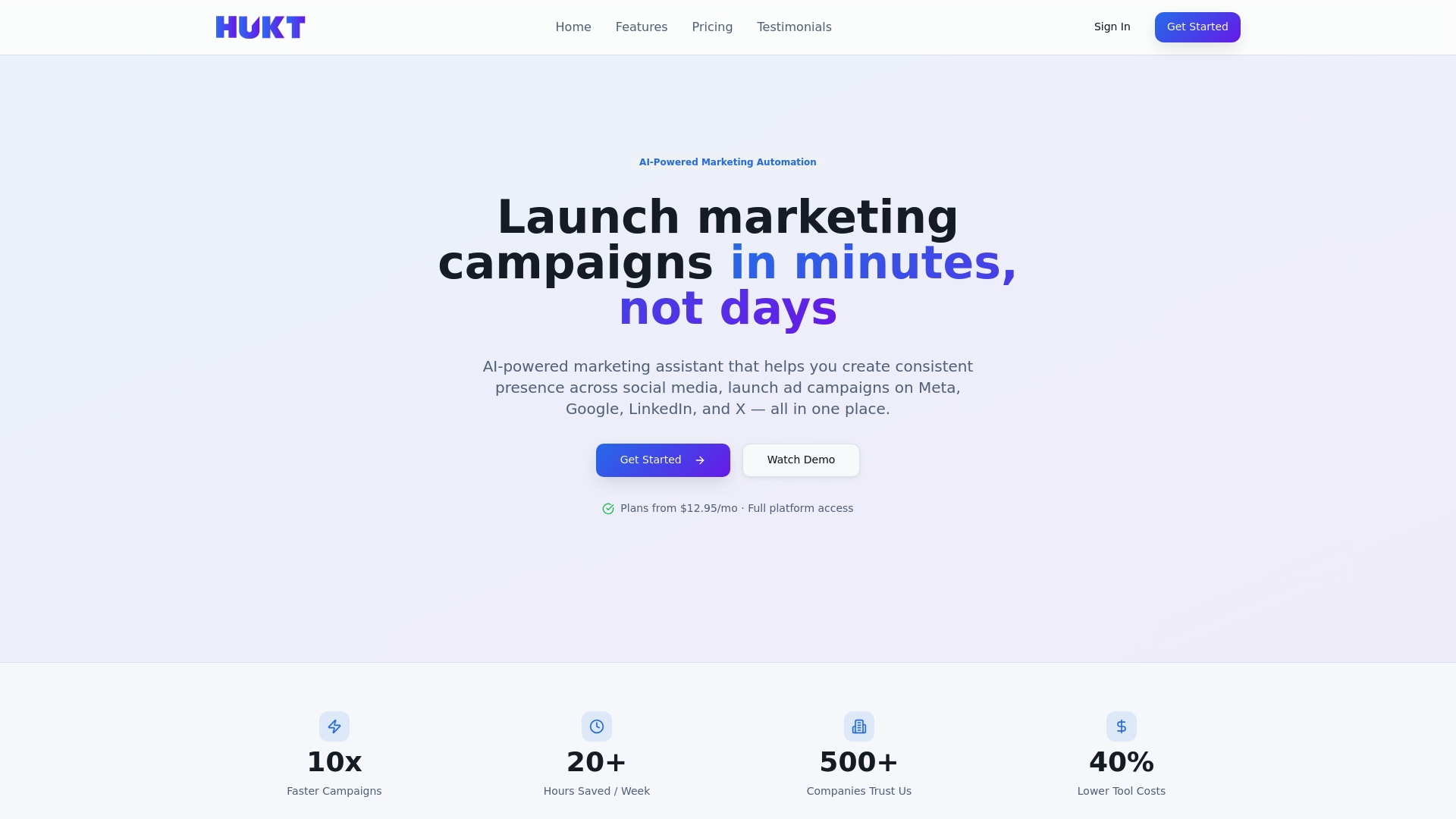
Whether you manage campaigns for a single brand or coordinate dozens of client accounts, Hukt AI scales to match your needs with flexible subscription tiers. The platform's AI generates on-brand creative in seconds, while real-time analytics let you optimize continuously rather than waiting for manual reviews. Explore proven marketing strategies brand managers use to launch AI campaigns 50% faster, or dive into this comprehensive multi-platform marketing automation guide for 2026 to see how integrated tools transform workflows.
Frequently asked questions
What is automation in digital ad campaigns?
Automation uses software and AI to streamline repetitive tasks like creative generation, content scheduling, bid management, and budget optimization in digital advertising. It reduces manual effort while helping you execute campaigns more efficiently across multiple platforms. The technology handles execution speed and scale while marketers maintain strategic control.
How does real-time optimization improve ad campaign performance?
Real-time optimization uses live performance data to adjust budgets, bids, and creative elements instantly rather than waiting for manual reviews. This dynamic approach typically boosts ROI by 20 to 30% compared to periodic manual adjustments by catching and responding to performance changes within minutes instead of days. The continuous monitoring eliminates the lag that wastes budget on underperforming elements.
Can automation replace human creativity in marketing?
No, automation enhances creative processes by handling routine execution tasks, freeing humans to focus on strategic thinking and creative direction. AI generates options based on parameters you set, but marketers still guide overall strategy, approve final creative, and ensure brand consistency. Human oversight remains essential to prevent errors and maintain the nuanced understanding of audience psychology that drives compelling campaigns.
What should I look for when choosing an automation tool?
Prioritize platforms with strong integration across your primary ad channels (Meta, Google Ads, LinkedIn, X), robust AI creative capabilities, real-time analytics, and clear scalability to grow with your needs. Ease of use and built-in human oversight features like approval workflows matter just as much as technical capabilities. Test the user interface thoroughly, as even powerful features go unused when tools frustrate your team.