

Many marketing professionals believe juggling multiple specialized tools delivers superior results. Yet fragmented tools lead to inefficiencies and inconsistent data that slow campaigns and inflate costs. This guide reveals how consolidating marketing tools into unified platforms streamlines workflows, improves data accuracy, and accelerates campaign execution. You'll discover the hidden costs of tool fragmentation, key benefits of consolidation, practical comparison frameworks, and actionable steps to successfully integrate your marketing stack for measurable efficiency gains and better ROI.
Table of Contents
- Key takeaways
- The hidden costs of fragmented marketing tools
- Key benefits of consolidating marketing tools
- Comparing consolidated platforms and standalone tools
- How to successfully consolidate your marketing tools
- Streamline your marketing with Hukt AI automation
- FAQ
Key Takeaways
| Point | Details |
|---|---|
| Tool fragmentation wastes time | Using many disconnected marketing tools forces manual data transfers and constant context switching that reduce focus and waste hours weekly. |
| Single platform improves data consistency | A unified platform provides a single source of truth and eliminates data silos, enabling consistent reporting across channels. |
| Real time insights accelerate decisions | Centralized dashboards surface timely insights that speed optimization and budget reallocation. |
| Automation lowers manual effort | When tools share data and triggers, segments sync automatically and campaigns run with fewer manual steps. |
The hidden costs of fragmented marketing tools
Using multiple disconnected marketing tools creates invisible drains on your budget and productivity. Each platform maintains its own data format, requiring manual exports and reconciliation that consume hours weekly. These transfers introduce errors that corrupt reporting accuracy and delay strategic decisions.
Marketing teams waste 12 to 15 hours per week switching between dashboards and copying data manually. This context switching reduces focus and creates bottlenecks when launching time-sensitive campaigns. Your team spends more time managing tools than optimizing actual marketing performance.

Subscription costs multiply rapidly as you add specialized apps for email, social media, analytics, advertising, and content creation. Each tool requires separate training investments and vendor management overhead. Hidden costs include integration fees, API maintenance, and consultant hours to connect systems that were never designed to work together.
Disconnected channels prevent you from delivering consistent customer experiences across touchpoints. A prospect might see conflicting messages on social media and email because your tools don't share audience data or campaign context. This fragmentation damages brand perception and reduces conversion rates.
Common efficiency drains from tool fragmentation:
- Duplicate data entry across multiple platforms wastes time and introduces errors
- Inconsistent metrics definitions make cross-channel performance comparison impossible
- Delayed reporting prevents real-time campaign optimization and budget reallocation
- Scattered customer data creates incomplete profiles that hurt targeting accuracy
- Manual workflow handoffs between tools slow campaign execution and increase costs
Real-time insights become impossible when data sits trapped in separate systems. By the time you manually compile reports from five different tools, market conditions have shifted and opportunities have passed. Centralized marketing platforms eliminate these delays by providing unified dashboards that surface actionable intelligence instantly.
"Marketing teams using fragmented tools spend 40% of their time on administrative tasks instead of strategy and creative work. Consolidation redirects that effort toward activities that directly impact revenue."
Key benefits of consolidating marketing tools
Consolidating your marketing stack into a unified platform transforms how your team operates and competes. Single-source data eliminates the silos that create conflicting reports and delayed insights. Every team member accesses the same real-time information, enabling faster decisions and coordinated execution across channels.
Unified platforms create seamless customer journeys by maintaining consistent messaging and timing across email, social media, advertising, and content. Your audience experiences your brand as cohesive rather than fragmented. This consistency builds trust and improves conversion rates throughout the funnel.
Automation becomes exponentially more powerful when your tools share data and triggers. Instead of manually copying audiences between platforms, consolidated systems automatically sync segments and orchestrate multi-channel campaigns. This reduces human error and frees your team to focus on strategy rather than repetitive tasks.
Primary advantages of platform consolidation:
- Unified data architecture provides complete customer views and eliminates reporting discrepancies
- Cross-channel orchestration coordinates messaging timing and content across all touchpoints
- Automated workflows trigger actions based on behavior across any channel without manual intervention
- Reduced software costs eliminate redundant subscriptions and integration maintenance fees
- Faster team collaboration removes handoff delays when everyone works in the same system
Team productivity increases dramatically when marketers stop context-switching between tools. Your specialists can launch campaigns, analyze performance, and optimize tactics within a single interface. This streamlined workflow unifies marketing channels for efficiency and accelerates time to market.
Cost savings extend beyond obvious subscription reductions. Consolidated platforms require less training investment because teams learn one system instead of five. Vendor management becomes simpler with a single point of contact for support and billing. IT overhead decreases when you maintain fewer integrations and security protocols.
Pro Tip: Calculate your total cost of ownership by adding subscription fees, integration costs, training time, and manual data reconciliation hours. Most agencies discover fragmented tools cost 40 to 60% more than consolidated platforms when accounting for hidden productivity drains.
Scalability improves when your platform grows with your needs rather than requiring new tools for each channel or function. Adding team members, campaigns, or markets becomes straightforward configuration rather than complex integration projects. This flexibility supports aggressive growth without technical bottlenecks.
Comparing consolidated platforms and standalone tools
Choosing between consolidated platforms and specialized standalone tools requires understanding how each approach impacts your workflow, costs, and results. Standalone tools excel at specific functions but create integration challenges that offset their specialized capabilities. Consolidated platforms trade some feature depth for operational efficiency and unified data.
Standalone tools force constant dashboard switching that fragments attention and slows decision-making. You might use separate apps for email marketing, social scheduling, ad management, analytics, and content creation. Each login and context switch costs mental energy and time that could drive strategy.
Consolidated platforms provide integrated analytics that connect cause and effect across channels. You can trace a customer journey from social ad impression through email nurture to final conversion without stitching together reports from multiple sources. This visibility enables smarter budget allocation and campaign optimization.
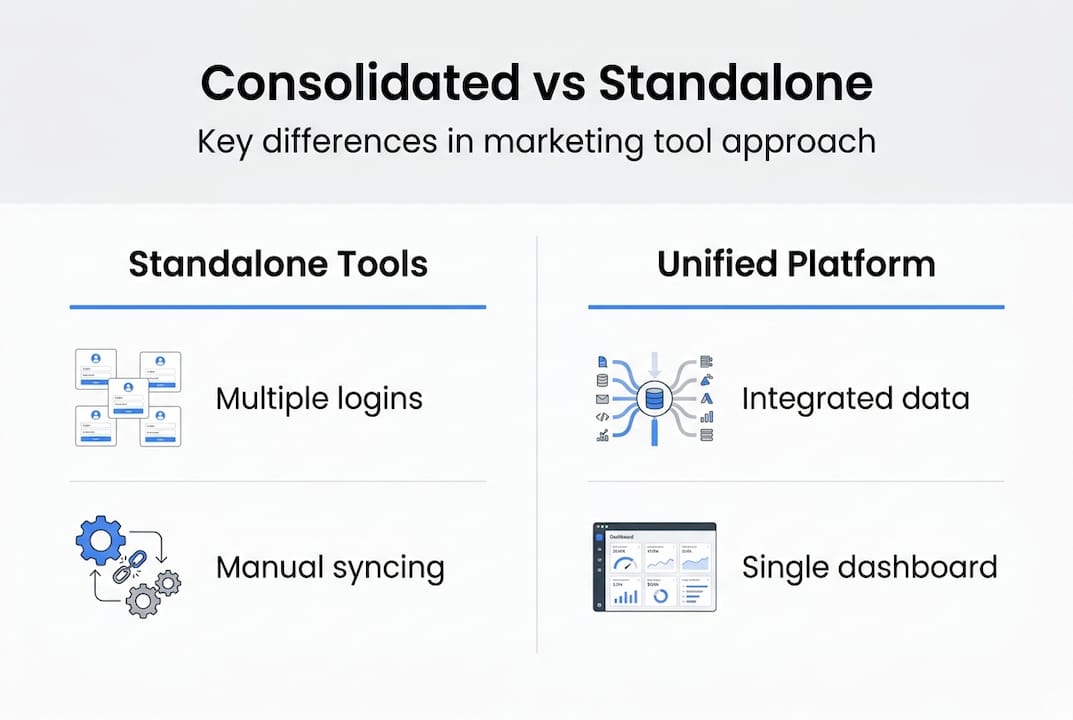
Feature and cost comparison:
| Aspect | Standalone Tools | Consolidated Platform |
|---|---|---|
| Data consistency | Manual reconciliation required | Automatic synchronization |
| Campaign launch time | 3-5 days across tools | 1-2 days in single system |
| Monthly software costs | $800-2000 for 5-7 tools | $400-900 for unified platform |
| Training investment | High (multiple systems) | Moderate (one system) |
| Cross-channel insights | Manual report compilation | Real-time unified dashboard |
| Automation complexity | Requires third-party connectors | Native workflow automation |
Cost analysis reveals surprising savings from consolidation. While standalone tools might appear cheaper individually, subscription fees accumulate rapidly. Adding integration platforms like Zapier to connect them increases costs further. Multi-platform marketing guide research shows consolidated platforms streamline workflows and cut launch time significantly.
Key decision factors for tool selection:
- Team size and collaboration requirements across departments or locations
- Campaign complexity and number of active channels you manage simultaneously
- Budget constraints including software, training, and integration maintenance
- Technical capabilities and IT support available for managing multiple systems
- Growth trajectory and need for scalable solutions that expand with your business
Smaller teams benefit most from consolidation because they lack resources to manage complex tool ecosystems. A three-person agency gains more from unified workflows than specialized features they rarely use. Larger enterprises might justify standalone tools for specific high-volume channels while consolidating others.
Pro Tip: Run a 30-day time audit tracking hours spent on tool management versus strategic work. If your team spends more than 25% of time on administrative tasks like data transfers and report compilation, consolidation will deliver immediate productivity gains.
Platform selection should prioritize your most critical workflows and pain points. If campaign launch speed matters most, choose platforms with strong automation and multi-channel publishing. If analytics depth drives decisions, prioritize unified reporting and attribution modeling capabilities.
How to successfully consolidate your marketing tools
Successful consolidation requires methodical planning to avoid disrupting active campaigns and losing valuable historical data. Rushing the transition creates gaps that damage performance and frustrate teams. A structured approach minimizes risk while maximizing the efficiency gains that justify consolidation.
Start by auditing your current tool ecosystem and workflows. Document every platform, its primary function, integration points, and monthly costs. Map how data flows between systems and identify manual handoffs that create bottlenecks. This visibility reveals which tools create the most friction and should be consolidated first.
Set specific, measurable goals for your consolidation project beyond vague efficiency improvements. Target concrete outcomes like reducing campaign launch time by 50%, cutting software costs by $500 monthly, or eliminating 10 hours of weekly manual reporting. Clear objectives help you evaluate platforms and measure success.
Step-by-step consolidation process:
- Audit current state by documenting all tools, costs, workflows, and pain points comprehensively
- Define success metrics including time savings, cost reductions, and performance improvements you expect
- Research platforms that match your channel mix, team size, and budget constraints
- Plan staged migration moving one function at a time to minimize disruption and validate results
- Execute data migration carefully preserving historical information and testing accuracy thoroughly
- Train teams systematically on new workflows and automation capabilities before going live
- Optimize continuously by measuring results against goals and refining processes monthly
Platform selection demands evaluating technical capabilities against your specific needs. Generic comparison charts miss nuances like API reliability, customer support quality, and feature roadmap alignment with your growth plans. Request demos focused on your actual workflows rather than generic presentations.
Migration timing matters significantly for campaign-driven businesses. Avoid consolidating during peak seasons when any disruption threatens revenue. Schedule transitions during slower periods when teams have capacity to learn new systems and troubleshoot issues without pressure.
Pro Tip: Create a rollback plan before migrating each function. Maintain your old tools in read-only mode for 60 days so you can access historical data if needed. This safety net reduces anxiety and allows confident commitment to the new platform.
Team training determines whether consolidation delivers promised efficiency gains. Invest in comprehensive onboarding that covers both technical features and strategic workflow changes. Reduce marketing costs with automation by ensuring teams fully leverage new capabilities rather than replicating old manual processes in new tools.
Monitor performance metrics closely during the first 90 days after consolidation. Track campaign launch times, reporting accuracy, team satisfaction, and cost savings against your baseline. Quick wins build momentum while identifying areas needing additional training or process refinement.
Streamline your marketing with Hukt AI automation
Consolidating your marketing tools delivers the efficiency gains and cost savings this guide describes, but choosing the right platform makes the difference between frustration and transformation. Hukt AI marketing automation software integrates content creation, multi-channel campaign management, and performance analytics in one AI-powered platform designed specifically for marketing professionals and agencies.
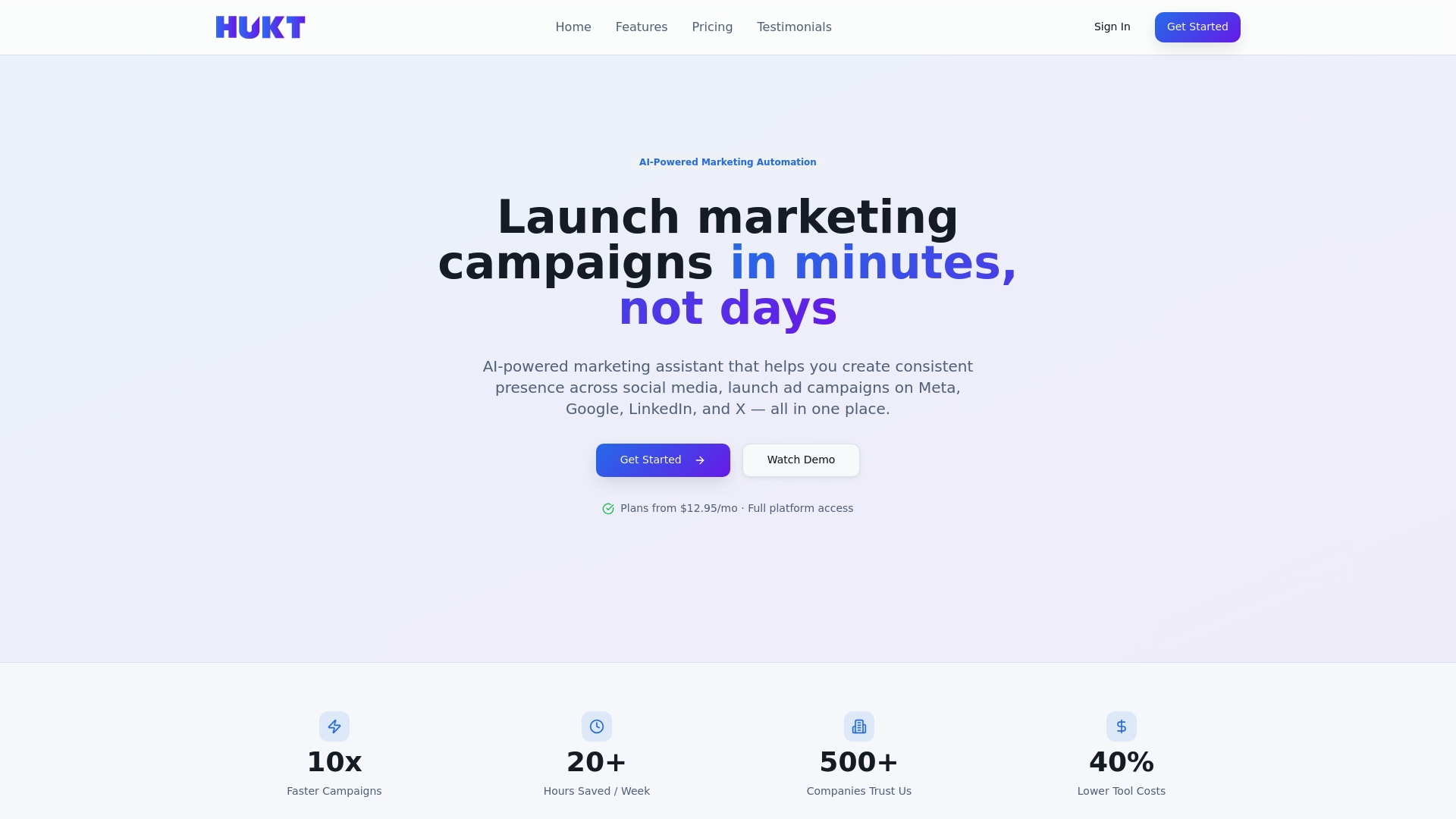
Hukt AI eliminates the tool fragmentation that slows your campaigns and inflates costs. Launch coordinated campaigns across Meta, Google, LinkedIn, and X simultaneously without platform switching or manual data transfers. AI-powered content generation creates consistent ad copy and social posts in minutes rather than hours. Real-time analytics dashboards surface insights that drive immediate optimization decisions. Tiered subscription plans scale with your team from individual marketers to full agencies, providing the consolidated efficiency and automation capabilities that modern marketing demands.
FAQ
What does it mean to consolidate marketing tools?
Consolidating marketing tools means combining multiple separate marketing functions into one integrated platform that handles content creation, campaign management, analytics, and automation together. This unified approach reduces complexity by eliminating the need to switch between different dashboards and manually transfer data between systems. Consolidation creates a single source of truth for customer data and campaign performance. It streamlines workflows and improves team collaboration by giving everyone access to the same real-time information.
How does consolidating tools improve marketing ROI?
Unified platforms reduce duplicated efforts and eliminate redundant software subscriptions that drain budgets unnecessarily. Automation accelerates campaign execution and improves targeting accuracy by maintaining consistent customer data across all channels. Teams spend less time on administrative tasks and more time on strategic activities that directly impact revenue. Consolidation improves ROI via efficiency and automation that reduce costs while improving campaign performance and conversion rates.
What are common challenges when consolidating marketing tools?
Migrating historical data without loss or downtime requires careful planning and technical expertise that many teams underestimate. Teams need comprehensive training to adapt to new consolidated systems and abandon familiar workflows from their old tools. Existing processes must be reviewed and redesigned to align with new platform capabilities rather than simply replicating old manual methods. Change management becomes critical as team members resist learning new systems and adjusting established habits.
Which marketing tools are best to consolidate first?
Start with tools creating the most manual work or data silos, particularly email marketing, advertising platforms, and analytics systems that require constant data transfers. Consider centralized marketing platforms offering integration across multiple channels for better results and faster efficiency gains. Prioritize consolidating tools where your team spends the most time on administrative tasks rather than strategic work. Focus on high-impact areas where unified data will improve decision-making and campaign performance most significantly.