

Marketing costs continue climbing in 2026, squeezing budgets and forcing professionals to do more with less. Rising ad spend, platform fees, and content production expenses create mounting pressure on agencies and in-house teams alike. The good news? AI-powered automation now offers proven strategies to cut costs by 30% or more while actually improving campaign performance. This guide walks you through preparing, implementing, and optimizing AI marketing automation to reduce expenses without sacrificing results. You'll learn practical tactics to streamline workflows, eliminate waste, and maximize every marketing dollar.
Table of Contents
- Understanding The Marketing Cost Problem In 2026
- Preparing To Reduce Marketing Costs: Tools And Prerequisites
- Executing Cost Reduction Strategies With AI Marketing Automation
- Verifying And Optimizing Marketing Cost Savings
- Maximize Your Marketing Cost Savings With Hukt AI
- How To Reduce Marketing Costs Frequently Asked Questions
Key takeaways
| Point | Details |
|---|---|
| Automation cuts costs significantly | AI-driven tools reduce marketing expenses by 30% while improving campaign efficiency and ROI. |
| Preparation is essential | Choose centralized platforms and align your team before implementing automation strategies. |
| Execution requires strategy | Follow step-by-step tactics to automate repetitive tasks and optimize resource allocation effectively. |
| Continuous optimization matters | Track metrics regularly and refine approaches to sustain cost savings and performance gains. |
Understanding the marketing cost problem in 2026
Marketing budgets face unprecedented pressure this year. Marketing professionals face rising costs and pressure to maximize ROI in 2026, making efficiency a top strategic priority. Understanding where money disappears helps you target the biggest opportunities for savings.
The primary cost drivers in modern marketing include:
- Paid advertising across multiple platforms eating 40-60% of budgets
- Content creation requiring expensive designers, writers, and video producers
- Marketing technology stack subscriptions accumulating monthly fees
- Agency fees or full-time salaries for specialized roles
- Testing and optimization consuming time without guaranteed returns
These expenses compound when teams work in silos, switching between platforms and duplicating efforts. Manual campaign management means paying people for repetitive tasks that software could handle instantly. Poor targeting wastes ad spend on audiences unlikely to convert. Inefficient workflows create bottlenecks that delay launches and reduce campaign volume.
The urgency to solve these problems intensifies as competition increases and customer acquisition costs rise. Brands that fail to optimize operations fall behind competitors leveraging automation. The solution lies in marketing efficiency in 2026 through intelligent systems that reduce manual work, improve targeting, and accelerate execution. Smart automation doesn't just cut costs, it frees your team to focus on strategy and creativity instead of repetitive execution.
Preparing to reduce marketing costs: tools and prerequisites
Successful cost reduction starts before you implement any automation. Laying proper groundwork prevents expensive mistakes and ensures your team adopts new systems smoothly. Think of this phase as building the foundation for sustainable savings.
First, evaluate your current marketing technology stack honestly. Many teams pay for overlapping tools that create more complexity than value. Centralized marketing platforms greatly boost efficiency and ROI by consolidating functions into unified systems. Instead of juggling separate tools for ads, social media, analytics, and content creation, you manage everything from one dashboard.
When selecting AI-powered marketing tools for 2026, prioritize platforms offering:
- Multi-channel campaign management across Meta, Google, LinkedIn, and X
- AI-driven content generation for ad copy, social posts, and creative concepts
- Automated scheduling and publishing to maintain consistent presence
- Real-time analytics dashboards showing performance across all channels
- Integration capabilities with your existing CRM and data sources
Research shows that top marketing apps streamline campaign management and reduce overhead significantly. Look for solutions designed specifically for your team size and use case rather than enterprise platforms with features you'll never use.
| Preparation Step | Purpose | Expected Time |
|---|---|---|
| Audit current tools | Identify redundancies and gaps | 1-2 weeks |
| Define automation goals | Set clear cost and efficiency targets | 3-5 days |
| Clean and organize data | Ensure quality inputs for AI systems | 2-3 weeks |
| Train team members | Build confidence with new platforms | 1-2 weeks |
Data readiness proves critical for AI success. Your automation tools need clean, organized customer data to generate accurate targeting and personalization. Spend time consolidating scattered spreadsheets, updating contact lists, and establishing consistent naming conventions. This upfront investment pays dividends when your AI systems can instantly access the information they need.

Team alignment matters just as much as technology. Schedule workshops explaining how automation will change daily workflows and why it benefits everyone. Address concerns about job security by emphasizing that automation handles tedious tasks, freeing people for higher-value strategic work. Designate automation champions within each department to support adoption and troubleshoot issues.
Pro Tip: Start with one or two core platforms rather than trying to automate everything simultaneously. Master the basics, prove ROI, then expand your automation footprint systematically. Tool overload creates confusion and resistance instead of efficiency gains.
Executing cost reduction strategies with AI marketing automation
With preparation complete, you're ready to implement automation tactics that deliver measurable cost savings. This section provides step-by-step guidance for deploying AI tools that reduce expenses while improving campaign performance.
Follow this implementation sequence for best results:
- Begin with content creation automation by setting up AI tools to generate ad copy variations, social media posts, and campaign concepts instantly instead of waiting days for human writers.
- Configure multi-platform campaign launches so you can deploy ads across Meta, Google, LinkedIn, and X simultaneously from one interface, eliminating platform switching time.
- Activate AI-powered scheduling to maintain consistent social media presence without manual posting, freeing 5-10 hours weekly per team member.
- Implement automated audience targeting using machine learning algorithms that identify high-value segments more accurately than manual selection.
- Set up real-time analytics dashboards that surface performance insights automatically, replacing time-consuming manual reporting.
- Enable automated A/B testing that continuously optimizes ad creative, copy, and targeting without human intervention.
Research confirms that automation in ad campaigns can boost efficiency by 30%, delivering substantial cost savings through reduced labor and improved performance. The key lies in choosing the right tasks to automate first.
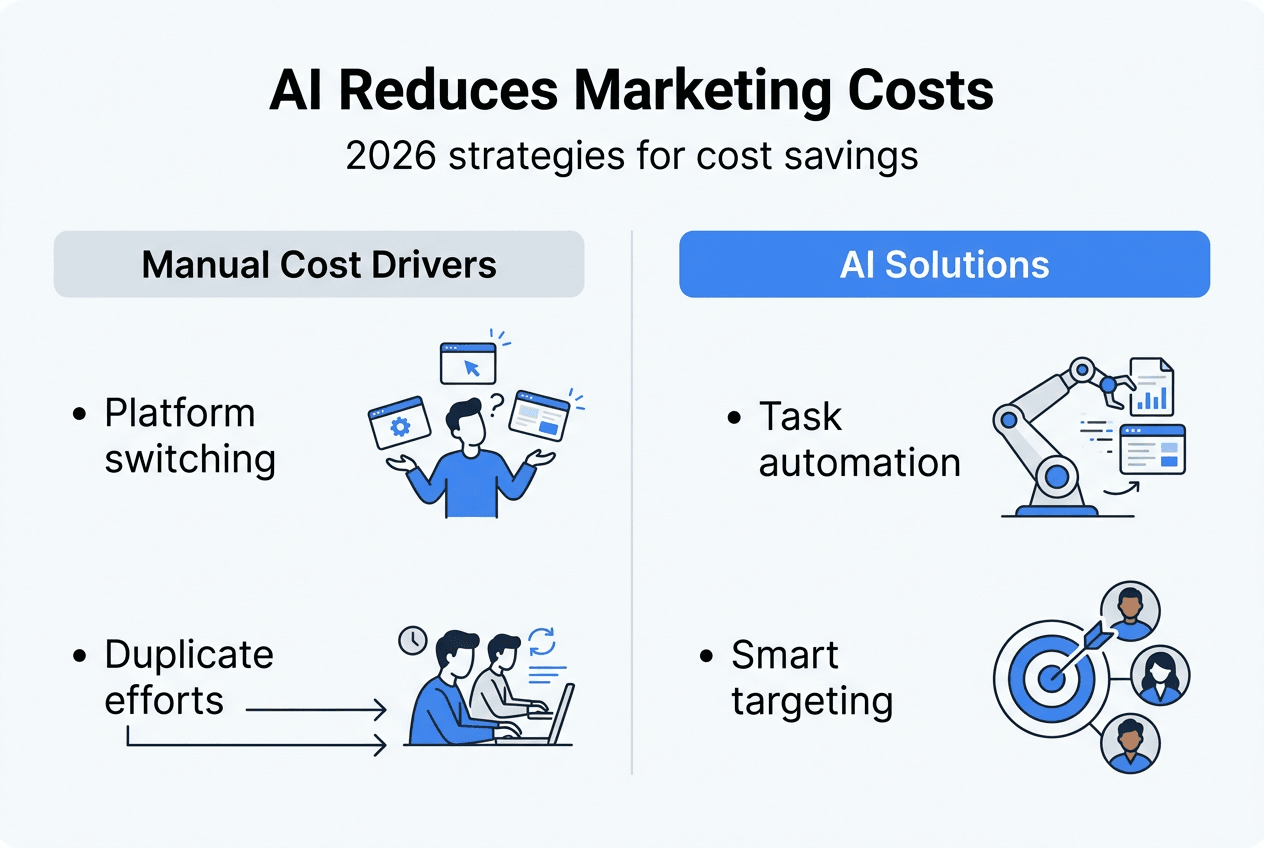
Focus automation efforts on repetitive, time-consuming activities that don't require human creativity or strategic judgment. Content formatting, campaign setup, bid management, and performance monitoring consume hours but follow predictable patterns. Let AI handle these while your team concentrates on strategy, messaging, and creative direction.
| Approach | Time Investment | Cost Savings | Performance Impact |
|---|---|---|---|
| Manual campaign management | 15-20 hours/week | Baseline | Variable results |
| Partial automation | 8-10 hours/week | 25-35% reduction | 15-20% improvement |
| Full AI automation | 3-5 hours/week | 40-50% reduction | 30-40% improvement |
The data shows clearly that comprehensive automation delivers superior results. Studies demonstrate that machine learning marketing ROI can increase by 30% in 2026 when properly implemented. Machine learning algorithms continuously improve targeting and optimization based on performance data, achieving results impossible through manual management.
Start small with low-risk campaigns to build confidence. Use AI to generate content variations for A/B tests, then compare performance against your traditional approach. Once you see positive results, expand automation to additional campaign types and channels. This gradual rollout reduces risk and gives your team time to adapt.
Pro Tip: Monitor your automation systems closely during the first month, checking daily for issues or unexpected behavior. AI tools learn from data, so initial performance may vary until algorithms accumulate enough information. Set clear performance thresholds and be ready to adjust settings or pause campaigns if results fall short.
Verifying and optimizing marketing cost savings
Implementing automation represents just the beginning. Sustained cost reduction requires ongoing verification and optimization to ensure systems deliver promised savings while maintaining campaign quality. Establish measurement frameworks before you need them.
Track these key metrics to verify cost reductions:
- Total marketing spend per month compared to pre-automation baseline
- Cost per acquisition showing efficiency gains in converting prospects
- Time spent on campaign management tasks by team members
- Campaign launch velocity measuring how many campaigns you deploy monthly
- Return on ad spend demonstrating improved performance from better targeting
Create a simple dashboard displaying these metrics side by side with historical data. Update it weekly during the first quarter after implementing automation, then monthly once patterns stabilize. Look for trends rather than day-to-day fluctuations, as marketing performance naturally varies.
Optimization techniques that sustain and enhance efficiency include:
- Regular AI model retraining using fresh performance data to improve accuracy
- Quarterly audits of automated campaigns to identify underperformers
- A/B testing of AI-generated content against human-created alternatives
- Continuous refinement of audience targeting parameters based on conversion data
- Integration of new automation features as platforms release updates
Research shows that multi-platform marketing automation can cut launch time by 40%, improving cost efficiency substantially. Faster launches mean you can test more campaign variations, identify winners quickly, and scale successful approaches before competitors catch on.
| Optimization Area | Frequency | Impact on Savings |
|---|---|---|
| Audience targeting refinement | Weekly | High |
| Creative performance analysis | Bi-weekly | Medium |
| Platform mix adjustment | Monthly | High |
| Budget reallocation | Monthly | Very High |
| Tool stack consolidation | Quarterly | Medium |
Watch for common pitfalls that erode savings over time. Teams sometimes add new tools without removing old ones, recreating the bloated tech stack they initially streamlined. Others set automation systems then ignore them, missing optimization opportunities or failing to catch performance drops. Establish regular review schedules to prevent these issues.
Implement a data-driven framework for continuous improvement. Each month, identify your three worst-performing campaigns and your three best performers. Analyze what differentiates them, then apply insights from winners to improve or replace losers. This systematic approach compounds gains over time.
Don't expect perfection immediately. AI systems improve with data, so performance typically increases over the first 60-90 days as algorithms learn your audience and optimize delivery. Benchmark against your pre-automation performance rather than theoretical ideals. Celebrate incremental wins while working toward larger goals.
Maximize your marketing cost savings with Hukt AI
The strategies outlined above work even better when you have the right platform supporting your efforts. Hukt AI marketing automation software consolidates everything discussed into one unified system designed specifically for marketing professionals and agencies seeking cost efficiency.
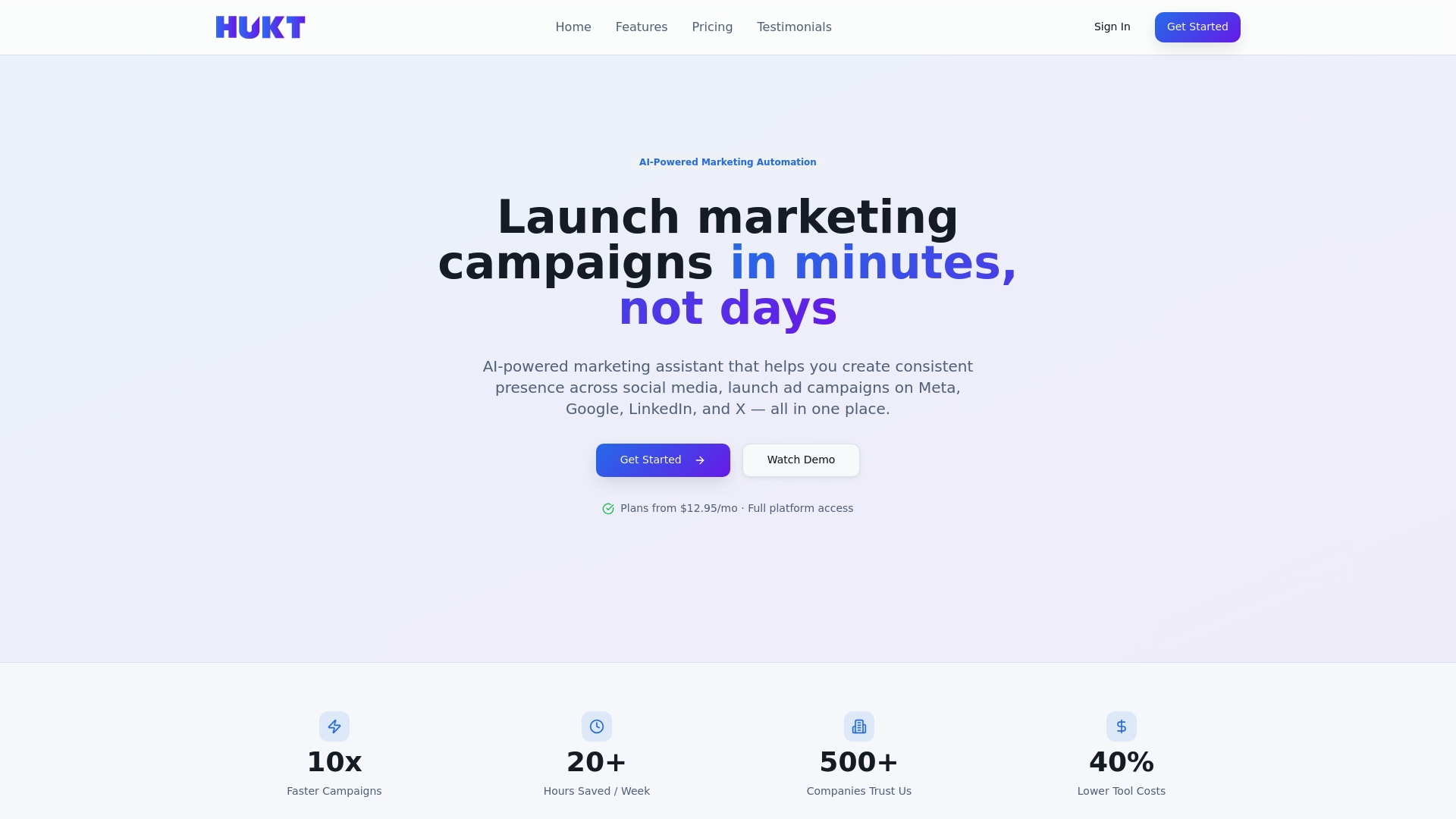
Hukt AI delivers AI-powered content generation, multi-platform campaign launches, automated scheduling, and real-time analytics in a single dashboard. You eliminate platform switching, reduce tool subscriptions, and accelerate campaign execution dramatically. The platform's machine learning algorithms continuously optimize targeting and creative performance, delivering the 30% efficiency gains and 40% faster launch times referenced throughout this guide. Explore how Hukt AI can transform your marketing operations and reduce costs while improving results.
How to reduce marketing costs frequently asked questions
How quickly can I expect to see cost savings from AI marketing automation?
Most teams notice initial savings within 30-45 days as automation reduces time spent on manual tasks. Substantial cost reductions of 25-30% typically materialize after 90 days once AI algorithms optimize performance and you eliminate redundant tools.
What skills does my team need to run automated marketing campaigns effectively?
You need basic digital marketing knowledge and comfort with software platforms, but no coding or technical expertise. Modern AI tools feature intuitive interfaces designed for marketers, not engineers. Focus on strategic thinking and creative skills while automation handles execution.
Can automation maintain personalization, or will campaigns feel generic?
Quality AI platforms enhance personalization by analyzing customer data at scale and tailoring messages to individual preferences. Automation enables more personalization than manual approaches because systems can process millions of data points humans cannot. The key is feeding your AI tools clean, comprehensive customer data.
Should I automate everything at once or start small?
Start with one or two high-impact areas like content generation and multi-platform campaign launches. Master these, prove ROI, then expand systematically. This approach reduces risk, builds team confidence, and allows you to refine processes before scaling.
How do I measure ROI from marketing automation investments?
Compare total marketing costs and performance metrics before and after automation implementation. Track time savings, reduced tool subscriptions, improved conversion rates, and increased campaign volume. Calculate the difference between automation platform costs and total savings to determine net ROI.