

Choosing the right marketing channels can make or break your startup's growth trajectory. With limited budgets and countless options, founders often waste resources testing tactics that don't fit their stage or audience. This guide cuts through the noise by presenting eight proven startup marketing strategies tailored to drive visibility and revenue efficiently. You'll learn how to prioritize high-impact channels, match tactics to your growth stage, and measure what truly matters. Whether you're validating your first product or scaling to seven figures, these frameworks will help you allocate resources strategically and accelerate sustainable growth.
Table of Contents
- Key takeaways
- How to select the right marketing channels for your startup
- 8 essential startup marketing strategies for growth
- Tailoring marketing strategies to your startup stage
- Effective testing and optimization for startup marketing
- Discover AI-powered marketing automation to accelerate growth
- FAQ
Key Takeaways
| Point | Details |
|---|---|
| Focus on core channels | Limit efforts to two to three high impact channels like SEO, content marketing, and paid ads to maximize ROI. |
| Strategy by stage | Align tactics with your startup's current phase whether validation, growth, or scaling to optimize resource use. |
| Track meaningful metrics | Prioritize revenue related metrics that reflect actual profitability and growth over vanity metrics. |
| Organic CAC advantage | Organic channels typically deliver lower customer acquisition cost than paid channels over the long term. |
How to select the right marketing channels for your startup
The biggest mistake early-stage founders make is spreading efforts across too many platforms simultaneously. This spray-and-pray approach dilutes your message, exhausts your team, and makes it impossible to determine what's actually working. Instead, focus on 2-3 high-impact channels like SEO, content marketing, and paid ads rather than trying to maintain presence everywhere.
Your channel selection should align with your current startup stage. Validation-stage companies need direct customer feedback and niche positioning, not broad awareness campaigns. Early growth requires testing multiple channels to identify scalable funnels. Scaling demands doubling down on proven winners while optimizing efficiency.
Resource constraints force strategic choices. A two-person team can't execute ten marketing channels effectively. Concentrate your limited budget and human capital on channels where your ideal customers actually spend time. B2B SaaS startups often find LinkedIn and content marketing more effective than Instagram, while consumer apps might prioritize TikTok and influencer partnerships.
Pro Tip: Use top marketing apps to track performance metrics for each channel from day one. Double down on channels showing strong early signals like low cost per lead or high engagement rates. Cut underperformers ruthlessly after giving them fair testing windows of 60-90 days.
The key is maintaining disciplined focus. Every new channel adds complexity, requires learning curves, and demands ongoing optimization. Master your core channels before expanding. This focused approach lets you build expertise, optimize campaigns deeply, and achieve better results than competitors scattered across a dozen platforms.
8 essential startup marketing strategies for growth
These eight tactics represent the highest-leverage opportunities for startups at different stages. Each offers distinct advantages depending on your product, audience, and resources.
-
Search engine optimization (SEO) builds organic visibility that compounds over time. Unlike paid ads that stop working when you stop paying, quality content ranks for years. SEO typically delivers 40-60% lower CAC than paid channels, making it essential for sustainable growth. The tradeoff is patience, results take 6-12 months to materialize meaningfully.
-
Content marketing establishes thought leadership while nurturing prospects through the buyer journey. Blog posts, guides, and case studies answer customer questions, build trust, and support SEO efforts. This strategy works exceptionally well for complex B2B products requiring education before purchase.
-
Paid advertising provides immediate market feedback and customer acquisition. Platforms like Google Ads and Meta let you test messaging, targeting, and offers quickly. However, product-led growth models show $379 CAC versus $1,120 for sales-led approaches, so match your ad strategy to your business model.
-
Social media marketing builds brand awareness and community engagement. Choose platforms where your audience congregates. B2B founders should prioritize marketing efficiency by focusing on LinkedIn rather than maintaining profiles across every network.
-
Email marketing nurtures leads cost-effectively with personalized sequences. Automated drip campaigns keep prospects engaged while you focus on product development. Email consistently delivers among the highest ROI of any channel.
-
Direct outreach and cold emailing work exceptionally well for bootstrapped startups targeting specific niches. Personalized outreach to 50 ideal customers beats generic campaigns to 5,000 random prospects. This approach validates product-market fit before scaling broader channels.
-
Referral programs leverage existing customer networks for trusted growth. Happy users become your sales force when incentivized properly. Dropbox famously grew through referrals by offering storage space for invites.
-
Influencer partnerships provide targeted reach in specific niches. Micro-influencers with engaged audiences often outperform celebrities for startup budgets. This tactic builds credibility quickly in communities where trust matters.
Pro Tip: Combine organic and paid strategies for balanced acquisition. Use paid ads to validate messaging quickly, then build organic channels for scalable marketing growth that improves economics over time.
| Channel | Typical CAC | Scalability | Best Stage | Expected ROI |
|---|---|---|---|---|
| SEO | Low | High | Growth/Scale | Very High |
| Content Marketing | Low | High | All Stages | High |
| Paid Ads | High | Very High | Validation/Scale | Medium |
| Social Media | Medium | High | Growth/Scale | Medium |
| Email Marketing | Very Low | High | All Stages | Very High |
| Direct Outreach | Low | Low | Validation | High |
| Referral Programs | Very Low | Medium | Growth/Scale | Very High |
| Influencer Partnerships | Medium | Medium | Growth | Medium |
This comparison helps you unify marketing channels strategically based on your current resources and growth objectives. Notice how organic channels dominate long-term ROI while paid tactics excel at speed and validation.
Tailoring marketing strategies to your startup stage
Your marketing approach must evolve as your startup matures. What works at $5K monthly recurring revenue fails at $500K. Evolve strategy by startup stage: validation requires different tactics than scaling.
Validation stage ($0-$10K MRR) demands deep customer understanding before broad marketing. Focus on:
- Customer development interviews to refine messaging and positioning
- Direct outreach to 50-100 ideal customer profile targets
- Niche community engagement where early adopters congregate
- Landing page tests to validate value propositions
At this stage, avoid expensive paid campaigns. Your goal is learning, not scale. Every conversation provides insights that shape product and marketing strategy. Budget should stay minimal while you prove people will pay for your solution.
Early growth ($10K-$100K MRR) shifts focus to identifying scalable channels. Test diverse tactics systematically:
- Launch content marketing with 2-4 posts monthly targeting bottom-funnel keywords
- Run small paid ad experiments across 2-3 platforms
- Build email nurture sequences for leads not ready to buy
- Establish social presence on one primary platform
Systematic experimentation reveals which channels deliver qualified leads efficiently. Track cost per acquisition and conversion rates religiously. This phase determines your scalable marketing cost effective growth formula for the next stage.
Scaling ($100K+ MRR) means doubling down on proven winners while optimizing ruthlessly. Your priorities shift to:
- Increasing budget on channels with strong LTV:CAC ratios above 3:1
- Implementing marketing automation to improve efficiency
- Hiring specialists for your top-performing channels
- Testing incremental improvements through structured experiments
Pro Tip: Use data-driven metrics like LTV:CAC ratio to guide investment decisions. Channels showing ratios above 3:1 with reasonable payback periods under 12 months deserve increased budget. Cut or minimize channels falling below these thresholds even if they feel productive.
Maintain budget flexibility to shift resources toward highest ROI tactics as you learn. The channel mix that worked at $10K MRR rarely matches what works at $1M. Continuous optimization based on actual performance data beats rigid annual plans.
Effective testing and optimization for startup marketing
Systematic experimentation separates successful startups from those that burn cash on ineffective tactics. Experiment systematically: run A/B tests and iterate rapidly while tracking revenue metrics over vanity numbers.

Structure each test to isolate one variable. Changing headline, image, and call-to-action simultaneously makes it impossible to know what drove results. Test headline variations first, then optimize the winner's imagery, then refine the call-to-action. This methodical approach builds knowledge about what resonates with your audience.
Measure meaningful KPIs that connect to revenue:
- Cost Per Acquisition (CPA) shows what you pay for each customer
- Return On Ad Spend (ROAS) reveals revenue generated per dollar spent
- Payback period indicates how quickly customers become profitable
- Conversion rates at each funnel stage identify optimization opportunities
Avoid vanity metrics like total page views, social media followers, or email list size. These numbers feel good but don't predict business success. A campaign generating 10,000 impressions but zero sales fails, while 100 impressions converting 5 customers at healthy margins succeeds brilliantly.
Iterate quickly to scale effective campaigns and stop underperformers. Set decision thresholds before testing begins. If an ad set doesn't generate leads under $50 after spending $500, kill it and try something new. Emotional attachment to creative ideas wastes money.
Use analytics tools to gain insights on customer behavior and channel efficiency. Optimize marketing ROI with analytics by tracking user paths from first touch to conversion. Understanding which touchpoints matter most lets you allocate budget strategically.
"The startups that win aren't necessarily the ones with the best initial strategy. They're the ones that test fastest, learn continuously, and adapt their approach based on real market feedback rather than assumptions."
Pro Tip: Prioritize experiments that can be run with minimal budget but deliver quick learnings. A $200 ad test teaching you which headline resonates provides more value than a $10,000 campaign built on untested assumptions. Start small, validate hypotheses, then scale winners aggressively.
Structured testing transforms marketing from expensive guesswork into a predictable growth engine. Each experiment builds knowledge about your customers, refines your messaging, and improves campaign performance systematically.
Discover AI-powered marketing automation to accelerate growth
Implementing these strategies manually across multiple channels overwhelms small teams quickly. AI marketing automation streamlines campaign launches while optimizing your channel mix based on performance data.
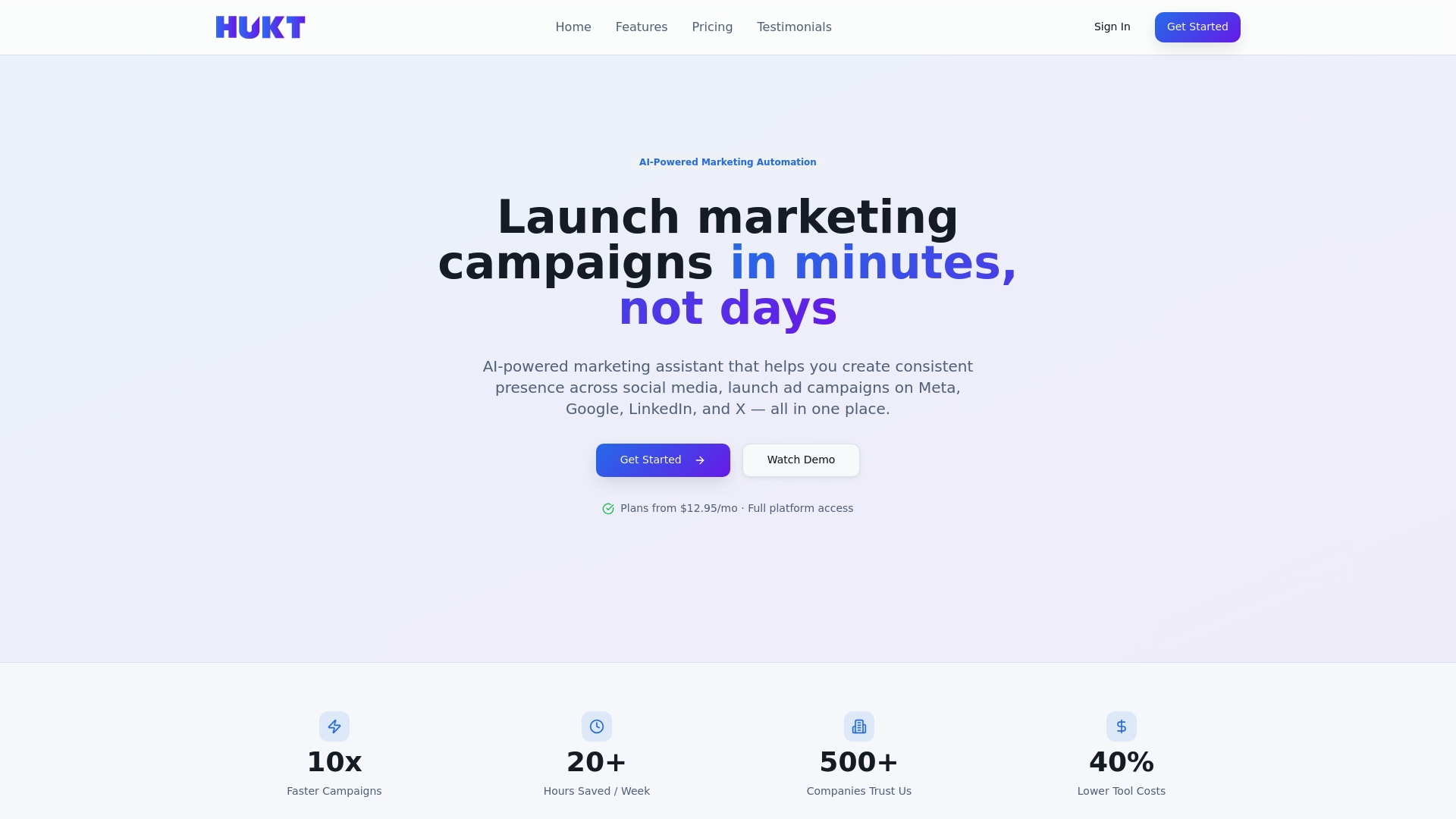
The Hukt AI platform helps startups execute sophisticated multi-channel campaigns without hiring large marketing teams. Generate ad copy, social posts, and campaign concepts in minutes rather than hours. Launch coordinated campaigns across Meta, Google, LinkedIn, and X simultaneously from one dashboard. Real-time analytics show which channels and messages drive actual conversions, letting you optimize spend dynamically.
Automation complements your strategy by handling repetitive tasks like content creation, scheduling, and performance tracking. This frees your team to focus on strategic decisions, creative direction, and customer relationships that truly require human judgment. Explore AI marketing automation software designed specifically for resource-constrained startups targeting efficient growth.
FAQ
What are the most cost-effective marketing channels for early-stage startups?
Organic channels like SEO and content marketing typically deliver the lowest Customer Acquisition Costs, often 40-60% below paid alternatives. Direct outreach and niche community engagement also minimize spend while validating product-market fit. These tactics require more time than money, making them ideal when cash is tight but founder effort is available.
How do I know when to scale a marketing channel?
Scale a channel after testing demonstrates strong Return on Advertising Spend (ROAS) and healthy LTV:CAC ratios consistently above 3:1. Look for decreasing payback periods and consistent lead quality as additional signals. If a channel shows these metrics over 60-90 days, gradually increase budget while monitoring whether performance holds at higher volumes.
What metrics should startups track to evaluate marketing success?
Track revenue-related metrics like Customer Acquisition Cost (CAC), Lifetime Value (LTV), Payback Period, Cost Per Acquisition (CPA), and Return On Ad Spend (ROAS) rather than vanity numbers. These metrics provide actionable insights for optimizing spend and channel focus. Add conversion rates at each funnel stage to identify specific optimization opportunities.
Is paid advertising worth it for bootstrapped startups?
Paid ads can validate markets and messaging quickly, making them valuable for specific tests even on tight budgets. However, bootstrapped startups should prioritize organic tactics and direct outreach before scaling paid spend significantly. Use small paid experiments to learn fast, then build sustainable organic channels for long-term growth as cash flow improves.