

Choosing the right marketing automation strategy can feel overwhelming with countless platforms promising better engagement and revenue. Marketing professionals and agencies need proven examples to guide their decisions and avoid costly missteps. This article presents real-world marketing automation examples with measurable results, comparing AI-driven and rule-based approaches to help you select strategies that genuinely improve campaign efficiency, customer engagement, and ROI. You'll discover specific case studies, evaluation criteria, and actionable recommendations to transform your marketing operations.
Table of Contents
- Key takeaways
- Criteria for evaluating marketing automation strategies
- Case studies of AI-driven marketing automation with measurable results
- Comparing marketing automation approaches: AI vs. rule-based systems
- Recommended marketing automation strategies for agencies and marketers
- Explore AI marketing automation software with Hukt AI
- Frequently asked questions
Key Takeaways
| Point | Details |
|---|---|
| Automation drives engagement and revenue | Track opens, clicks, conversions, and revenue attribution to gauge impact. |
| Segmented AI personalization boosts orders | Tailor messages by behavior and segment to lift average order value and sales growth. |
| Balance automation with human touch | Incorporating human oversight prevents fatigue and preserves brand authenticity. |
| Core workflows to master | Welcome series, abandoned cart, and lead nurture are the foundational workflows every marketer should implement. |
Criteria for evaluating marketing automation strategies
Understanding the core mechanics of marketing automation helps you evaluate which strategies will work best for your campaigns. Every automation workflow consists of four essential components: a trigger event that initiates the sequence, an action or series of personalized messages, a loop or exit condition based on user behavior, and a measurable output like engagement rates or revenue impact. Common trigger events include new subscriber signups, cart abandonment, content downloads, or specific browsing behaviors that signal purchase intent.
The most effective automation strategies use behavior-based loops that adapt to how recipients interact with your messages. If someone opens your welcome email but doesn't click, the system automatically sends a different follow-up than it would to someone who clicked through to your product pages. This dynamic adjustment creates personalized experiences at scale without manual intervention. The three foundational workflows every marketing team should master are welcome series for new subscribers, abandoned cart recovery sequences, and lead nurture campaigns that guide prospects through your sales funnel.
When evaluating automation options, focus on measurable criteria that directly impact your bottom line. Look at engagement rates like email opens and clicks, conversion metrics including form submissions and purchases, and revenue attribution that connects automation efforts to actual sales. Lead scoring systems that assign points based on prospect behaviors help prioritize your highest-value opportunities. However, implementing decay mechanisms where scores decrease over time prevents you from chasing cold leads that showed interest months ago but have since moved on.
Pro Tip: Start by automating your existing high-performing campaign segments rather than building entirely new workflows from scratch. This approach lets you test automation with proven content and audiences, reducing risk while you learn what works. You can refine triggers and sequences based on real performance data before expanding to additional segments.
Frequency caps are essential for preventing marketing fatigue that damages your sender reputation and annoys customers. Set maximum limits on how many automated messages a single contact can receive per day or week across all your campaigns. This prevents the common scenario where someone triggers multiple automation sequences simultaneously and gets bombarded with emails. Balancing automation efficiency with respect for your audience's inbox creates sustainable marketing strategies brand managers can rely on for long-term success.
Case studies of AI-driven marketing automation with measurable results
Real-world examples demonstrate how AI-powered automation transforms campaign performance with concrete numbers you can benchmark against. Prism Global Marketing implemented AI-powered email automation that increased opens by 18.9%, clicks by 14.3%, and generated $141,000 in incremental revenue for their B2B clients. The system analyzed past engagement patterns to predict optimal send times for each recipient and dynamically adjusted subject lines based on what historically performed best for similar audience segments.
Salesforce Einstein AI delivered even more dramatic improvements for e-commerce brands, with 40% higher open rates, 20% click-through increases, and 15% growth in email-driven sales. The platform used predictive analytics to determine which products each customer was most likely to purchase next, personalizing product recommendations in automated emails based on browsing history, past purchases, and similar customer behavior patterns. This level of individualization at scale would be impossible with manual campaign management or simple rule-based automation.

Building materials retailer Byggmax implemented AI personalization across 10 distinct customer segments, increasing average order value by 15% and supporting their $1 billion e-commerce revenue. The system automatically adjusted product recommendations, promotional offers, and content messaging based on each segment's unique characteristics and purchase patterns. Contractors received different automated sequences than DIY homeowners, with content tailored to project size, buying frequency, and product preferences learned from historical data.
These cases illustrate several key benefits of segment-focused AI automation. The technology handles complexity that would overwhelm marketing teams trying to manually personalize at this scale. It continuously learns and improves based on new data, adapting strategies faster than humans can analyze performance reports and make adjustments. The results prove that sophisticated AI marketing delivers measurable ROI, not just theoretical advantages.
The most successful implementations share common technical features:
- Dynamic content personalization that adapts email copy, subject lines, and product recommendations to individual recipients
- Send-time optimization that predicts when each contact is most likely to engage based on their past behavior
- Multi-channel integration connecting email, SMS, and push notifications in coordinated sequences
- Predictive analytics that forecast customer lifetime value and churn risk to prioritize retention efforts
- Automated A/B testing that continuously experiments with message variations and implements winning combinations
Comparing marketing automation approaches: AI vs. rule-based systems
Understanding the differences between AI-driven and traditional rule-based automation helps you choose the right approach for your specific needs and resources. Both methods deliver value, but they excel in different scenarios and require different levels of investment and technical sophistication.
| Feature | AI-Driven Automation | Rule-Based Systems |
|---|---|---|
| Personalization | Dynamic, learns from behavior patterns | Fixed rules, manual segmentation |
| Flexibility | Adapts automatically to new data | Requires manual rule updates |
| Data requirements | Needs substantial historical data | Works with basic contact information |
| Setup complexity | Higher initial configuration | Simpler to implement |
| Ongoing optimization | Self-improving algorithms | Manual testing and adjustments |
| Cost | Higher upfront investment | Lower initial costs |
AI systems excel when you have large, diverse audiences where individual personalization significantly impacts conversion rates. They continuously analyze engagement patterns, purchase history, and behavioral signals to predict what each contact wants to see next. This makes them ideal for e-commerce brands with extensive product catalogs, B2B companies with long sales cycles requiring nurture sequences, and media companies personalizing content recommendations. The technology handles complexity that would require dozens of manual rules to approximate.
Rule-based automation works well for simpler, more predictable workflows where the logic doesn't need to change frequently. A straightforward abandoned cart sequence that waits 2 hours then sends a reminder email doesn't require AI sophistication. Welcome series that deliver the same content to all new subscribers, event reminder sequences, and basic lead scoring based on explicit actions like form submissions or demo requests all work perfectly with traditional automation. These approaches cost less upfront and are easier for smaller teams to manage without specialized data science expertise.
Marketing automation benchmarks show average ROI of 353-478%, with $6.71 returned for every dollar spent, 451% more qualified leads, and 53% conversion improvement when lead scoring is properly implemented. Both AI and rule-based systems can achieve strong returns, but AI typically delivers higher lead quality and conversion rates by identifying subtle patterns humans miss. The key is matching your approach to your data availability, team capabilities, and the complexity of customer journeys you're trying to automate.
Key advantages of AI-driven automation:
- Predictive lead scoring that identifies high-value prospects before they explicitly signal purchase intent
- Automatic content optimization that tests variations and implements winners without manual intervention
- Churn prediction that triggers retention campaigns before customers disengage
- Cross-channel orchestration that coordinates messaging across email, SMS, social, and ads
Key advantages of rule-based automation:
- Simpler implementation requiring less technical expertise and shorter setup time
- Predictable behavior that's easier to troubleshoot when issues arise
- Lower data requirements making it accessible for newer businesses with limited history
- Transparent logic that marketing teams can understand and explain to stakeholders
The best approach often combines both methods, using AI for complex personalization decisions while relying on rules for straightforward workflows. This hybrid strategy lets you optimize marketing ROI by applying sophisticated technology where it delivers the most value while keeping simpler processes manageable and cost-effective.
Recommended marketing automation strategies for agencies and marketers
Implementing automation effectively requires starting with high-impact, low-risk campaigns that deliver measurable results quickly. Focus first on automated workflows that address universal customer needs and have proven track records across industries. Welcome series for new subscribers, abandoned cart recovery sequences, and post-purchase follow-ups consistently deliver strong returns because they respond to clear behavioral triggers with relevant, timely messages. These quick wins build internal support for expanding automation efforts while you learn what works for your specific audience.
Before launching any automation, audit your data infrastructure to ensure compliance and performance. Verify that you have proper consent for all contacts in your database, with clear opt-in records that meet privacy regulations. Check that your CRM integration is working correctly, with customer data flowing smoothly between systems without duplicates or sync errors. Poor data quality undermines even the most sophisticated automation strategies, sending irrelevant messages to the wrong people at the wrong times. Clean, well-organized data is the foundation that makes automation effective.
When implementing AI-powered automation, use phased rollouts and lead scoring with decay mechanisms to reduce risk and improve results. Start by testing new AI features with a small segment of your audience, perhaps 10-20% of your list, before rolling out to everyone. This limits your exposure if something goes wrong while giving you real performance data to evaluate. Lead scoring systems should include decay that reduces scores over time for contacts who haven't engaged recently, preventing your sales team from wasting effort on cold leads. Combine this with frequency caps that limit how many automated messages any single contact receives per week.
A/B testing within automation workflows should focus on one variable at a time for clear insights. Test subject lines separately from send times, and content variations separately from calls to action. Testing multiple changes simultaneously makes it impossible to know which element drove performance differences. Run tests long enough to achieve statistical significance, typically requiring at least several hundred recipients per variation and multiple send cycles to account for day-of-week effects.
Transparency builds trust and reduces unsubscribe rates even as you increase automation sophistication. Make it easy for contacts to update their preferences, choosing which types of messages they want to receive and how frequently. Clearly explain why they're receiving each automated message, referencing the action that triggered it. This respect for audience preferences prevents the customer fatigue that damages sender reputation and campaign performance over time.
Measure success using revenue per recipient rather than vanity metrics like total emails sent or list size growth. Calculate the actual revenue generated by each automation workflow divided by the number of contacts who entered it. This metric directly connects your automation efforts to business outcomes, making it easy to identify which workflows deserve more investment and which need improvement. Track this alongside engagement metrics like open and click rates, but always tie performance back to revenue impact when making strategic decisions about your AI ad campaign strategy.
Pro Tip: Integrate your automation platform with your CRM and analytics tools before building complex workflows. This connectivity ensures you have complete visibility into how automated campaigns influence the entire customer journey, from first touch through purchase and retention. You'll spot opportunities to optimize that would be invisible if you only looked at email metrics in isolation.
Agencies managing automation for multiple clients should develop standardized workflow templates that can be customized for each account. Build libraries of proven sequences for common scenarios like lead nurture, customer onboarding, and re-engagement campaigns. This approach lets you deploy effective automation faster while maintaining the flexibility to adapt messaging and timing to each client's unique audience and business model. Document your testing results and share insights across accounts to continuously improve your machine learning marketing capabilities and deliver better results for every client.
Explore AI marketing automation software with Hukt AI
Now that you understand proven automation strategies and implementation best practices, you need powerful tools to put these insights into action. Hukt AI offers a comprehensive platform designed specifically for marketing professionals and agencies seeking to maximize campaign efficiency through intelligent automation. The system combines AI-driven content generation, multi-channel campaign orchestration, and real-time analytics in a single interface that eliminates platform switching and streamlines your entire workflow.
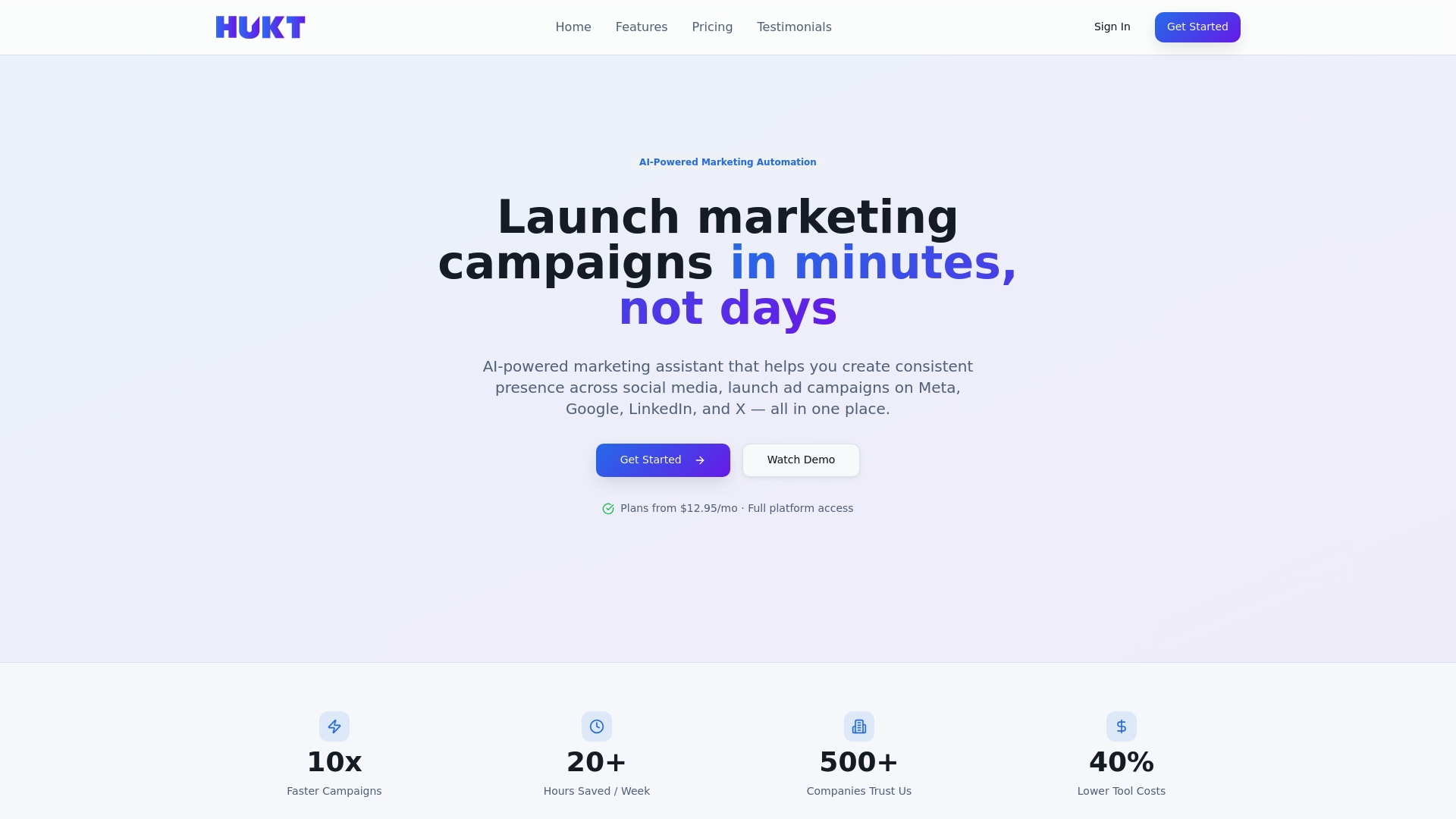
Hukt AI's automation capabilities include dynamic personalization that adapts messaging to individual recipients, predictive send-time optimization that identifies when each contact is most likely to engage, and sophisticated lead scoring that prioritizes your highest-value opportunities. The platform supports coordinated workflows across email, social media, and paid advertising channels, ensuring consistent messaging while respecting frequency caps that prevent customer fatigue. Real-time dashboards let you monitor performance and make data-driven optimizations without waiting for end-of-campaign reports.
Pro Tip: Start your Hukt AI implementation by connecting your existing CRM and testing automation with a small segment of your highest-value customers. This approach reduces risk while you familiarize yourself with the platform's capabilities, letting you refine workflows based on real performance data before scaling to your entire audience.
Explore additional marketing strategies for brand managers to discover how AI-powered automation integrates with broader campaign planning and execution. The combination of strategic thinking and sophisticated automation tools positions your marketing efforts for sustainable growth and continuously improving ROI.
Frequently asked questions
What are some common marketing automation examples?
Welcome email series for new subscribers, abandoned cart recovery sequences, lead nurturing workflows that guide prospects through sales funnels, and post-purchase follow-up campaigns are the most widely used automation examples. SMS follow-ups, social media scheduling, and re-engagement campaigns for inactive contacts also deliver strong results across industries.
How does marketing automation improve campaign efficiency?
Automation triggers personalized messages based on specific user behaviors without manual intervention, ensuring timely, relevant communication at scale. This eliminates repetitive tasks, reduces human error, and allows marketing teams to focus on strategy and creative development rather than campaign execution logistics.
What makes AI-powered automation more effective than traditional methods?
AI systems analyze vast amounts of behavioral data to predict optimal send times, personalize content recommendations, and identify high-value leads before they explicitly signal purchase intent. This predictive capability and continuous learning delivers higher engagement rates and conversion improvements compared to static rule-based workflows.
What are best practices for implementing marketing automation ethically?
Phased rollouts that test new automation with small audience segments before full deployment reduce risk and improve results. Implement frequency caps limiting how many messages contacts receive per week, provide clear preference centers where recipients control their communication, and maintain transparency about why they're receiving each automated message.
How should I measure marketing automation success?
Track revenue per recipient by dividing total revenue generated by each workflow by the number of contacts who entered it. This metric directly connects automation efforts to business outcomes. Monitor engagement metrics like open and click rates alongside conversion data, but always evaluate performance based on actual revenue impact rather than vanity metrics like list size or total emails sent.
Can small businesses benefit from marketing automation?
Yes, automation delivers value for businesses of all sizes by eliminating repetitive tasks and ensuring consistent customer communication. Start with simple rule-based workflows for welcome series and abandoned carts before investing in more sophisticated AI-powered personalization as your audience and data grow.