

Marketing campaigns powered by data deliver up to 20% higher ROI than traditional approaches. This guide reveals how to leverage behavioral insights, analytics, and AI automation to optimize targeting, reduce waste, and accelerate campaign success across every digital platform in 2026.
Table of Contents
- Understanding The Role Of Data In Modern Marketing
- Types Of Marketing Data And Their Impact On Campaigns
- How Analytics And Automation Enhance Marketing Effectiveness
- Common Misconceptions And Pitfalls In Data-Driven Marketing
- Frameworks And Best Practices For Leveraging Marketing Data
- Real-World Case Studies: Data-Driven Campaign Success Stories
- Unlock Growth With AI Marketing Automation
Key takeaways
| Point | Details |
|---|---|
| ROI impact | Data-driven strategies boost ROI by 15-20% compared to non-data approaches. |
| Targeting precision | Behavioral and first-party data enable personalized campaigns that increase engagement by up to 30%. |
| Automation advantage | AI-powered tools reduce campaign launch time by 40% and improve conversions by 18%. |
| Quality matters | Poor data quality can reduce campaign effectiveness by 25%, making integration and audits critical. |
| Framework approach | Analytics maturity models guide marketers from descriptive reporting to prescriptive optimization. |
Understanding the role of data in modern marketing
Data has become the foundation of successful digital marketing. When you harness customer behavior, preferences, and engagement patterns, you gain the ability to craft campaigns that resonate deeply and convert efficiently.
Marketers using data-driven strategies see 15-20% higher ROI in digital campaigns. This performance gap stems from precision targeting, personalized messaging, and real-time optimization that traditional marketing cannot match. Every click, conversion, and customer journey leaves traces that reveal what works and what wastes budget.
Behavioral data sits at the heart of personalization. When you track how prospects interact with your content across touchpoints, you can tailor messages to their exact stage in the buying journey. This specificity transforms generic outreach into relevant conversations that drive action.
Multi-platform data integration amplifies your competitive edge. By connecting insights from Meta, Google, LinkedIn, and X, you achieve accurate attribution and understand which channels truly drive results. AI marketing automation software consolidates these streams into unified dashboards that reveal cross-platform patterns impossible to spot manually.
Campaign optimization becomes exponentially more effective when fueled by comprehensive data. You can test variations, identify winning combinations, and scale successful tactics faster than competitors relying on intuition. The velocity advantage compounds over time, turning small improvements into significant market share gains.
Key benefits of data-driven marketing:
- Precise audience segmentation based on actual behavior
- Dynamic budget allocation to highest-performing channels
- Predictive modeling to forecast campaign outcomes
- Continuous learning loops that improve every iteration
Types of marketing data and their impact on campaigns
Understanding which data types to prioritize transforms your ability to connect with audiences. Each category serves distinct functions in building comprehensive customer profiles and driving engagement.
Behavioral data captures how users interact with your brand across digital properties. Page visits, time spent on content, click patterns, and conversion paths reveal intent signals that demographic information alone cannot provide. Campaigns leveraging behavioral insights can boost engagement by up to 30% because they respond to demonstrated interests rather than assumptions.
Demographic data provides the foundation for audience segmentation. Age, location, job title, and company size help you craft relevant messaging frameworks. While less dynamic than behavioral data, demographics ensure your content speaks the right language to the right professional cohorts.
Transactional data tracks purchase history, average order value, and buying frequency. This information identifies your most valuable customers and reveals upsell opportunities. You can create lookalike audiences based on high-value buyer profiles to expand reach efficiently.

First-party data has become increasingly critical as privacy regulations restrict third-party tracking. Information collected directly from your owned channels provides clean, compliant insights you fully control. Building robust first-party data assets protects your marketing capabilities as the digital landscape evolves.
Contextual data adds situational awareness to campaigns. Device type, time of day, and seasonal patterns influence how messages land. A mobile user browsing during lunch breaks requires different creative than someone researching on desktop during business hours.
Prioritize these data collection strategies:
- Implement progressive profiling to gather information gradually
- Track micro-conversions that signal interest before purchase
- Use unified customer identifiers across platforms
- Audit data sources quarterly to maintain relevance
Data quality matters more than volume. A smaller set of accurate, recent information outperforms massive databases filled with outdated or incorrect records. Focus your efforts on collecting data types that directly support your multi-platform marketing guide 2026 strategic objectives rather than hoarding every available data point.
How analytics and automation enhance marketing effectiveness
AI-powered analytics and automation have fundamentally changed how quickly and precisely marketers can execute campaigns. These technologies transform data into actionable insights and executable tactics at speeds impossible through manual processes.
Automation reduces campaign launch time by 40% by eliminating repetitive tasks like audience setup, creative versioning, and bid management. You can deploy multi-platform campaigns simultaneously across Meta, Google, LinkedIn, and X without switching between interfaces. This efficiency allows you to test more variations and respond to market shifts before competitors react.
Real-time analytics improve conversion rates by 18% through dynamic optimization. When systems automatically adjust bids, budgets, and creative based on performance signals, you capture opportunities that disappear within hours. Manual monitoring simply cannot match the reaction speed of AI-driven platforms.
Consistent execution across channels becomes manageable with automation. Your brand voice remains uniform whether prospects encounter you on social media, search engines, or display networks. This consistency builds recognition and trust faster than fragmented manual efforts.
High data quality remains critical to automation success. Systems trained on poor data make poor decisions at scale. A 25% drop in effectiveness can result from feeding algorithms outdated customer information or inaccurate conversion tracking. Regular data hygiene practices protect your automation investments.
Pro Tip: Pair automation with human strategic oversight. Let AI handle execution speed and pattern recognition, but reserve creative direction, brand positioning, and strategic pivots for your marketing team. This hybrid approach captures the best of both worlds: machine efficiency with human creativity and judgment.
Predictive analytics forecast campaign outcomes before you commit full budgets. By analyzing historical patterns and current signals, you can identify which creative concepts, audience segments, and channel mixes will likely succeed. This foresight reduces wasted spend on underperforming approaches.
Machine learning marketing ROI boost 2026 techniques continuously improve targeting accuracy. As systems process more campaign data, they identify subtle patterns connecting audience characteristics to conversion likelihood. Your targeting precision compounds over time without additional manual analysis.
Integrated dashboards consolidate metrics across platforms into unified performance views. Instead of jumping between five analytics interfaces, you see holistic campaign health at a glance. This visibility accelerates decision-making and helps you spot cross-channel synergies. AI impacts on email marketing demonstrates how automation extends beyond paid media into owned channels.
Speed matters in competitive markets. Faster AI-driven marketing campaigns reach audiences before competitors saturate attention. The ability to launch, measure, and optimize within days rather than weeks creates compounding advantages throughout the year.
Common misconceptions and pitfalls in data-driven marketing
Many marketers assume more data automatically produces better results. This belief leads to collection bloat where teams drown in metrics without gaining actionable insights. Quality and relevance matter far more than volume.
Poor data quality reduces campaign effectiveness by up to 25%. Outdated contact information, incorrect behavioral tracking, and flawed attribution models feed faulty decisions into automated systems. You end up optimizing toward the wrong goals or targeting the wrong audiences at scale.
Complex multi-source integration creates its own challenges. When data lives in disconnected silos across platforms, you lose the holistic view needed for smart optimization. The effort required to manually reconcile metrics delays campaign adjustments until opportunities pass.
Over-reliance on automation without strategic input produces technically efficient campaigns that miss the mark strategically. Algorithms optimize toward defined objectives, but they cannot question whether those objectives align with broader business goals. Human oversight ensures tactical execution serves strategic vision.
"The biggest mistake I see agencies make is collecting every possible data point without a clear plan for using it. This creates analysis paralysis where teams spend more time arguing about metrics than improving campaigns. Focus ruthlessly on data that directly informs decisions you can act on." – Marketing Analytics Director, Digital Agency Network
Misinterpreting correlation as causation leads to misguided optimization. Just because an audience segment shows high engagement does not mean your campaign caused that engagement. They might have been ready to convert regardless of your messaging. Rigorous testing separates true lift from coincidental timing.
Ignoring privacy regulations and user consent damages brand trust and creates legal exposure. Data-driven marketing must balance performance goals with ethical data practices. Transparent collection and respectful use of customer information builds long-term relationships that sustain growth.
Avoid these critical mistakes:
- Tracking vanity metrics that look impressive but do not connect to revenue
- Failing to document data sources and transformation logic
- Running campaigns on data older than 90 days without validation
- Neglecting cross-device identity resolution in attribution models
Centralized marketing platforms benefits include eliminating many integration pitfalls by design. When campaign execution, data collection, and analytics live in one system, you avoid the synchronization problems that plague multi-tool stacks.
Data security breaches destroy customer trust and brand reputation instantly. As you collect more information to fuel personalization, you must invest equally in protecting that data. Encryption, access controls, and regular security audits are not optional components of data-driven marketing.
Frameworks and best practices for leveraging marketing data
Structured frameworks help you progress from basic reporting to sophisticated predictive optimization. The analytics maturity model defines four stages that guide capability development.
Descriptive analytics answers what happened by summarizing past campaign performance. You review metrics like impressions, clicks, and conversions to understand historical results. Most marketers operate at this foundational level.
Diagnostic analytics explains why outcomes occurred by identifying patterns and correlations. You dig into audience segments, creative variations, and timing factors that influenced performance. This stage requires more sophisticated analysis tools.
Predictive analytics forecasts what will happen based on historical patterns and current signals. Machine learning models estimate which prospects will convert, which channels will deliver best ROI, and how market conditions will affect results. You can proactively adjust strategies.
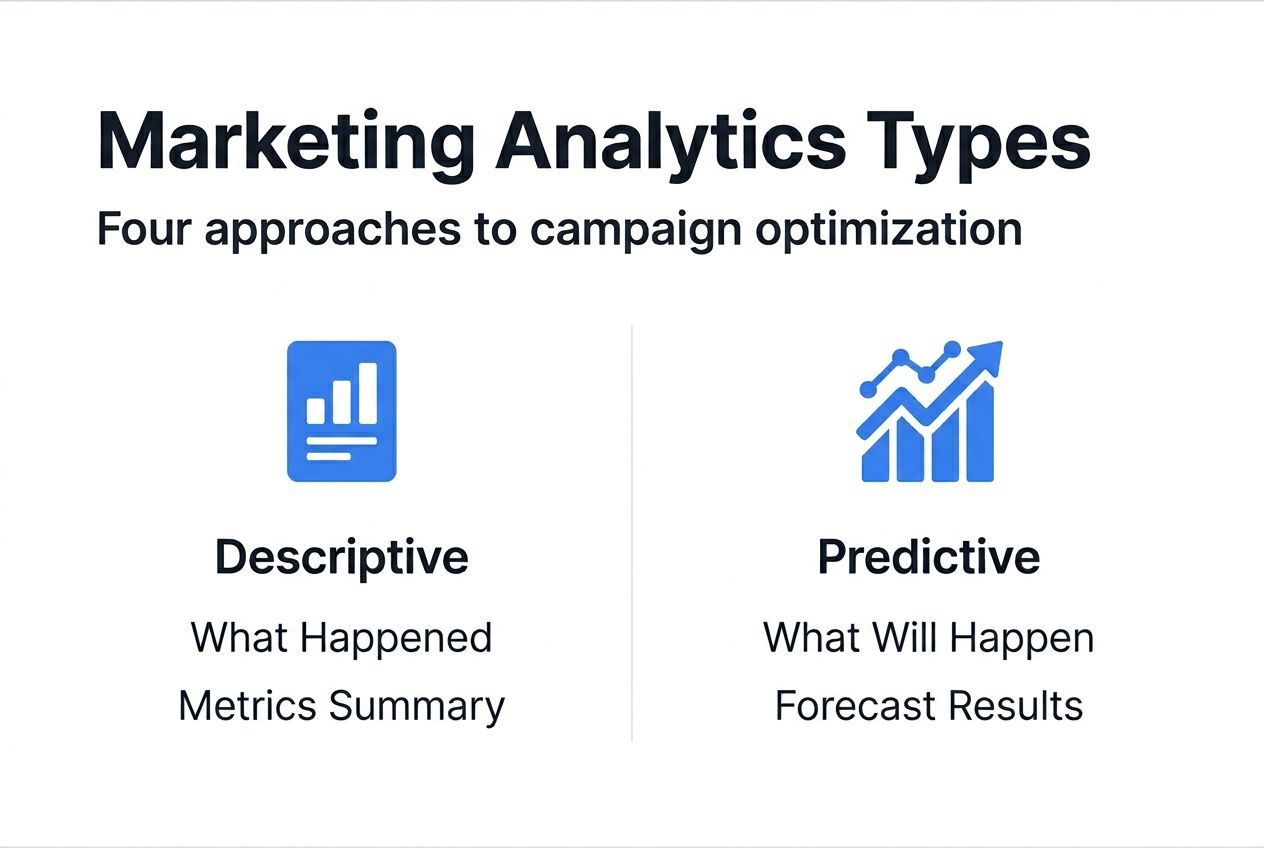
Prescriptive analytics recommends what actions to take by evaluating multiple scenarios and their likely outcomes. AI systems suggest optimal budget allocations, audience targets, and creative approaches to maximize objectives. This represents the most advanced capability level.
| Maturity Level | Key Question | Primary Benefit | Required Capability |
|---|---|---|---|
| Descriptive | What happened? | Historical understanding | Basic reporting tools |
| Diagnostic | Why did it happen? | Pattern identification | Advanced analytics platforms |
| Predictive | What will happen? | Proactive planning | Machine learning models |
| Prescriptive | What should we do? | Optimized decision-making | AI-driven recommendations |
Data quality and relevance audits should occur quarterly at minimum. Review each data source for accuracy, completeness, and continued business value. Remove outdated fields and add new tracking for emerging campaign types.
Implement data-driven marketing in five steps:
- Define clear business objectives that data will support, focusing on revenue impact over vanity metrics
- Map customer journeys to identify critical data collection points across all touchpoints
- Establish unified tracking and attribution models that connect channels accurately
- Build automated reporting dashboards that surface insights rather than raw numbers
- Create testing protocols to validate assumptions before scaling budgets on untested hypotheses
Overcoming integration challenges requires standardized data formats and shared customer identifiers. When every system uses the same ID for each customer, you can connect their behavior across platforms. Invest in customer data platforms or unified marketing tools that solve this problem architecturally.
Pro Tip: Run small-scale experiments continuously rather than waiting for perfect data before acting. Launch micro-campaigns with limited budgets to test targeting hypotheses, creative approaches, and channel mixes. The learning velocity from rapid iteration often exceeds insights from prolonged analysis. Use findings to refine your data collection priorities for the next cycle.
Governance policies ensure data remains a strategic asset rather than a compliance liability. Document who can access what information, how long you retain different data types, and processes for handling customer requests. Clear policies enable confident use of data across your marketing organization.
Real-world case studies: data-driven campaign success stories
A mid-sized B2B agency implemented integrated data platforms and achieved 35% campaign efficiency improvements within six months. By connecting CRM data with advertising platforms and website analytics, they identified which content topics attracted highest-value prospects.
The agency discovered their assumed buyer personas differed significantly from actual converters. Data revealed technical decision-makers engaged with implementation case studies while executives preferred ROI calculators. They restructured campaigns around these behavioral insights rather than demographic assumptions.
Budget allocation shifted dramatically once accurate attribution revealed LinkedIn drove 40% more qualified leads than previously credited. They increased LinkedIn spend by 60% while reducing generic display advertising. This reallocation cut overall ad spend waste by 25% while improving lead quality.
Real-time optimization powered by AI identified that campaigns performed significantly better when launched between Tuesday and Thursday. Weekend launches generated 30% lower engagement despite identical creative and targeting. Automated scheduling concentrated activity during high-performance windows.
Key results from data integration:
- 35% reduction in cost per qualified lead
- 25% decrease in wasted ad spend
- 18% improvement in lead-to-customer conversion rate
- 40% faster campaign iteration cycles
Another agency serving e-commerce clients implemented predictive modeling to forecast customer lifetime value. They shifted acquisition budgets toward channels attracting buyers with highest predicted LTV rather than lowest cost per acquisition. This strategic pivot increased six-month customer value by 45% despite slightly higher initial acquisition costs.
Dynamic creative optimization tested thousands of ad variations automatically, identifying that user-generated content images outperformed professional photography by 22% for specific audience segments. The agency could not have manually tested enough combinations to discover this insight.
Cross-device attribution revealed 60% of conversions involved multiple devices before purchase. Mobile drove initial awareness while desktop completed transactions. Budget models that ignored this journey underfunded mobile awareness campaigns. Correcting attribution led to more balanced investment and better overall performance.
The most significant lesson across these examples: data value comes from integration and action, not collection alone. Agencies that connected disparate data sources and built processes to act on insights quickly outperformed those with sophisticated analytics but slow execution.
Unlock growth with AI marketing automation
You have seen how data transforms marketing performance when leveraged strategically. The frameworks, best practices, and real-world results demonstrate that integrated platforms deliver the speed and precision modern campaigns demand.
AI marketing automation software | Hukt AI puts these principles into practice through a unified platform built for efficiency. Launch campaigns simultaneously across Meta, Google, LinkedIn, and X without platform switching. Real-time analytics dashboards surface optimization opportunities the moment they emerge, letting you adjust strategies dynamically rather than waiting for weekly reports. AI-powered content generation ensures consistent messaging at scale while predictive modeling guides budget allocation toward highest-return activities. Marketing professionals and agencies reduce campaign launch times by up to 40% and improve ROI through integrated data intelligence that turns insights into immediate action.
Frequently asked questions
What is the role of data in marketing?
Data enables precise audience targeting by revealing actual behavior patterns rather than demographic assumptions. It supports real-time measurement of campaign performance across channels, allowing dynamic optimization. Personalization powered by behavioral insights increases engagement and conversion rates. Data-driven approaches consistently deliver 15-20% higher ROI than traditional methods by eliminating guesswork from strategic decisions.
How can marketers improve data quality for better campaigns?
Regularly audit data sources quarterly to identify outdated or inaccurate information that degrades targeting precision. Focus collection efforts on first-party behavioral data from owned channels rather than purchasing unreliable third-party lists. Implement validation rules at collection points to catch errors before they enter systems. Standardize customer identifiers across platforms to enable accurate cross-channel tracking and attribution.
What common mistakes should agencies avoid in data-driven marketing?
Avoid collecting excessive data without clear use cases, which creates analysis paralysis and storage costs. Do not rely solely on automation without human strategic oversight to ensure tactical execution serves business goals. Failing to integrate data across platforms produces incomplete customer views that miss optimization opportunities. Ignoring data quality maintenance allows outdated information to degrade campaign effectiveness by up to 25%.
How does AI improve marketing analytics?
AI automates campaign creation and deployment across multiple platforms simultaneously, reducing launch time by 40%. Machine learning models identify subtle patterns in audience behavior that manual analysis cannot detect at scale. Real-time optimization adjusts bids, budgets, and creative elements dynamically based on performance signals, improving conversion rates by 18%. Predictive analytics forecast campaign outcomes before full budget commitment, reducing wasted spend on underperforming approaches.