

Managing digital campaigns across multiple channels while coordinating creative assets, targeting parameters, budget allocations, and performance tracking creates complexity that slows launch timelines and introduces costly errors. Marketing teams juggling Meta, Google, LinkedIn, and X campaigns often struggle with inconsistent workflows and missed steps that derail execution. A structured marketing campaign checklist transforms this chaos into streamlined processes, particularly when combined with AI automation tools that handle repetitive tasks and enable real-time optimization across platforms.
Table of Contents
- Key takeaways
- Defining key criteria for an effective marketing campaign checklist
- Top checklist items for launching multi-channel AI marketing campaigns
- Comparing popular AI marketing automation tools for checklist integration
- Optimize your campaigns with AI marketing automation software
- Frequently asked questions
Key Takeaways
| Point | Details |
|---|---|
| Structured checklist boosts efficiency | A comprehensive checklist reduces launch time and minimizes costly errors across multiple platforms. |
| AI automation scales campaigns | Automated tasks like bidding refinements and performance reporting enable real time optimization across channels. |
| Multi channel planning | Plan and execute across Meta, Google, LinkedIn, and X to maximize reach and keep workflows consistent. |
| Analytics driven optimization | Use performance data to optimize budgets, creative, and targeting in real time. |
Defining key criteria for an effective marketing campaign checklist
Building a comprehensive checklist starts with identifying campaign objectives that align directly with business goals. You need measurable targets like lead generation volume, conversion rates, or brand awareness metrics that guide every downstream decision. Without clear objectives, your team wastes resources on activities that look productive but deliver minimal business impact.
Target audience definition comes next. Specify demographics, psychographics, behavioral patterns, and platform preferences for each channel. A LinkedIn audience responds to different messaging than an X audience, so your checklist must account for these variations. Generic targeting wastes budget on irrelevant impressions.
KPI selection establishes how you measure success. Track engagement rates, click-through rates, cost per acquisition, return on ad spend, and conversion metrics specific to each platform. Structured planning with clear criteria cuts launch time significantly while improving outcomes through systematic execution.
Content and creative planning requires platform-specific assets. Instagram demands high-quality visuals, LinkedIn needs professional copy, and Google search ads require compelling headlines within character limits. Your checklist should specify asset requirements, approval workflows, and version control processes.
AI tool integration automates repetitive tasks like bid adjustments, audience targeting refinements, and performance reporting. Identify which processes consume the most manual time and prioritize those for automation. Budget allocation and resource planning ensure you have sufficient funds, personnel, and technology to execute the campaign fully.
Pro Tip: Create separate checklist sections for pre-launch, launch day, and post-launch activities to maintain focus during each campaign phase without overlooking critical tasks.
Timeline development with specific milestones keeps everyone accountable. Include creative deadlines, review cycles, technical setup completion dates, and go-live times. Role assignment clarifies who owns each checklist item, eliminating confusion about responsibilities that causes delays.
Top checklist items for launching multi-channel AI marketing campaigns
Channel selection and integration form your foundation. Confirm technical connections between your marketing automation platform and Meta Ads Manager, Google Ads, LinkedIn Campaign Manager, and X Ads. Test API connections and verify pixel installations before loading creative assets. Integration failures discovered at launch waste hours of troubleshooting time.

AI tool configuration comes next. Set up automated bidding strategies, audience targeting parameters, and budget pacing algorithms within your automation platform. Configure real-time alerts for performance anomalies like sudden cost spikes or conversion drops. Multi-platform marketing automation reduces coordination overhead dramatically when properly configured.
Creative asset preparation requires platform-specific versions. Prepare multiple ad sizes for display campaigns, square and vertical formats for social feeds, and text variations that fit character limits. Include UTM parameters in all URLs for accurate attribution tracking. Store all assets in organized folders with clear naming conventions.
Data tracking implementation ensures accurate performance measurement. Install conversion pixels on key pages, configure event tracking for micro-conversions, and test attribution models before launch. Verify that your analytics platform correctly receives data from all channels. Missing tracking data makes optimization impossible.
Launch schedule coordination synchronizes publishing across platforms. Use automated scheduling tools to release campaigns simultaneously or in strategic sequences based on audience behavior patterns. Stagger launches only when testing different messaging approaches requires isolated data.
Quality assurance testing catches errors before they reach audiences. Check landing page functionality, verify ad copy accuracy, test form submissions, and confirm mobile responsiveness. Review targeting parameters to avoid wasting budget on irrelevant audiences. A single targeting error can drain thousands of dollars overnight.
Contingency planning prepares your team for rapid response. Document procedures for pausing underperforming ads, reallocating budget to winning variants, and escalating technical issues. Quick reaction to performance data separates profitable campaigns from money pits.
Comparing popular AI marketing automation tools for checklist integration
Selecting the right automation platform determines how efficiently you execute your checklist. Different tools offer varying capabilities for AI-driven optimization, multi-channel management, and workflow automation. Understanding these differences helps you choose a platform that matches your campaign complexity and team size.
| Platform | AI Capabilities | Multi-Channel Support | Integration Ease | Pricing Model |
|---|---|---|---|---|
| Hukt AI | Advanced content generation, automated bidding, real-time optimization | Meta, Google, LinkedIn, X | Native integrations, no coding required | Tiered subscriptions with scalable credits |
| HubSpot Marketing Hub | Email automation, lead scoring, basic ad management | Email, social, limited paid ads | Extensive third-party integrations | Starts at $800/month for professional tier |
| Marketo Engage | Lead nurturing, account-based marketing, basic AI | Email, social, some paid channels | Complex setup, often requires consultant | Enterprise pricing, typically $20,000+ annually |
| Salesforce Marketing Cloud | Journey orchestration, predictive analytics | Email, mobile, social, advertising | Steep learning curve, technical expertise needed | Custom pricing, generally $12,000+ annually |
Hukt AI specializes in campaign launch speed and creative automation. The platform generates ad copy, social posts, and campaign concepts using AI, then publishes directly to multiple channels without platform switching. This eliminates the context switching that slows traditional workflows. Automation in ad campaigns delivers substantial efficiency gains when properly implemented.
HubSpot excels at inbound marketing automation but offers limited capabilities for complex paid advertising campaigns. The platform works well for email nurturing and social publishing but requires separate tools for advanced ad management. Integration with external ad platforms adds complexity.
Marketo targets enterprise marketing teams with sophisticated lead management needs. The platform handles complex customer journeys but requires significant technical resources for setup and maintenance. Smaller teams often find the learning curve prohibitive.
Salesforce Marketing Cloud provides comprehensive capabilities but demands substantial investment in both licensing and implementation. The platform suits large organizations with dedicated marketing operations teams. Smaller agencies typically find it overcomplicated for their needs.
Pro Tip: Prioritize platforms offering native integrations with your primary advertising channels to minimize technical debt and reduce ongoing maintenance requirements.
When evaluating tools, consider your team's technical expertise and campaign volume. AI marketing automation software that simplifies workflows without sacrificing capabilities delivers the best return for most marketing teams and agencies.
Optimize your campaigns with AI marketing automation software
Implementing your marketing campaign checklist becomes significantly easier with purpose-built automation tools. Hukt AI consolidates campaign planning, creative generation, multi-channel publishing, and performance monitoring into a unified platform designed specifically for marketing teams seeking faster launch times and improved ROI.
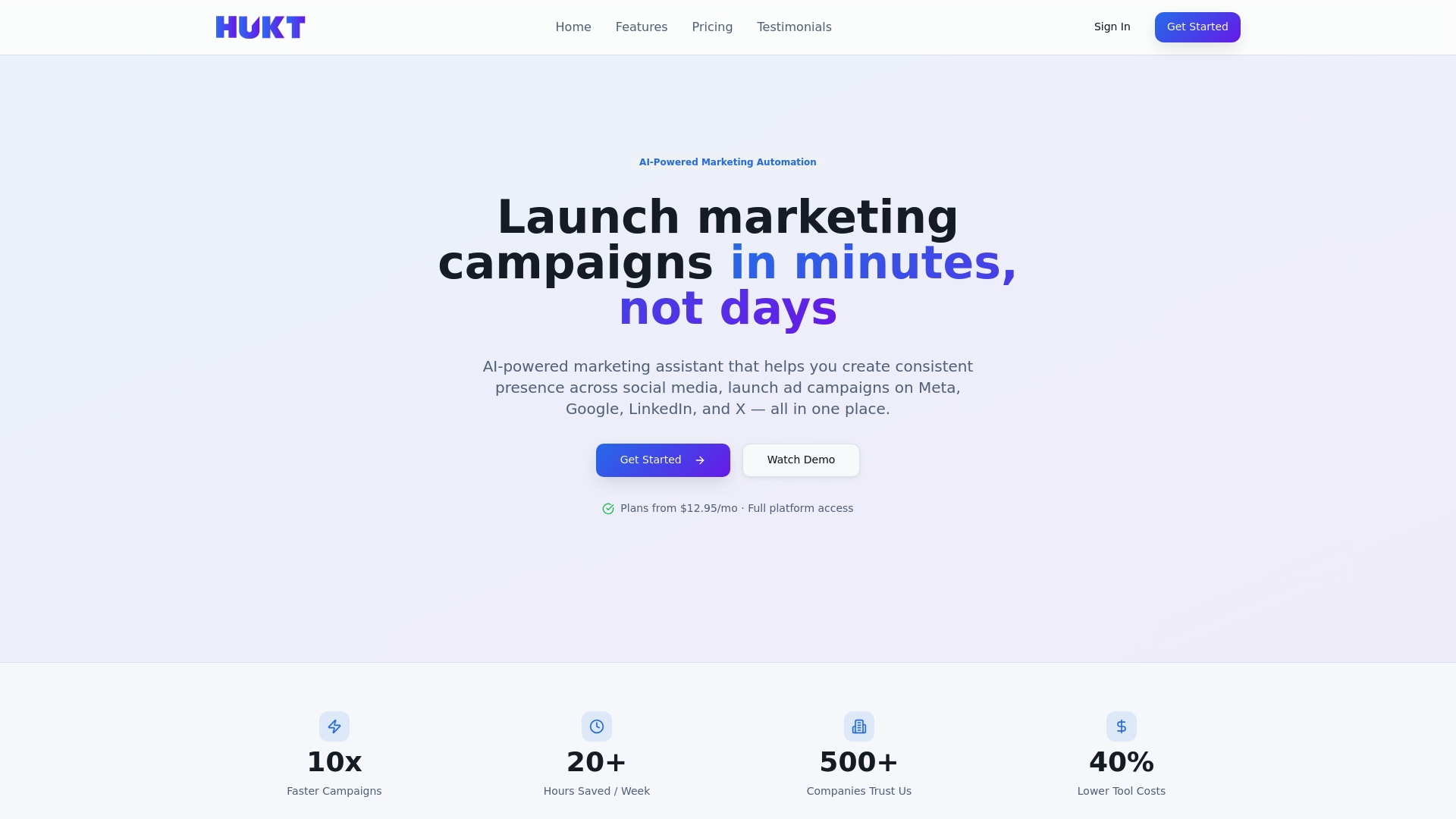
The platform's AI-driven content generation creates ad copy, social posts, and campaign concepts in minutes rather than hours, addressing the creative bottleneck that delays most campaigns. Multi-platform publishing eliminates the tedious process of logging into separate ad managers, copying campaign settings, and manually adjusting creative specifications for each channel. Real-time analytics dashboards surface performance insights immediately, enabling quick optimizations that maximize campaign effectiveness. Marketing professionals and agencies using AI marketing automation software report dramatic reductions in campaign launch times while maintaining consistency across all digital channels. The tiered subscription model scales with your needs, providing flexible credit allocations for content creation that grow alongside your campaign volume.
Frequently asked questions
What is a marketing campaign checklist and why is it important?
A marketing campaign checklist is a systematic tool listing all steps and tasks required for campaign planning, launch, and optimization. It ensures nothing gets overlooked during the complex process of coordinating creative assets, targeting parameters, budget allocations, and technical implementations across multiple platforms. Checklists improve team coordination by clarifying responsibilities and deadlines, reducing the errors that occur when team members make assumptions about who handles specific tasks.
How does AI automation improve marketing campaign efficiency?
AI automation handles repetitive tasks like bid adjustments, audience targeting refinements, and performance reporting without manual intervention. This frees marketing teams to focus on strategic decisions and creative development rather than administrative work. Automation in marketing campaigns enables real-time data-driven adjustments that improve ROI by responding to performance signals faster than human operators can manually process them.
What are best practices for multi-channel campaign execution?
Coordinate messaging and timing across all chosen platforms to create a cohesive brand experience. Use automation tools to schedule activities and monitor performance without constantly switching between different ad managers. Track and analyze results with unified analytics that aggregate data from all channels, enabling you to identify which platforms deliver the best ROI for specific campaign objectives. Multi-platform marketing automation streamlines this coordination significantly.
How often should I update my marketing campaign checklist?
Review and update your checklist after every major campaign to incorporate lessons learned and new best practices. Platform algorithm changes, new advertising features, and evolving audience behaviors require periodic checklist revisions. Quarterly reviews work well for most marketing teams, with immediate updates when platforms release significant new capabilities or change their requirements.
What metrics should I track in my campaign checklist?
Track metrics aligned with your specific campaign objectives, including impressions, click-through rates, conversion rates, cost per acquisition, and return on ad spend. Include platform-specific metrics like engagement rate for social campaigns or quality score for search ads. Monitor both leading indicators that predict performance trends and lagging indicators that measure final outcomes, enabling proactive optimizations before campaigns waste significant budget.